Question
In: Economics
1) Alexandra Kollontai --a hypothetical person with extraordinary sensibilities--views one graphic novel to be a perfect...
1) Alexandra Kollontai --a hypothetical person with extraordinary sensibilities--views one graphic novel to be a perfect substitute for two comic books. If a graphic novel costs $30, a comic book costs $10, and Alexandra allocates Y = $60 per year for graphic novels and comic books, what bundle does she buy? If the price of graphic novels falls to $20, how will Alexandra’s behavior change? Show the utility-maximizing bundles on diagrams with bud- get line and indifference curves (with comic books on the horizontal axis)
2) Suppose that you are asked to conduct a study to understand the behavior of students in college who are performing to some minimum acceptable standard. In this context, is util- ity maximizing behavior a good assumption? What would this assumption imply in the context of school performance? Can you think of another/good assumption that you can use to understand school performance behavior? Explain --If you cannot think of another assumption to be used to conduct such a study, explain why you cannot do so.
Solutions
Expert Solution
1. The consumer's marginal rate of substitution
is 1/2. The consumer's budget equation is:

Where x is the quantity of comic books and y is the quantity of
graphic novels. The consumer compares the price ratio with their
marginal rate of substitution. The price ratio is 1/3 which is less
than the marginal rate of substitution. Therefore, the consumer
only consumes the cheaper of the two goods-comic books. The
consumer's utility maximizing bundle is (6,0).
If the price of graphic novels decreases to $20, the consumer's new
budget equation is:

Now, the price ratio is 1/2 which is equal to the consumer's
marginal rate of substitution. Hence, the consumer is indifference
between any bundle of the two goods that lies on the consumer's
budget line.
Representing this on a graph:
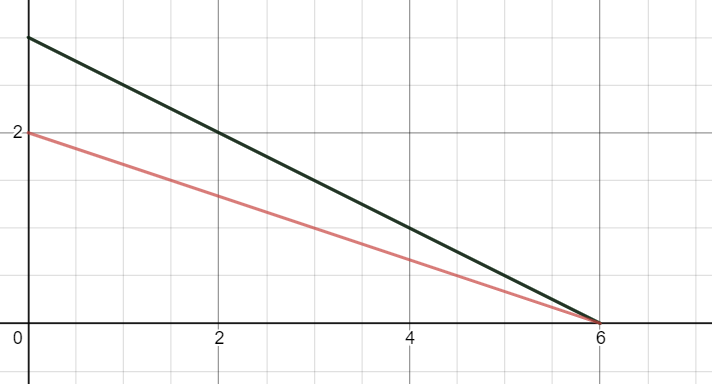
The black line shows both the consumer's budget line and his
indifference curve after the price change and the red line shows
the consumer's original budget line.
 Rahul Sunny answered 1 month ago
Related Solutions
Consider these two views: One person says that all property should be held in common, another...
1. A publisher faces the following demand schedule for the next novel from one of its...
Case1 1)Express design Ltd provide $5000 of graphic design service to one of its clents with...
Question 1. Any act by which one person gives to or receives from another person information...
1.(a)When a person exercises, one of the physiological responses is an increase in blood flow. In...
One-Way ANOVA 1) Below is a hypothetical experiment with data included: Please perform a data analysis...
1. Derive the equilibrium condition for a one-person Robinson Crusoe economy and prove that the same...
The variable Home Ownership can take on one of two values: 1 if the person living...
Phase 1 ; not going to go into detials but only one person suffered seizures. she...
true or false: 1. in order to lose one pound of body fat, a person need...
- STOICHIOMETERY QUESTION :-When aluminum metal is added to sulphuric acid, hydrogen gas and aluminum sulphate is...
- Constructa 99% confidence interval for the population mean, µ, AND State what type of Interval you...
- Bob Loblaw and Wayne Jarvis get together to form a new corporation. They each own 50%...
- 1- Create a class called Point that has two instance variables, defined as private, as follows:...
- A football kicker can give the ball an initial speed of 24 m/s. He is 45...
- Austin Corporation started its production operations on January 1. During January, the Mixing Department completed 20,000...
- A company maintains two offices in a certain region, each staffed by two employees. Information concerning...