Question
In: Physics
A 3.60-kg block starts from rest at the top of a 30.0° incline and slides a...
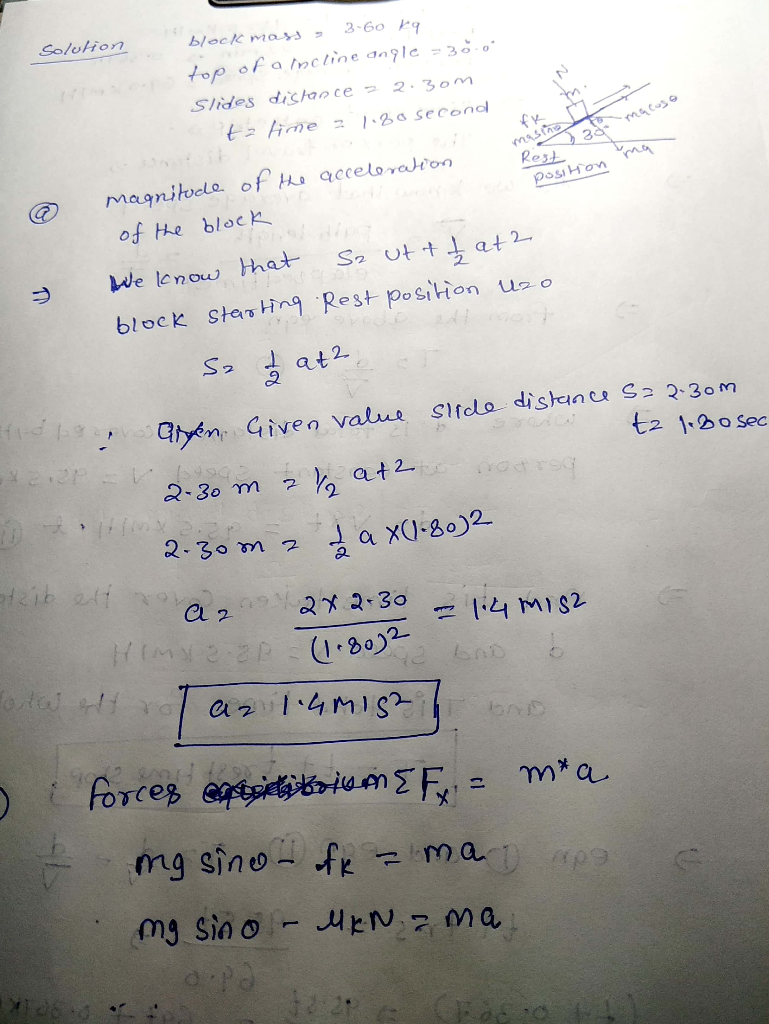
A 3.60-kg block starts from rest at the top of a 30.0° incline and slides a distance of 2.30 m down the incline in 1.80 s.
(a) Find the magnitude of the acceleration of the block.
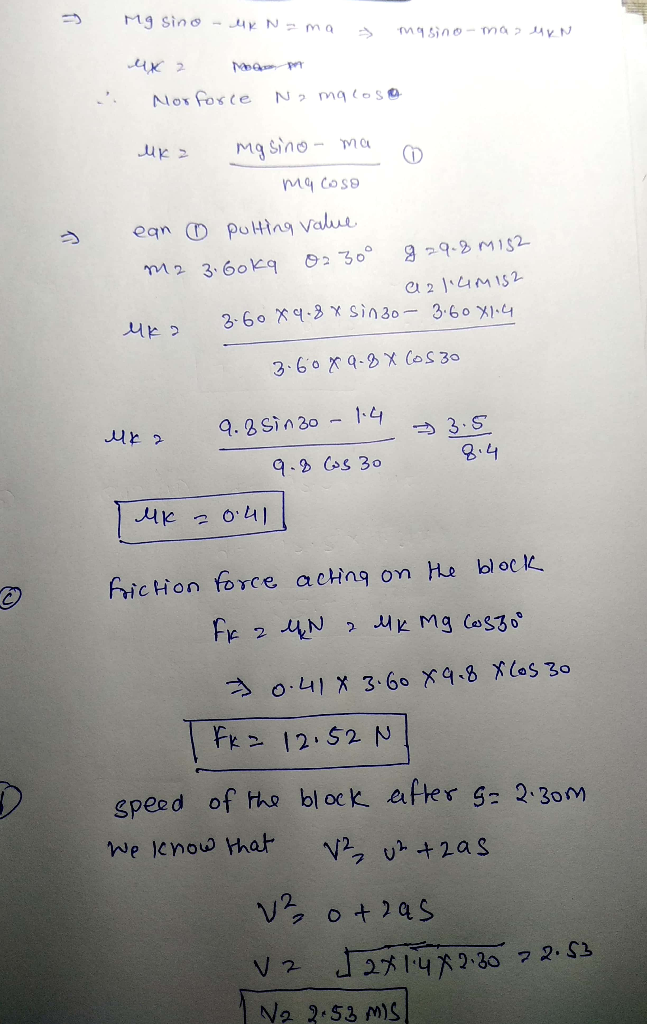
(b) Find the coefficient of kinetic friction between block and plane.
(c) Find the friction force acting on the block.
magnitude
direction
(d) Find the speed of the block after it has slid 2.30 m.
Solutions
 genius_generous answered 4 months ago
Related Solutions
A block of mass m = 2.30 kg slides down a 30.0∘ incline which is 3.60...
A block of mass m = 2.30 kg slides down a 30.0∘ incline which is
3.60 m high. At the bottom, it strikes a block of mass M = 6.20 kg
which is at rest on a horizontal surface (Figure 1). (Assume a
smooth transition at the bottom of the incline.) The collision is
elastic, and friction can be ignored.
a) Determine the speed of the block with mass m = 2.30 kg after
the collision.
b)Determine the speed of...
Starting from rest, a 4.20-kg block slides 2.30 m down a rough 30.0° incline. The coefficient...
Starting from rest, a 4.20-kg block slides 2.30 m down a rough
30.0° incline. The coefficient of kinetic friction between the
block and the incline is μk =
0.436.
(a) Determine the work done by the force of gravity.
J
(b) Determine the work done by the friction force between block and
incline.
J
(c) Determine the work done by the normal force.
J
(d) Qualitatively, how would the answers change if a shorter ramp
at a steeper angle were...
A 30.0 kg block is released at the top of a 20° frictionless incline. The block...
A 30.0 kg block is released at the top of a 20° frictionless
incline. The block slides down the incline and compresses a spring
(k=800 N/m) by 0.75 meters. What is the total distance the block
traveled?
It should be 1.5m
a 17.1-kg crate starts at rest at the top of a 60 degree incline. The coefficients...
a
17.1-kg crate starts at rest at the top of a 60 degree incline. The
coefficients of frictuon are us=.400 ans uk=.300. The crate is
connected to a hanging 8.00kg box and an ideal rope and pulley.
a) as the crate slides down the incline, what is the tension
in the rope?
b) How long does it take the crate ti slide 2.00m down the
incline?
c) to push the crate back up the incline at a constant speed,
with...
Starting from rest, a 5 kg block slides 2.5 m down a roughly 30 degree incline....
Starting from rest, a 5 kg block slides 2.5 m down a roughly 30
degree incline. the coefficient of kinetic friction between the
block and the incline is uk= .436. Determine a) the work done by
the force of gravity, b) the work done by the friction force
between the rock and the incline and c) the work done by the normal
force. d) qualitatively how would answers change if a shorter ramp
at a steeper angle were used to...
A ski starts from rest and slides down a 30 ∘ incline 70 m long. A)If...
A ski starts from rest and slides down a 30 ∘ incline 70 m
long.
A)If the coefficient of friction is 0.075, what is the ski's
speed at the base of the incline?
B)If the snow is level at the foot of the incline and has the
same coefficient of friction, how far will the ski travel along the
level? Use energy methods.
A ski starts from rest and slides down a 30 ∘ incline 70 m long. a)...
A ski starts from rest and slides down a 30 ∘ incline 70 m
long.
a) If the coefficient of friction is 0.095, what is the ski's
speed at the base of the incline?
b) If the snow is level at the foot of the incline and has the
same coefficient of friction, how far will the ski travel along the
level? Use energy methods.
A ski starts from rest and slides down a 24 ∘ incline 95 mlong. Part A...
A ski starts from rest and slides down a 24 ∘ incline 95
mlong.
Part A
If the coefficient of friction is 0.085, what is the ski's speed
at the base of the incline?
Express your answer using two significant figures.
Part B
If the snow is level at the foot of the incline and has the same
coefficient of friction, how far will the ski travel along the
level? Use energy methods.
Express your answer using two significant figures.
A skier of mass 75kg starts from rest at the top of a friction less incline...
A
skier of mass 75kg starts from rest at the top of a friction less
incline that is 20.0 m in height. As soon as she touches the bottom
of the incline, she encounters a horizontal surface that is 1000 m
long and the skier eventually comes to rest. The coefficient of
kinetic friction between skier and snow is 0.205. Find the distance
the skier covers before coming to rest. Show all work.
A 3 kg block (block A) is released from rest at the top of a 20...
A 3 kg block (block A) is released from rest at the top of a 20
m long frictionless ramp that is 3 m high. At the same time, an
identical block (block B) is released next to the ramp so that it
drops straight down the same 3 m. Find the values for each of the
following for the blocks just before they reach ground level. (a)
gravitational potential energy Block A____J Block B____J (b)
kinetic energy Block a____...
ADVERTISEMENT
ADVERTISEMENT
Latest Questions
- 1. Why is leadership outlook on security critical to employee buy-in at all levels? Give examples to...
- Students performed a procedure similar to Part III of this experiment (Analyzing a Vitamin Supplement for...
- The output of the function is a dictionary whose keys represent the bins and whose values...
- The shape of a graph of a binomial distribution depends on the value of both n...
- In 2012, cost per Medicare beneficiary did what?
- 3. A. What techniques can a firm use to optimize demand deposit holdings? B. How do...
- The half-life of mercury-197 is 64.1 hours. If a patient undergoing a kidney scan is given...
ADVERTISEMENT