Question
In: Physics
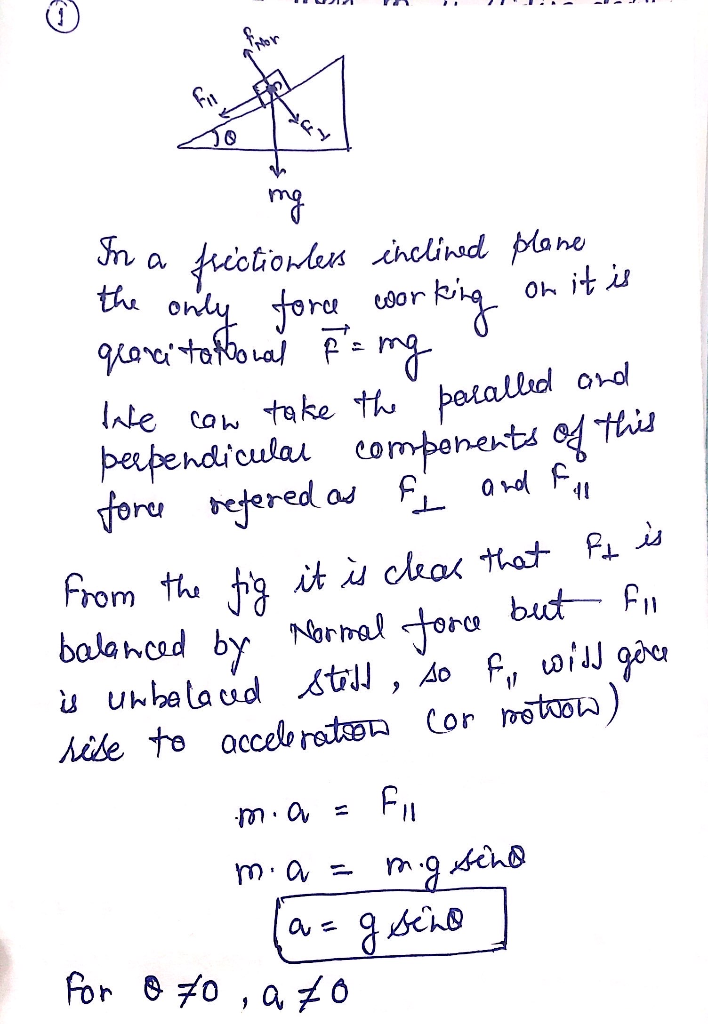
Consider an object sliding down a frictionless incline. 1. Would you expect the object to move...
Consider an object sliding down a frictionless incline.
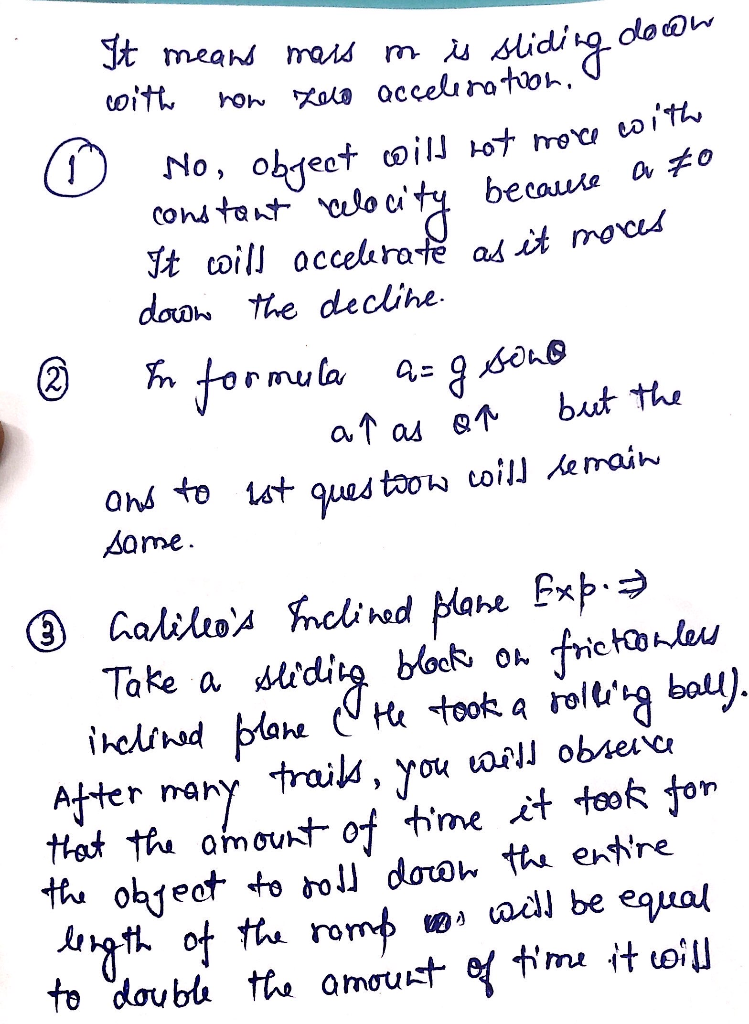
1. Would you expect the object to move at a constant velocity or would you expect the object to accelerate as it moves down the incline?
2. If the angle of inclination increased, would you expect your answer to the previous question to change? If not, why not? If so, why and how?
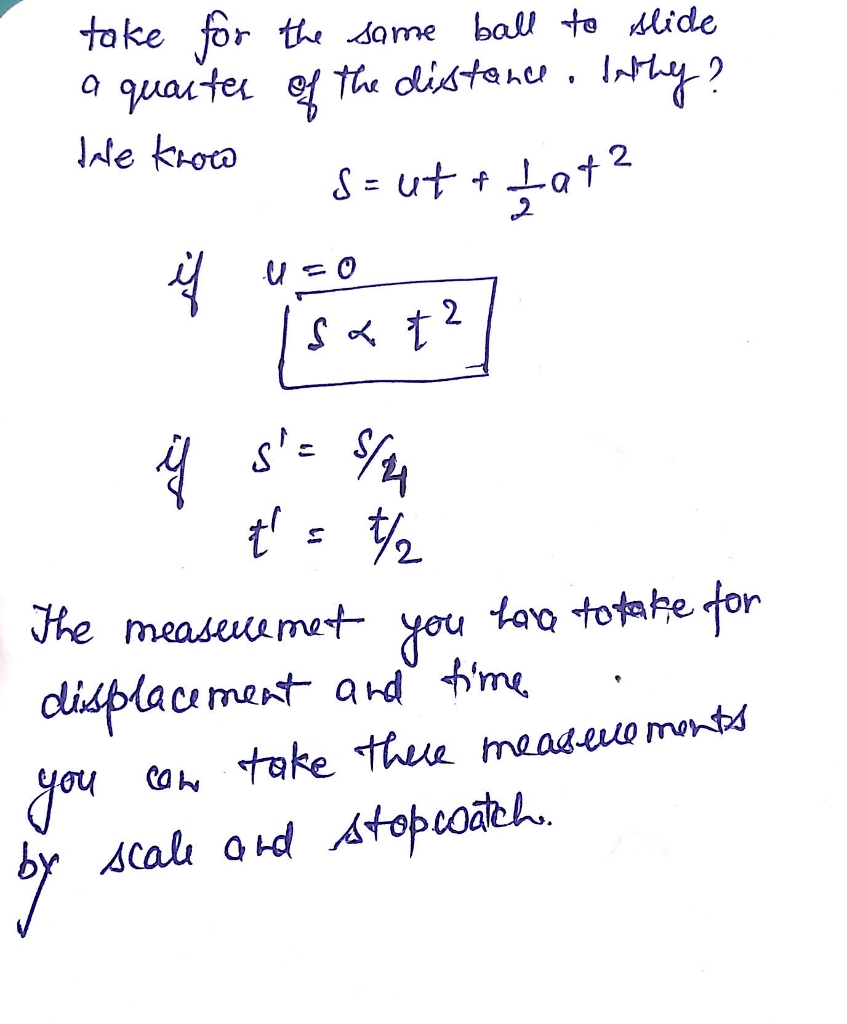
3. How could you experimentally show that the velocity changed as the object slid down the incline? What measurements would you have to make and how could you make them?
Solutions
 genius_generous answered 4 months ago
Related Solutions
8) Would gravity do more work on a brick sliding down a frictionless ramp if the...
8) Would gravity do more work on a brick sliding down a
frictionless ramp if the brick started from rest, or if it started
with an initial velocity down the slope?
a) Gravity does more work if it started from rest.
b) Gravity does more work if it started with an initial velocity
down the slope.
c) Gravity does the same amount of work in both cases.
9) In a particular instant, a rock slides horizontally along a
slope. The...
In lab you will roll a cart down a nearly frictionless incline set at a small...
In lab you will roll a cart down a nearly frictionless incline
set at a small angle. The cart will start at rest and travel a
distance of 30.0cm±0.2cm. After travelling, the flag will pass
through the photogate in order to measure the speed, vf or v30 (the
speed at the end of the 30.0cm trip).
Size of flag: d(flag width)=1.50cm±0.10cm
Time through photogate t(blocked) = 0.02095s±0.00010s
You know the initial speed, final speed, and distance the cart
travels (not...
A bucket of water is sliding down a frictionless ramp, whose angle of inclination is \thetaθ....
A bucket of water is sliding down a frictionless ramp, whose
angle of inclination is \thetaθ. What angle does the water surface
make with the horizontal? Is it zero, \thetaθ, or greater than
\thetaθ? You must provide a convincing argument.
A box slides down a frictionless incline and a hoop, uniform disk and a solid sphere...
A box slides down a frictionless incline and a hoop, uniform
disk and a solid sphere all roll down another incline of exactly
the same length and height. They all have the same mass
and start out from rest at the same time. Rank the
objects: box, hoop, disk and sphere in the order they reach the
bottom of the ramp. If any reach the bottom at the same
time, state that explicitly.
Reaches first
______ ______ ______ ______
Reaches bottom last
A) Determine the acceleration of a 25.0 kg mass down a frictionless incline plane (angle of...
A) Determine the acceleration of a 25.0 kg mass down a
frictionless incline plane (angle of incline=30 degrees)
B) Repeat the above problem for an incline with a coefficient of
friction of 0.15.
A cube with mass M slides down a frictionless curved incline as shown in the figure...
A cube with mass M slides down a frictionless curved incline as
shown in the
figure below. It has a completely inelastic collision with another
cube m at the bottom that is
A block of mass m=2kg can slide down a frictionless 53 degree incline but is connected...
A block of mass m=2kg can slide down a frictionless 53 degree
incline but is connected to a pully of mass M=4kg and radius
R=0.5m. The pulley may be treated as a uniform disk. Find:
a) The angular acceleration of the pulley
b) The speed of the block after it has slid 1m starting from
rest
an object m = 3.05kg rolls from rest down an incline plane, its center initially at...
an object m = 3.05kg rolls from rest down an incline plane, its
center initially at a height of 7.55m above the bottom of the ramp.
The inclination of the incline as measured from the horizontal is
37.3o. If the object is a solid uniform cylinder of radius r =
1.25m, then at the bottom of the incline, what is the (a)
rotational kinetic energy and (b) the angular momentum. If the
object is a hoop of radius, r =...
1. Ball rolling down an incline :Later you will be measuring the acceleration of the rolling...
1. Ball rolling down an incline :Later you will be measuring the
acceleration of the rolling ball down the incline for several
different incline angles, and we want to compare with the
theoretical expected value. The best way to show this is to plot
the acceleration on the vertical axis, and the value of sin(θ) on
the horizontal axis, as shown on the plot below. Draw in the
expected theoretical variation of the acceleration on this
plot.
2. A 0.200...
1. You slide an object across a horizontal surface, that object will eventually slow down and...
1. You slide an object across a horizontal surface, that
object will eventually slow down and stop. What’s causing this and
why?
2. Name two instances in your daily
life where “conservation of energy” plays a role.
3. In a very general sense, if one object hits another
that is stationary, how does the collision’s type (elastic vs.
inelastic) affect the energy of the objects?
4. When opening a door, it is easier to do so by pushing
on the...
ADVERTISEMENT
ADVERTISEMENT
Latest Questions
- Use the internet to read more about journaling file systems such as NTFS, extfs2, and extfs3....
- Consider the quick sort algorithm. The quick sort algorithm is a divide and conquer approach which...
- Tesla 1. How to make these weaknesses into strengths? Burn through cash, high prices, bottlenecking/product delays,...
- Assignment # 12: Email Presentation Learning Objectives and Outcomes Design a PowerPoint presentation appropriate for middle...
- Identify which of the perspectives you believe is the BEST for accurately explaining human behavior and...
- What trade policies should a country adopt? why? Explain. Also, find some reference materials on this...
- In Java: Suppose you want to implement a Sudoku game that consists of 9x9 rows and...
ADVERTISEMENT