Question
In: Computer Science
Please use python. Step a: Create two dataframes df1 and df2 as follows: import numpy as...
Please use python.
Step a: Create two dataframes df1 and df2 as follows:
|
import numpy as np import pandas as pd rng = np.random.RandomState(100) df1 = pd.DataFrame(rng.randint(0, 100, (4, 3)), columns=['A', 'B', 'C']) df2 = pd.DataFrame(rng.randint(0, 100, (3, 4)), columns=['A', 'B', 'C', 'D']) |
Step b: Create a new dataframe df which is the summation of df1 and df2;
Step c: Subtract all columns of df by the half of column 'C' in df1; (Remark: the values in df should be updated)
Step d: Replace the NaN in df by 10; (Remark: the values in df should be updated)
Step e: Use df.apply() to calculate the summation of the numbers in each row of df, and show the result. (Remark: the result should be a vector of four values)
Solutions
Expert Solution
PLEASE GIVE A THUMBS UP
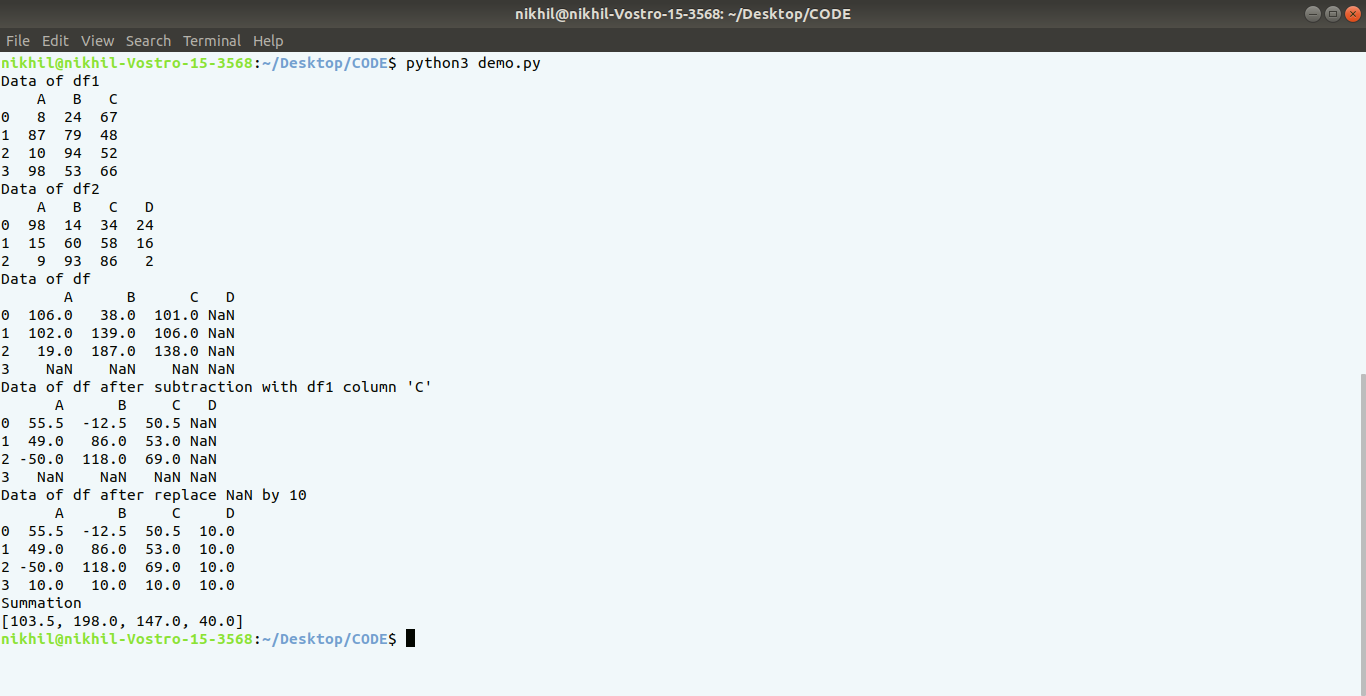
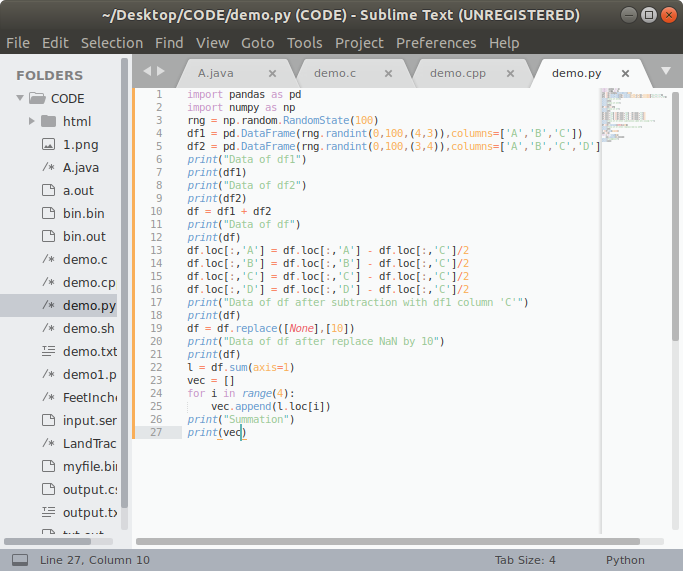
import pandas as pd
import numpy as np
rng = np.random.RandomState(100)
df1 =
pd.DataFrame(rng.randint(0,100,(4,3)),columns=['A','B','C'])
df2 =
pd.DataFrame(rng.randint(0,100,(3,4)),columns=['A','B','C','D'])
print("Data of df1")
print(df1)
print("Data of df2")
print(df2)
df = df1 + df2
print("Data of df")
print(df)
df.loc[:,'A'] = df.loc[:,'A'] - df.loc[:,'C']/2
df.loc[:,'B'] = df.loc[:,'B'] - df.loc[:,'C']/2
df.loc[:,'C'] = df.loc[:,'C'] - df.loc[:,'C']/2
df.loc[:,'D'] = df.loc[:,'D'] - df.loc[:,'C']/2
print("Data of df after subtraction with df1 column 'C'")
print(df)
df = df.replace([None],[10])
print("Data of df after replace NaN by 10")
print(df)
l = df.sum(axis=1)
vec = []
for i in range(4):
vec.append(l.loc[i])
print("Summation")
print(vec)
 venereology answered 5 months ago
Related Solutions
Please use python. Step a: Create two DataFrames df1 and df2 from the following two tables...
Please I seek assistance Python Programing import os import numpy as np def generate_assignment_data(expected_grade_file_path, std_dev, output_file_path):...
UsePython (import numpy as np) use containers (Branching if statement, while loop, for loop, numpy Array)...
In python import numpy as np Given the array b = np.arange(-6, 4) compute and print...
Develop a python program to - Create a 2D 10x10 numpy array and fill it with...
Create and Compile a Python Script without using Numpy that Generate an nxn matrix using Python...
Using Python: Normalize a 5x5 random matrix hints: use numpy create a random matrix X apply...
In Python Create customer information system as follows: Python 3 Create customer information system as follows:...
Use NumPy to create a My_Array; a 3 by 3 array where in,m = n +...
Please use Python to create a method for a linked list that returns the index of...
- Two 10-cm-diameter charged rings face each other, 15cm apart. The left ring is charged to -29nC...
- Under what conditions would it be possible for an excise tax to have no efficiency cost...
- explain the difference between activities and financial statements of service businesses and merchandising businesses.
- 2. Compare and compare the matrix multiplication algorithm and the Floyd-Warshall algorithm to find all pairs...
- Q: 50.00 ml of 0.5216 M copper(II) nitrate solution is combined with 100.0 ml of 0.5580...
- This is a business law question. Explain how environmental laws regulate the use of toxic substances...
- A sky diver and her parachute system weigh a total of 800 N. She is falling...