Question
In: Computer Science
The graph of f is shown . Evaluate each integral by interpreting it in terms of areas.
The graph of f is shown. Evaluate each integral by interpreting it in terms of areas.
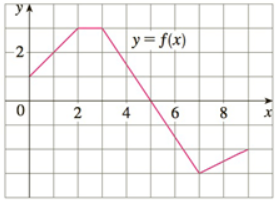
(a) ∫2 0 f(x) dx
(b) ∫5 0 f(x) dx
(c) ∫7 5 f(x) dx
(d) ∫9 0 f(x) dx
Solutions
Expert Solution
Given graph is:
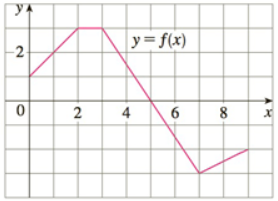
Then we can get,
(a)
$$ \begin{aligned} &\int_{0}^{2} f(x) d x \\ &=3+\frac{1}{2} \times 2 \\ &=3+1 \\ &=4 \end{aligned} $$
(b)
$$ \begin{aligned} &\int_{0}^{5} f(x) d x \\ &=7+\frac{1}{2} \times 6 \\ &=7+3 \\ &=10 \text { square units } \end{aligned} $$
(c)
$$ \begin{aligned} &\int_{5}^{7} f(x) d x \\ &=1+\frac{1}{2} \times 4 \\ &=1+2 \\ &=3 \end{aligned} $$
(d)
$$ \begin{aligned} &\int_{0}^{9} f(x) d x \\ &=12+\frac{1}{2} \times 12 \\ &=12+6 \\ &=18 \end{aligned} $$
Answers can be found in the Explanation section.
 DogeShow answered 4 years ago
Related Solutions
Evaluate the surface integral S F · dS for the given vector field F and the...
Evaluate the surface integral
S
F · dS
for the given vector field F and the oriented
surface S. In other words, find the flux of
F across S. For closed surfaces, use the
positive (outward) orientation.
F(x, y, z) = xy i + yz j + zx k
S is the part of the paraboloid
z = 6 − x2 − y2 that lies above the square
0 ≤ x ≤ 1, 0 ≤ y ≤ 1,
and has...
Evaluate the surface integral S F · dS for the given vector field F and...
Evaluate the surface integral
S
F · dS
for the given vector field F and the oriented
surface S. In other words, find the flux of
F across S. For closed surfaces, use the
positive (outward) orientation.
F(x, y, z) = x i − z j + y k
S is the part of the sphere
x2 + y2 + z2 = 1
in the first octant, with orientation toward the origin
Evaluate the surface integral S F · dS for the given vector field F and...
Evaluate the surface integral
S
F · dS
for the given vector field F and the oriented
surface S. In other words, find the flux of
F across S. For closed surfaces, use the
positive (outward) orientation.
F(x, y, z) = x i − z j + y k
S is the part of the sphere
x2 + y2 + z2 = 9
in the first octant, with orientation toward the origin
Evaluate the surface integral S F · dS for the given vector field F and the...
Evaluate the surface integral
S
F ·
dS for the given
vector field F and the oriented surface
S. In other words, find the flux of F
across S. For closed surfaces, use the positive (outward)
orientation.
F(x, y, z) =
xzey i −
xzey j + z
k
S is the part of the plane x + y +
z = 3 in the first octant and has downward orientation
Evaluate the surface integral S F · dS for the given vector field F and...
Evaluate the surface integral
S
F · dS
for the given vector field F and the oriented
surface S. In other words, find the flux of
F across S. For closed surfaces, use the
positive (outward) orientation.
F(x, y, z) = x i + y j + z4 k
S is the part of the cone z =
x2 + y2
beneath the plane
z = 1
with downward orientation
What is the welfare effect in terms of areas on the supply and demand graph; that...
What is the welfare effect in terms of areas on the supply and
demand graph; that show consumer surplus, government revenue AND
loss to producers Graphically, what is the welfare effect for the
U.S.?
1) The graph of the derivative f ' of a continuous function f is shown. (Assume...
1) The graph of the derivative f ' of a continuous function f is
shown. (Assume the function f is defined only for 0 < x <
∞.)
(a) On what interval(s) is f increasing? (2a) On what
interval(s) is f decreasing?
(b) At what value(s) of x does f have a local
maximum? (2b) At what value(s) of x does f have a
local minimum? x=?
(c) On what interval(s) is f concave upward? (2c) On
what interval(s) is...
Evaluate the integral
Evaluate the integral ∫11+x2dx from 0 to ∞
Evaluate the integral:
Evaluate the integral: 32i7π∫0∞xln2(x)(ln(ln(x2)))x4−1dx
Sketch the graph, shade the region and set up the integral and DO NOT EVALUATE. 8.Find...
Sketch the graph, shade the region and set up the integral and
DO NOT EVALUATE.
8.Find the area A of the region bounded by the line y = x^2 and
y= x is revolved
a) About the x axis using disks or washers
b) About the line x = 2 (any method you like)
ADVERTISEMENT
ADVERTISEMENT
Latest Questions
- describe why independent oversight is important to taxpayers.
- Graph a Monopoly. Compare the price, quantity, and ATC of a monopoly with a perfectly competitive...
- Problem 18-12 Various shareholders' equity topics; comprehensive [LO18-1, 18-4, 18-5, 18-6, 18-7, 18-8] Part A In...
- Hello There, This is discussion Question For Advanced Database Systems Question: (a) Please define what a...
- Physicians at a clinic gave what they thought were drugs to 860860 patients. Although the doctors...
- On January 1, 2018, bonds with a face value of $ 79,000 were sold. The bonds...
- How do I make this sort in true alphabetical order instead of ascii(ABCabc) order? I am...
ADVERTISEMENT