Question
In: Other
To observe the effect of temperature on reaction rate, the reaction between KMnO4 and H2C2O4 in...
- To observe the effect of temperature on reaction rate, the reaction between KMnO4 and H2C2O4 in acidic media is performed according to the given redox reaction,
2MnO4- + 16H+ + 5(C2O4)2- → 10CO2 + 2 Mn2+ + 8 H2O
In the experiment, 4 mL 5x10⁻³ M H2C2O4 is added to the test tube containing 5 mL of 3x10⁻⁴ M KMnO4 and 1 mL of 0.25 M H2SO4 solutions, at 450C.
- Write expressions for the rate of the reaction in terms of the reactants and products (stoichiometric rate equation)
- Which reactant is the limiting compound? Explain why?
- If the reaction is completed in 60 s at 45°C, calculate the reaction rate
- Explain the possible effect of temperature on the reaction rate by using the Arrhenius equation.
Solutions
Expert Solution
the problem is based on the concepts of the reaction engineering.
rate of the reaction determines how fast the reaction is progressing. it is rate of change of the concentration of the reactant.
the rate of reaction is given as,
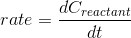
in this problem we have to find out the rate of the reaction which is ,

we can calculate the moles as product of molar concentration and volume of solution. based on this

similarly,

now 1 mol of H2SO4 will give 2 moles of H ion so, based on this

a)
the rate of reaction in terms of products and reactants will be found by first finding the balance reaction,which is
divide the entire equation by 2, we get

now ,let
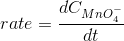
so, the relation will be obtained by the stoichiometric law for
rate, which states that the rate rate of product / stoichiometric
coefficient of product is equal to negative of rate of reactant /
stoichiometric coefficient of reactant. ........
{ans.}
........
{ans.}
hence the rate of the reaction in terms of the products and reactants is written.
b)
now we have to find the limiting reagent.
limiting reagent is the reactant which gets utilized completely in the reaction.
here , the reaction is
we have calculated the mini moles of the reactants as,
and
so, from the stoichiometry of the reaction , we can observe that, 2 moles of MnO4 ion reacts with 5 mol of C2O4 ion. so, 0.02 mol of C2O4 ion will require moles of MnO4 ions = 0.02 mol * 2mol/5mol = 0.008 mol
but we are given that MnO4 ion we have is 0.0015 moles which is less that required that means that MnO4 ions moles. that means that MnO4 ion will get completely utilized in the reaction. so here the limiting reagent is MnO4 ion.
c)
we are given that reaction will get over in 60 sec. we have to find the rate of the reaction. which is given as,
rate = - change in concentration of reactant / time interval
so,
time interval = 60 sec
change of concentration of reactant = change in concentration of MnO4 ion = final concentration - initial concentration
final concentration = 0 mol/L because the reaction is completing and MnO4 ion is a limiting reagent.
initial concentration = 0.0015 mmol / Total volume of solution
here total volume of solution = sum of all the volumes added in test tube = 4 mL + 5 mL +1 mL = 10 mL
so,initial concentration = 0.0015 mmol / 10 mL = 0.00015 mol/L
so, change of concentration of reactant = change in concentration of MnO4 ion = final concentration - initial concentration = 0 mol/L - 0.00015 mol/L = -1.5 *10^{-4} mol/L
so,
the rate = -change in concentration of reactant / time interval
= - (-1.5 *10^{-4} mol/L) / 60 sec =  ............ {ans.}
hence the rate of reaction is
.
d)
the arrhenius equation is shows the relations between rate constant and the temperature as,

here
A0 = arrhenius constant
Ea = activation energy
R = universal gas constant
T = temperature
K = rate constant
we know that rate is directly proportional to the rate constant.
so,
from the arrhenius equation we can see that if the temperature increase that means that rate constant increases, which will result in rate of the reaction to increase.
so, we conclude that in the temperature increases the rate of reaction increases.
 Amanda K answered 6 hours ago
Related Solutions
KMnO4 and H2C2O4 react according to the following balanced equation: 2 KMnO4 + 5 H2C2O4 +...
An experiment was conducted to observe the effect of an increase in temperature on the potency...
An experiment was conducted to observe the effect of an increase in temperature on the potency...
Explain why temperature has an effect on reaction rate. Explain why concentration has an effect on...
3. a. What effect does temperature have on the reaction rate of oxalic acid and permanganate?...
difference between the rate of a reaction, the reaction rate, and the rate law
For determination 1: Initial concentration for H2C2O4: 0.31 mol/L Initial concentration for KMnO4: 0.011 mol/L Average...
Given a reaction between an organic molecule, denoted as A, and NaSH, we observe the following...
Consider this initial-rate data at a certain temperature for the reaction described by :  
14-Consider the following reaction at equilibrium. What effect will increasing the temperature have on the system?...
- Describe a positive workplace culture(5 elements). Select one of those elements and describe how a leader...
- A balloon is to be used to carry meteorological instruments to an elevation of 18000 feet....
- an object 5 cm tall is placed 40 cm from a flat mirror find a) the...
- Discuss with examples the importance of ethics in managing and delivering Information Technology projects.
- Select True or False for the following statements about electromagnetic waves. True False A vertical automobile antenna...
- To observe the effect of temperature on reaction rate, the reaction between KMnO4 and H2C2O4 in...
- The mean score on a science assessment for 59 male high school students was 319.5 and...