Question
In: Chemistry
Why is the spectrum of He+ resembles that of Hydrogen?
Why is the spectrum of He+ resembles that of Hydrogen?
Solutions
Expert Solution
Dear Friend
Bohr Atomic theorey valid for atoms containing one electron only. Hence Hydrogen & Helium Cation have same number of electrons, so they will give same spectrum. Because spectrum depends on number of electrons, not on number of protons.
Singly ionized helium is an atom that has lost one of its electrons. We must expect its remaining electron to act like a hydrogen electron. There is only one difference between a hydrogen atom and a singly ionized helium atom; number of protons in the nucleus, so the nuclear charge. Thereby we have to modify our equation that we found for hydrogen atom. Only thing we have to do is to simply multiply the equation of the hydrogen atom by Z2 and we must get Z=2 since there are 2 protons in a helium atom. And when we arrange our formula for Z=2 we will get:
En = {-(4 X 13.6)} / n2 ev
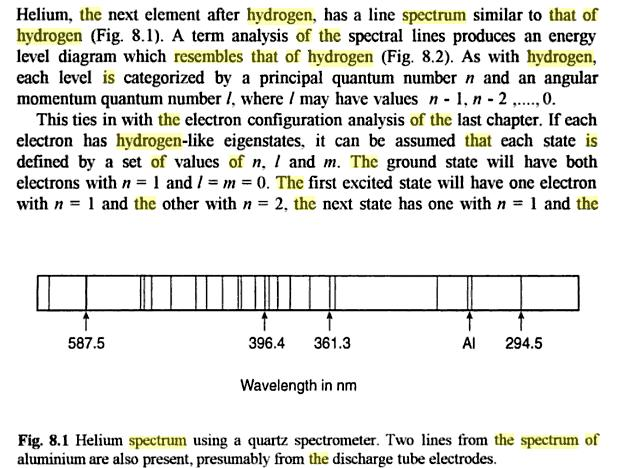
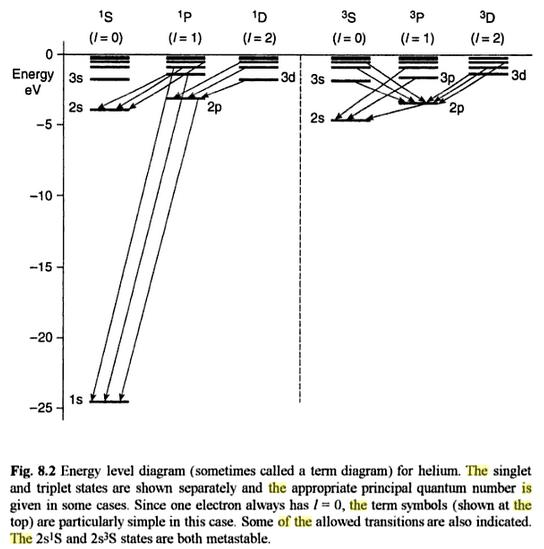
So we can define the energy states for a singly ionized helium atom by using the formula above. When we give numbers for n, n=1, 2, 3, ..., we will get the energy value for each state. On the left, there is an energy diagram for a singly ionized helium atom. Now it is so easy to find the emission spectrum for a singly ionized helium.
Lets find the wavelength of the emitted photons when the single electron of the helium atom falls to the state n=3 from the state n=4, which corresponds to the first line of the Paschen series:

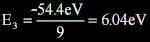
Then we find the energy difference of these two states as 2.64 eV. From the energy difference we can find the wavelength of the photon as 470 nm.
This wavelength is in the visible part of the spectrum. Actually green. If the electron has fallen to n=1 from n=2 the incoming photon will have the wavelength; 30 nm. Which is in the ultraviolet region and very close to x-ray spectrum. Furthermore, if we want to ionize the remaining electron from the ground state, an external energy of 54.4 eV is needed.
Thank you, all the best.
 queen_honey_blossom answered 1 hour ago
Related Solutions
why might one expect the water vapor spectrum to be different than the hydrogen lab spectrum?
the first line in the lyman series of a spectrum of hydrogen is located at 121.6nm....
Why a linear spectrum is observed after hydrogen atom ionization? Please I need really detailed description....
The wavelengths in the hydrogen spectrum with m = 1 form a series of spectral lines...
Why is the spectrum of the Sun continuous?
Regarding the emmission spectra, are the lines present in the hydrogen spectrum the same lines predicted...
Show Work. A series of lines in the spectrum of atomic hydrogen lies at 656 nm,...
Which spectral lines in the emission spectrum of hydrogen atoms can be observed if the atoms...
The visible emission spectrum of hydrogen involves a transition to n final = 2. What is...
Draw a sketch for the Hydrogen (discrete) spectrum, labeling the lines according to their respective quantum...
- Why is the spectrum of He+ resembles that of Hydrogen?
- (Package Inheritance Hierarchy) Package-delivery services, such as FedEx®, DHL® and UPS®, offer a number of different...
- At a sales level of 30,000 the budget data for labor is as follows: 40000 hours...
- Blocks A (mass 3.50 kg ) and B (mass 8.00 kg ) move on a frictionless,...
- lol
- PLEASE DONT ROUND ANYTHING KEEP ALL DECIMALS A 32.5 kg box initially at rest is pushed...
- For these elements PCl3, H2O2, CH2O, N2, CO2, O3, NO3-, NO2, PCl, SiF6^-2, SF4, I3-, IF5,...