Question
In: Chemistry
lol
lol
Solutions
Expert Solution
3. Benzene can be converted to n-propyl benzene by using two different reagents.
In the first step, benzene is converted to phenyl ethyl ketone through Friedel-Craft's acylation of propanoyl chloride in presence of anhydrous AlCl3.
In the second step phenyl ethyl ketone is reduced to n-propyl benzene through Clemmensen's reduction (reagent used is (Zn-Hg/ con.HCl) as shown in the figure below.
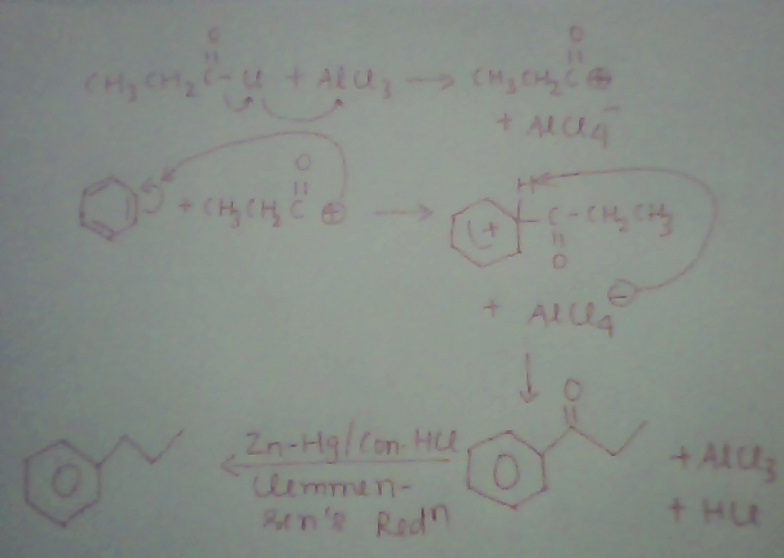
4.(A) When electron donating groups like -OCH3 activate the benzene by donating electron to the benzene ring and hence are the most reactive towards electrophilic aromatic substitution reaction.
Electron withdrawing groups like -Cl, -COCH3, -CF3, and -NO2 deactivate the benzene ring by withdrawing electron from the benzene ring. However -Cl is weakly deactivating, -COCH3, -CF3 are moderately deactivating and -NO2 is strongly deactivating. Hence -NO2 is the least reactive towards electrophilic aromatic substitution reaction.
Hence the order of reactivity is -OCH3 > -Cl> -CF3 >-COCH3 > -NO2
Hence (A) is the correct answer.
 queen_honey_blossom answered 3 weeks ago
Related Solutions
- Do you think that CAFTA will have a major impact on the U.S. economy? Why?
- Assignment 4, Fraction Comparable Instructions For this assignment, you will be updating the Fraction class from...
- what crystal claim that English is doing across the world?
- Site map for your e-commerce site. How many webpages this site has? What’s the name of...
- A skier of mass 60 kg starts at the top of a steep slope with an...
- If banks must hold $4 in reserves for each $10 in deposits, and the public decides...
- A 244 g mass is hung on a spring. As a result the spring stretches 20.5...