Question
In: Physics
Blocks A (mass 3.50 kg ) and B (mass 8.00 kg ) move on a frictionless,...
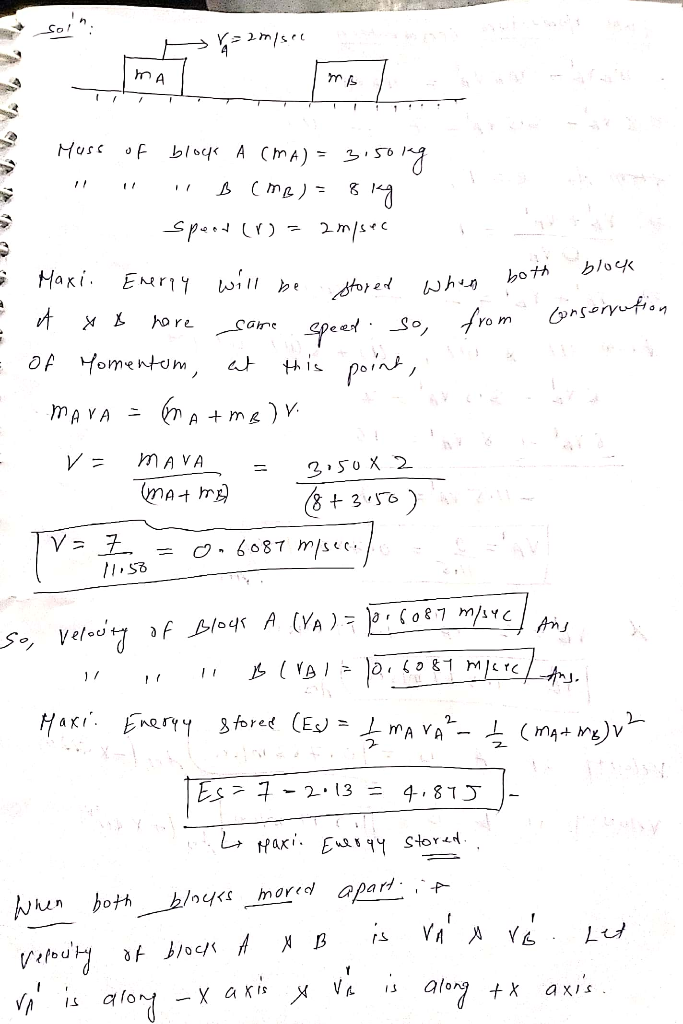
Blocks A (mass 3.50 kg ) and B (mass 8.00 kg ) move on a frictionless, horizontal surface. Initially, block B is at rest and block A is moving toward it at 2.00 m/s . The blocks are equipped with ideal spring bumpers. The collision is head-on, so all motion before and after the collision is along a straight line. Let +x be the direction of the initial motion of block A.
Find the maximum energy stored in the spring bumpers.
Find the velocity of block A when the energy stored in the spring bumpers is maximum.
Find the velocity of block B when the energy stored in the spring bumpers is maximum.
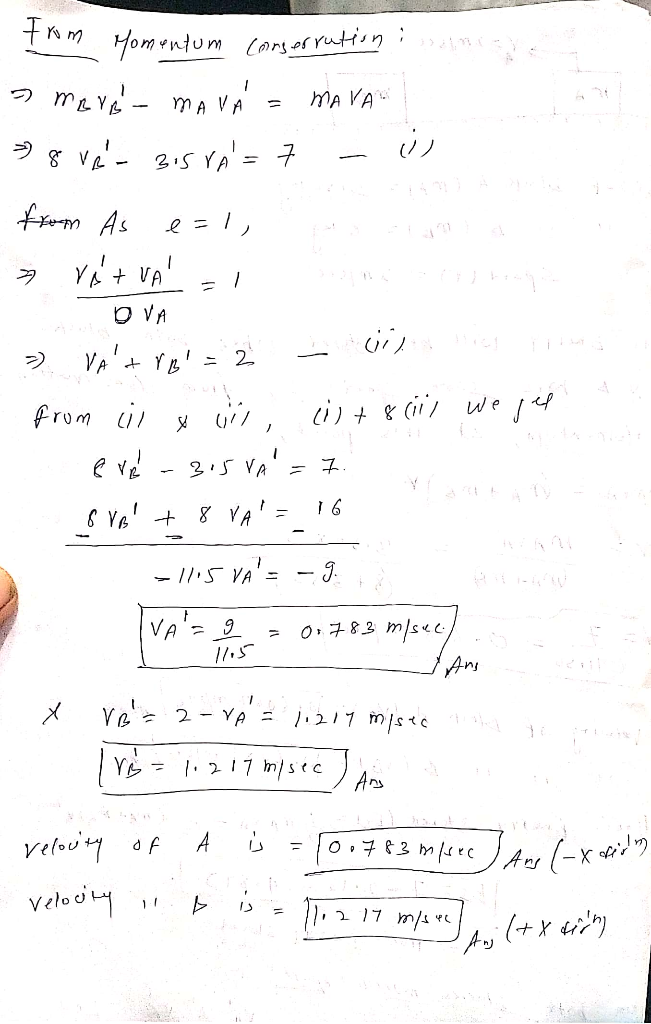
Find the velocity of block A after they have moved apart.
Find the velocity of B after they have moved apart.
Solutions
 genius_generous answered 2 hours ago
Related Solutions
Blocks A (mass 4.00 kg ) and B (mass 7.00 kg ) move on a frictionless,...
Blocks A (mass 4.00 kg ) and B (mass 7.00 kg ) move on a
frictionless, horizontal surface. Initially, block B is at rest and
block A is moving toward it at 4.00 m/s . The blocks are equipped
with ideal spring bumpers. The collision is head-on, so all motion
before and after the collision is along a straight line. Let +x be
the direction of the initial motion of block A.
Find the maximum energy stored in the spring...
Blocks A (mass 4.00 kg ) and B (mass 6.00 kg ) move on a frictionless,...
Blocks A (mass 4.00 kg ) and B (mass 6.00 kg ) move on a
frictionless, horizontal surface. Initially, block B is at rest and
block A is moving toward it at 5.00 m/s . The blocks are equipped
with ideal spring bumpers. The collision is head-on, so all motion
before and after the collision is along a straight line. Let +x be
the direction of the initial motion of block A. Find the maximum
energy stored in the spring...
Blocks A (mass 5.00 kg ) and B (mass 9.00 kg ) move on a frictionless,...
Blocks A (mass 5.00 kg ) and B (mass 9.00 kg ) move on a
frictionless, horizontal surface. Initially, block B is at rest and
block A is moving toward it at 2.00 m/s . The blocks are equipped
with ideal spring bumpers. The collision is head-on, so all motion
before and after the collision is along a straight line. Let +x be
the direction of the initial motion of block A.
a.) Find the maximum energy stored In the...
Blocks A (mass 3.00 kg) and B (mass 12.00 kg, to the right of A) move...
Blocks A (mass 3.00 kg) and B (mass 12.00 kg, to the right of A)
move on a frictionless, horizontal surface. Initially, block B is
moving to the left at 0.500 m/s and block A is moving to the right
at 2.00 m/s. The blocks are equipped with ideal spring bumpers. The
collision is head on, so all motion before and after it is along a
straight line. Let +x be the direction of the initial motion of
A.
Find...
Blocks A (mass 2.00 kg ) and B (mass 12.00 kg , to the right of...
Blocks A (mass 2.00 kg ) and B (mass 12.00 kg , to the right of
A) move on a frictionless, horizontal surface. Initially, block B
is moving to the left at 0.500 m/s and block A is moving to the
right at 2.00 m/s. The blocks are equipped with ideal spring
bumpers. The collision is headon, so all motion before and after it
is along a straight line. Let +x be the direction of the initial
motion of A....
Blocks A (mass 3.00 kg ) and B (mass 14.00 kg , to the right of...
Blocks A (mass 3.00 kg ) and B (mass 14.00 kg , to the right of
A) move on a frictionless, horizontal surface. Initially, block B
is moving to the left at 0.500 m/s and block A is moving to the
right at 2.00 m/s. The blocks are equipped with ideal spring
bumpers. The collision is headon, so all motion before and after it
is along a straight line. Let +x be the direction of the initial
motion of A....
Three identical blocks, A, B, and C, are on a horizontal frictionless table. The blocks are...
Three identical blocks, A, B, and C, are on a horizontal
frictionless table. The blocks are connected by strings of
negligible mass, with block B between the other two blocks. If
block C is pulled horizontally by a force of magnitude F =
49 N, find the tension in the string between blocks B and
C.
Three blocks of unknown mass m1, m2=2.0 kg, and m3 = 3.0 kg are on a frictionless horizontal surface as shown on the figure below.
Three blocks of unknown mass m1, m2=2.0 kg, and m3 = 3.0 kg
are on a frictionless horizontal surface as shown on the figure
below. The blocks are connected by ideal, massless strings. A force
FL=11 N is applied to the left block and is directed to the left. A
force FR=33 N is applied to the right block, and is directed to the
right. The tension T12 in the string between m1 and m2 is 13 N and
the...
A 3.50-kg ball, moving to the right at a velocity of +3.47 m/s on a frictionless...
A 3.50-kg ball, moving to the right at a velocity of +3.47 m/s
on a frictionless table, collides head-on with a stationary 8.30-kg
ball. Find the final velocities of (a) the 3.50-kg
ball and of (b) the 8.30-kg ball if the collision
is elastic. (c) Find the final velocity of the two
balls if the collision is completely inelastic.
A metal cylinder with a mass of 3.50 kg is attached to a spring and is...
A metal cylinder with a mass of 3.50 kg is attached to a spring
and is able to oscillate horizontally with negligible friction. The
cylinder is pulled to a distance of 0.200 m from its equilibrium
position, held in place with a force of 18.0 N,and then released
from rest. It then oscillates in simple harmonic motion. (The
cylinder oscillates along the x-axis, where
x = 0
is the equilibrium position.)
(a)
What is the spring constant (in N/m)?
N/m...
ADVERTISEMENT
ADVERTISEMENT
Latest Questions
- Blocks A (mass 3.50 kg ) and B (mass 8.00 kg ) move on a frictionless,...
- lol
- PLEASE DONT ROUND ANYTHING KEEP ALL DECIMALS A 32.5 kg box initially at rest is pushed...
- For these elements PCl3, H2O2, CH2O, N2, CO2, O3, NO3-, NO2, PCl, SiF6^-2, SF4, I3-, IF5,...
- This is a question for a Computer Organization course: Answer the following with 1 to 2...
- Norwall Company’s budgeted variable manufacturing overhead cost is $1.40 per machine-hour and its budgeted fixed manufacturing...
- A solution is made using 16.5 percent by mass CH₂Cl₂ in CHCl₃. At 30 °C, the...
ADVERTISEMENT