Question
In: Physics
Consider eight of the ions Cl? and Na+ in a crystal lattice of common salt. The...
Consider eight of the ions Cl? and Na+ in a crystal lattice of common salt. The ions are located at the vertices of a cube measuring 2.82
Solutions
Expert Solution
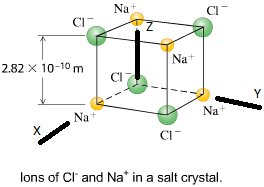 At
every corner you will observe that one anion is surrounded by 3
cations and every cation is surrounded by 3 anions, also every
anion has next adjacent atom as anion and every cation has adjacent
atom as cation
At
every corner you will observe that one anion is surrounded by 3
cations and every cation is surrounded by 3 anions, also every
anion has next adjacent atom as anion and every cation has adjacent
atom as cation
also an anion has diagonal atom as cation and a cation has diagonal atom anion
So taking Cl for force consideration at origin we have
also charge on every atom is electronic charge which has value= e=1.6x10⁻¹⁹C
Now Force due to adjacent atoms, Fa= K*((e2/d2)i +(e2/d2) j +(e2/d2) k) =(K.e2/d2)*(i+j+k)
Now force due to next adjacent atoms, they will be at a distance of ?2*d from Cl atom
Hence, Fn,a = K*(-(e2/2d2)*?2i -(e2/2d2)*?2 j -(e2/2d2)*?2 k) [we have taken coponent in x, y z of forces by all anions and adding them will lead to above)
=-(K.e2/?2d2)*(i+j+k)
Now force due to diagonally opposite cation, Fd = K*((e2/3d2)*(1/?3)i +(e2/3d2)*(1/?3)j +(e2/3d2)*(1/?3) k)
[taking component in x, y andz direction]
=(K.e2/3?3d2)*(i+j+k)
Thus net force on anion, F= Fd+Fa+Fn,d =(K.e2/3?3d2)*(i+j+k)-(K.e2/?2d2)*(i+j+k)+(K.e2/d2)*(i+j+k)
magnitude,|F|= (K.e2/d2)*((1/3?3) -(1/?2)+1)*|(i+j+k)|
=0.485*1.732*9x109x(1.6x10-19)2/(2.82x10-10)2
=2.434x10⁻⁹ N
 genius_generous answered 1 hour ago
Related Solutions
The separation between neighboring Na+ and Cl- ions in crystal of NaCl is 0.281 nm, whilst...
The Goldman Equation K+, Na+ and Cl- ions concentrations Changing the ratio of one of...
Consider the following species: Na, Mg, Cl^-1,S,Cl,Ar,Na^+ (a) Order the above species in order of increasing...
Sodium chloride (NaCl) exhibits predominantly ionic bonding. The Na+ and Cl- ions have electron structures that...
Consider a cubic I crystal with a lattice parameter of 3 Å, and a single atom...
2- a) Assume the following concentrations of Na+ and K+ ions: [Na+]o = 120 mM, [Na+]i...
Draw a picture for what it means for a crystal lattice to be fcc, bcc, or...
consider the isoelectronic ions Cl- and K+. Which ion is smaller? ssuming the core electrons contribute...
Using both H + ions and Cl - ions, why does food digests completely?
Furosemide: Relative to normal, what would happen if the drug furosemide inhibits Na+/K+ and Na+/Cl- symport...
- Consider eight of the ions Cl? and Na+ in a crystal lattice of common salt. The...
- How is the market efficient hypothesis relevant to financial reporting?
- concept map of an intergumatary system
- How does the fluoride ion-selective electrode detect the fluoride ion? Include the species of fluoride that...
- How important are current economic conditions to the process of making an estimate of the allowance...
- Questions a b and c have been answered (answers underneath each), I'm looking for d e...
- please write business plan project