Question
In: Economics
Questions a b and c have been answered (answers underneath each), I'm looking for d e...
Questions a b and c have been answered (answers underneath each), I'm looking for d e and f.
Swedish Automobiles Are the Best (SAAB) sells two types of vehicles: a truck and a car. Based on past trends, the inverse demand equation for trucks is estimated as Pt = 50 - 0.05Qt where Qt is the number of trucks sold per month and Pt is the price per truck (in thousands). The price equation for cars is: Pc = 40 - 0.1Qc. It costs SAAB $20 (thousand) to produce each additional truck and $18 (thousand) to produce each additional car. Assume no fixed costs for SAAB.
a. State the separate total profit and the marginal profit equations for trucks and cars:
Trucks 30-.1Qt ; Cars 22-.2Qc
b. Determine the profit-maximizing output for trucks and cars respectively price that SAAB should charge for each vehicle type.
Trucks Qt = 300, Pt = 35 ; Cars Qc = 110, Pc = 29
c. Compute the monthly total profit for trucks and cars using the quantities computed in part b:
Trucks 4,500 ; Cars 1,210
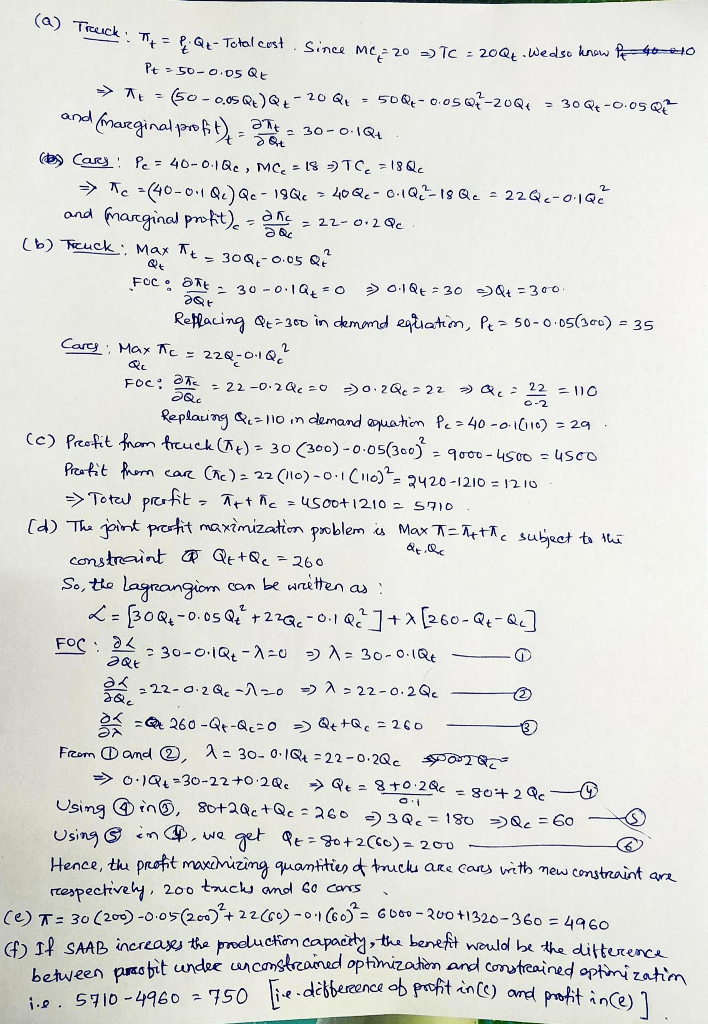
d. Suppose now that SAAB’s production capacity is limited to 260 vehicles per year. Determine the profit-maximizing quantities of trucks and cars with this new constraint. 2 points
e. Compute the monthly total profit for trucks and cars using the quantities computed in part d:
f. What would it be the benefit (in dollars) to SAAB to increase their production capacity so that their output is no longer constrained?
Solutions
 Rahul Sunny answered 2 hours ago
Related Solutions
Multiple-choice questions each have five possible answers (a, b, c, d, e), one of which is correct
I have answered sections A/B. Can you double check my answers for C/D, then solve E/F....
I have A B and C answered I only need the answer to D and E....
Consider the cross: A/a; b/b; C/c; D/d; E/e x A/a; B/b; c/c; D/d; e/e a) what...
A multiple-choice test consists of 22 questions with possible answers of a, b, c, d, e,...
A multiple-choice test consists of 22 questions with possible answers of a, b, c, d, e,...
1.Multiple-choice questions each have four possible answers left parenthesis a comma b comma c comma d right parenthesis(a, b, c, d)
Multiple-choice questions each have four possible answers left parenthesis a comma b comma c comma d...
Multiple-choice questions each have fourfour possible answers left parenthesis a comma b comma c comma d...
I ONLY NEED PART "e" and "g", parts "a" to "d" have been answered and included...
- concept map of an intergumatary system
- How does the fluoride ion-selective electrode detect the fluoride ion? Include the species of fluoride that...
- How important are current economic conditions to the process of making an estimate of the allowance...
- Questions a b and c have been answered (answers underneath each), I'm looking for d e...
- please write business plan project
- Indicate how each of the following would shift the (1) marginal-cost curve, (2) average-variable-cost curve, (3)...
- Identify at least two (2) factors (other than culture) that can impact a person's food choices...