Question
In: Physics
why does it seem always windier in the city?
why does it seem always windier in the city?
Solutions
Expert Solution
This is called the urban canyon effect.
Tall buildings can significantly disturb airflows over urban areas,
and even a building 10 yards high can deflect winds.
Denser collections of buildings in downtown districts of larger
metropolitan areas can be windier than surrounding rural areas,
with quite marked gusts. This is the result of the increased
surface roughness that the urban skyline creates, leading to strong
vortices and eddies. In some cases, these faster, turbulent winds
are funneled in between buildings while barely perceptible
pocket-vacuums are formed.
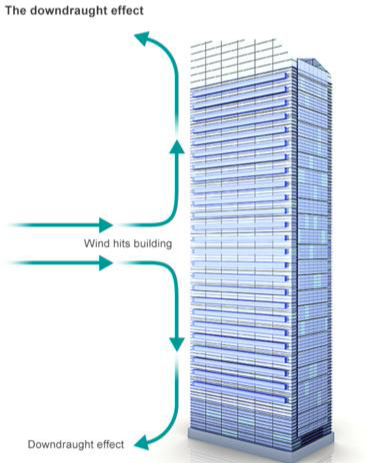
Bernoulli's principle enters this urban situation wherein,any
velocity of a gas or liquid will increase as pressure drops .
When the wind hits a high building, the air stream divides. A part
of it moves upwards and the rest goes around the building. These
swirling eddies--products of Bernoulli's principle--demonstrate the
Venturi Effect.
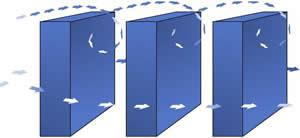
Streets with high buildings on each side of the road create wind
tunnels with these small portions of spinning air. It is the main
roads leading into a city that act as the main corridors by which
the wind enters. These wide thoroughfares for the wind initially
allow the wind to follow the direction of the street. But in the
more narrow street "canyons," the wind speed is significantly
increased at street corners and local eddies are additionally
generated at these junctions where different air currents meet.
 genius_generous answered 1 month ago
Related Solutions
What do you think of the keto diet? Does it seem healthy (why or why not...
If there is an externality, does it seem likely that private markets will arise that allow this externality to be internalized? Why or why not?
Using appropriate terminology, explain why public radio stations, which rely on contribution from listeners, always seem...
when calculating the moment of a trianglular distrubted load the answers always seem to be in...
Why does the way our text describes and analyzes global stratification seem to be more of...
why does a child in a wagon seem to fall backward when you give the wagon...
Explain why auxin does not seem to play the same role in sunflowers and other eudicots...
A. Why does there seem to be three different Aggregate Supply curves in the Aggregate Supply/Aggregate...
Question 1 a-c Bookstores in a large city would seem to be an example of a...
Why does classical physics seem more intuitive to us than modern physics does Relativistic quantum mechanics...
- Do you think that CAFTA will have a major impact on the U.S. economy? Why?
- Assignment 4, Fraction Comparable Instructions For this assignment, you will be updating the Fraction class from...
- what crystal claim that English is doing across the world?
- Site map for your e-commerce site. How many webpages this site has? What’s the name of...
- A skier of mass 60 kg starts at the top of a steep slope with an...
- If banks must hold $4 in reserves for each $10 in deposits, and the public decides...
- A 244 g mass is hung on a spring. As a result the spring stretches 20.5...