Question

In: Physics

3. Work is inputted to isothermally move a 1500 Kg mass from an elevation of zero...

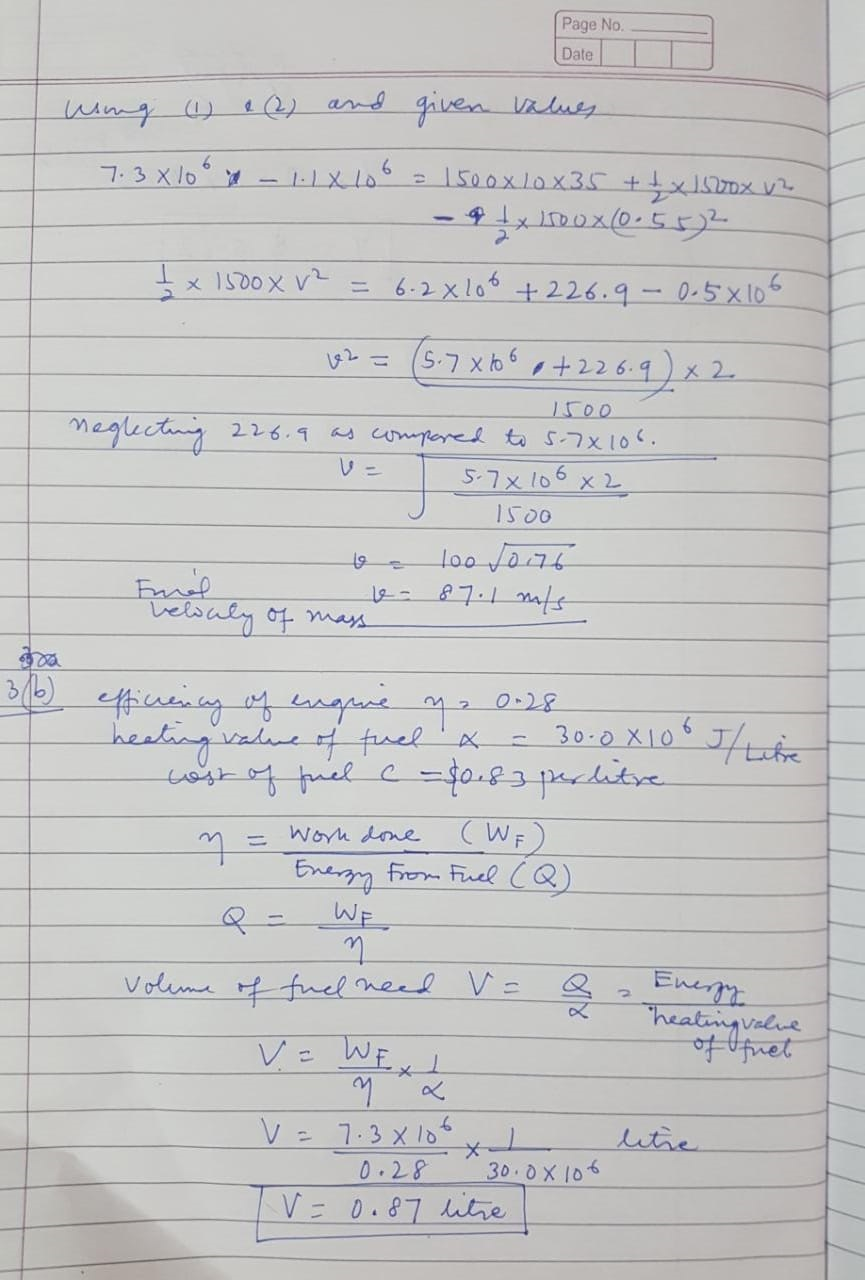
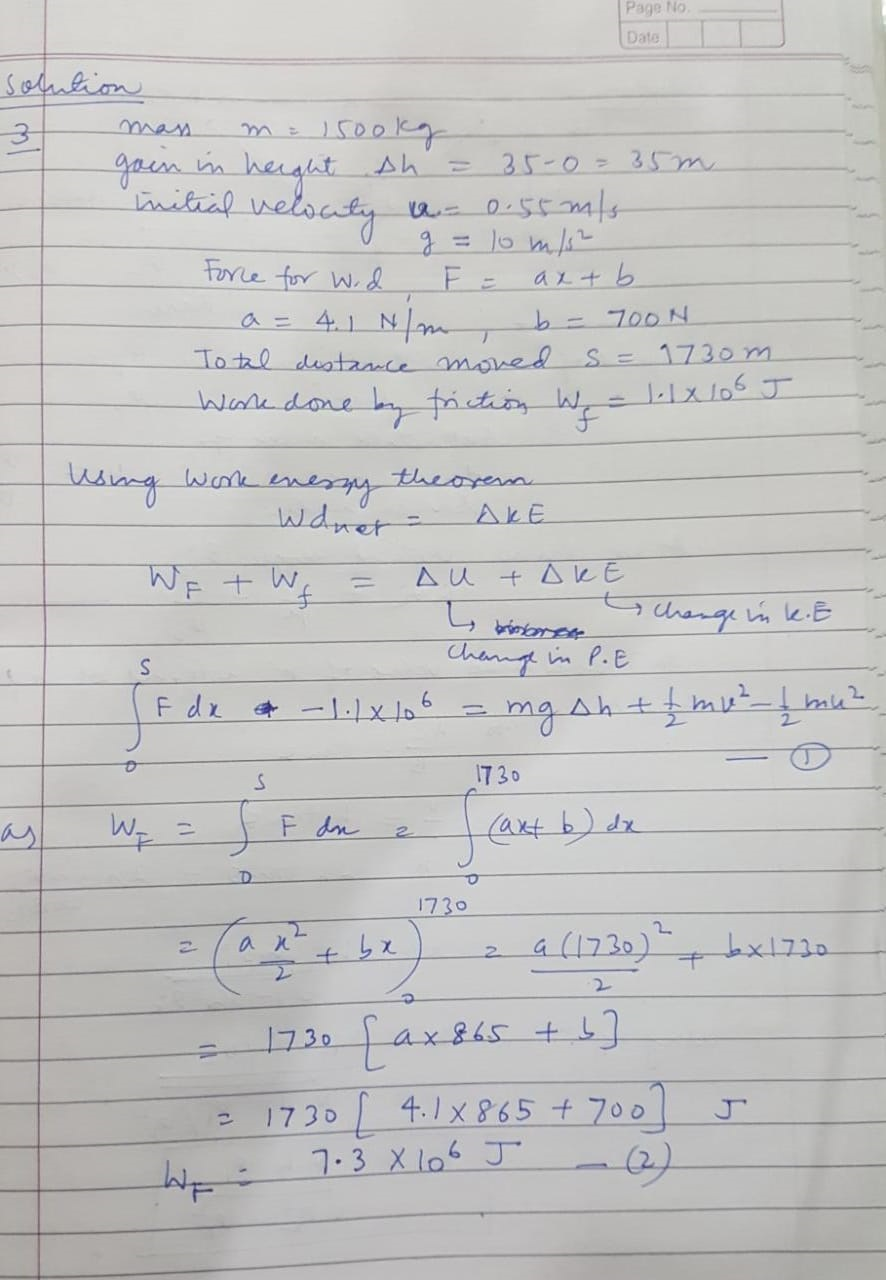
3. Work is inputted to isothermally move a 1500 Kg mass from an elevation of zero to 35m and to change it velocity. The initial velocity of the mass is 0.55 m/s. The drag work for this process is described by a force which varies over the distance travel, F = ax + b; where F is in Newtons, the coefficient (a) has units of N/m and the constant (b) has units of N. For this application a = 4.1 N/m and b = 700 N. The force is applied over a distance of 1730 m. There is a heat loss from friction of 1.1(106 ) J during this process. Determine the final velocity of the mass.

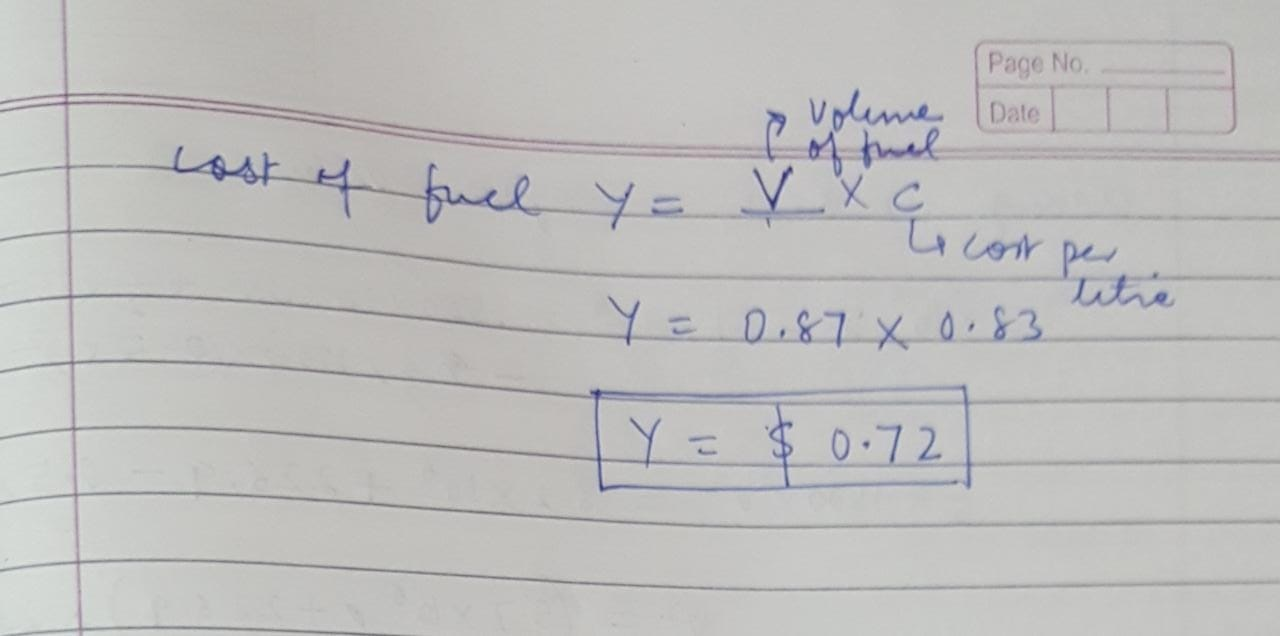
3b. The input work for this process is from a combustion engine that has an efficiency of 0.28. The heating value of the fuel is 30.0 MJ/liters and its cost is $0.83/liter. Determine the volume of fuel required and its cost to perform the process described in (3.).

Please solve with sketches and clear equations. Thanks!

Solutions
Expert Solution

The solution of the problem is given below


Related Solutions

Blocks A (mass 3.00 kg) and B (mass 12.00 kg, to the right of A) move...
Blocks A (mass 3.00 kg) and B (mass 12.00 kg, to the right of A) move on a frictionless, horizontal surface. Initially, block B is moving to the left at 0.500 m/s and block A is moving to the right at 2.00 m/s. The blocks are equipped with ideal spring bumpers. The collision is head on, so all motion before and after it is along a straight line. Let +x be the direction of the initial motion of A. Find...
Blocks A (mass 4.00 kg ) and B (mass 7.00 kg ) move on a frictionless,...
Blocks A (mass 4.00 kg ) and B (mass 7.00 kg ) move on a frictionless, horizontal surface. Initially, block B is at rest and block A is moving toward it at 4.00 m/s . The blocks are equipped with ideal spring bumpers. The collision is head-on, so all motion before and after the collision is along a straight line. Let +x be the direction of the initial motion of block A. Find the maximum energy stored in the spring...
Blocks A (mass 4.00 kg ) and B (mass 6.00 kg ) move on a frictionless,...
Blocks A (mass 4.00 kg ) and B (mass 6.00 kg ) move on a frictionless, horizontal surface. Initially, block B is at rest and block A is moving toward it at 5.00 m/s . The blocks are equipped with ideal spring bumpers. The collision is head-on, so all motion before and after the collision is along a straight line. Let +x be the direction of the initial motion of block A. Find the maximum energy stored in the spring...
Blocks A (mass 5.00 kg ) and B (mass 9.00 kg ) move on a frictionless,...
Blocks A (mass 5.00 kg ) and B (mass 9.00 kg ) move on a frictionless, horizontal surface. Initially, block B is at rest and block A is moving toward it at 2.00 m/s . The blocks are equipped with ideal spring bumpers. The collision is head-on, so all motion before and after the collision is along a straight line. Let +x be the direction of the initial motion of block A. a.) Find the maximum energy stored In the...
An elevator (1500 kg mass, with passengers) is attached to a 1000 kg counterweight by a...
An elevator (1500 kg mass, with passengers) is attached to a 1000 kg counterweight by a cable that is wrapped over a pulley. It is also attached (by a second cable) to a motor. The elevator is moving down at a constant speed of 5 m/s. a) Determine the force that the motor must apply to the second cable. b) Determine the force that the motor must exert to lower the elevator with a constant downward acceleration of 1 m/s^2....
A parachutist whose mass is 65 kg drops from a helicopter hovering 1500 m above the...
A parachutist whose mass is 65 kg drops from a helicopter hovering 1500 m above the ground and falls toward the ground under the influence of gravity. Assume that the force due to air resistance is proportional to the velocity of the​ parachutist, with the proportionality constant b1 = 30 ​N-sec/m when the chute is closed and b2= 100 ​N-sec/m when the chute is open. If the chute does not open until the velocity of the parachutist reaches 15 ​m/sec,...
Design a system to move 100 gpm of water from a river with surface water elevation...
Design a system to move 100 gpm of water from a river with surface water elevation of 201.35 ft msl to a tank with surface water elevation = 246.55 ft msl. The tank is pressurized; the air pressure in the tank is 60 psig. The total length of pipe is 125 ft with 6 standard elbows all made of Sch 40 steel pipe. Your design should specify the nominal diameter of pipe (use only commercially available sizes) and the power...
The particle has a mass of 0.6 kg and is confined to move along the smooth...
The particle has a mass of 0.6 kg and is confined to move along the smooth horizontal slot due to the rotation of the arm OA. Assume the particle contacts only one side of the slot at any instant. The arm has an angular acceleration of θ¨ = 3 rad/s2 when θ˙ = 2 rad/s at θ = 30∘. (Figure 1) Part A Determine the magnitude of the force of the rod on the particle when θ = 30∘. Express...
A block of mass 2 kg and a block of mass 3 kg are sliding on...
A block of mass 2 kg and a block of mass 3 kg are sliding on a frictionless surface. They collide and stick together. Before the collision the first block was travelling at 5 m/s in the positive x direction. After the collision the two blocks are travelling at 6 m/s in the negative x direction. What was the x component of the velocity of the second block before the collision?
Two satellites, A and B, both of mass m = 115 kg, move in the same...
Two satellites, A and B, both of mass m = 115 kg, move in the same circular orbit of radius r = 7.57 106 m around Earth but in opposite senses of rotation and therefore on a collision course. a) What is the total mechanical energy EA + EB of the two satellites + Earth system before the collision? b)If the collision is completely inelastic so that the wreckage remains as one piece of tangled material (mass = 2m), what...
ADVERTISEMENT
ADVERTISEMENT
ADVERTISEMENT