Question
In: Economics
Graph a Monopoly. Compare the price, quantity, and ATC of a monopoly with a perfectly competitive...
Graph a Monopoly. Compare the price, quantity, and ATC of a monopoly with a perfectly competitive firm. Who is more efficient and why?
Solutions
Expert Solution
Monopoly:-
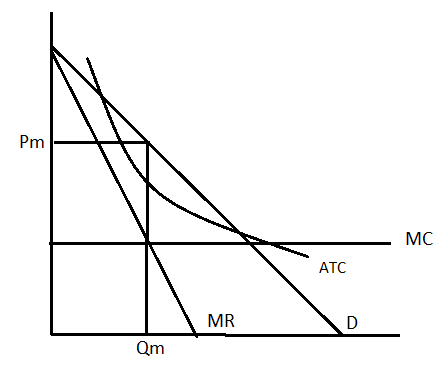
A monopoly sets MC=MR for profit maximization where the quantity produced is lower and the price charged is higher than the perfectly competitive firm. Since it is a single producer in the market,it earns economic profits both in the short run and in the long run so its ATC is below the price.
Perfect competitive firm:-
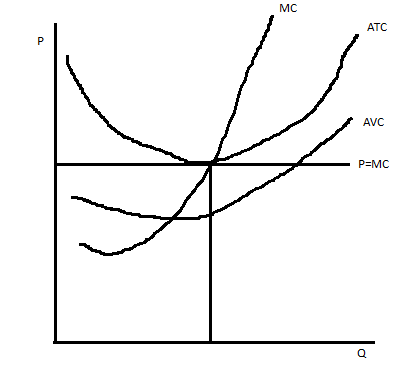
A perfectly competitive firm sets P=MC for profit maximization so it produces a greater quantity and charges a lower price than a monopoly. Since it operates in the market where there are a lot of producers selling the identical good, the price charged is equal to the ATC in the long run and it earns zero profits.
A perfectly competitive market is more efficient than a monopoly since it sets P=MC where all the quantity demanded by the market is being produced whereas a monopoly produces a lower quantity which leads to a deadweight loss and inefficiency.
 Rahul Sunny answered 1 day ago
Related Solutions
a)How do we compare the price and quantity of a monopoly and perfectly competitive market? b)Why...
3. Compare the price and quantity outcomes delivered by monopolistically competitive and perfectly competitive industries. State...
For a perfectly competitive firm, if MC = minimum ATC, then:
1.) a. Graph and explain how a monopoly determines the quantity to produce and the price...
A. Graph the equilibrium price and quantity if Apple operates as a monopoly. B. Using the...
Calculate the price and quantity an Airline would select if it were in a Perfectly Competitive...
1) Compare the profit maximization of a perfectly competitive firm and a monopoly. Support your answer...
Categorize the following as price takers or price makers: perfectly competitive market, monopoly, monopolistic completion, and...
A major difference between a monopoly and a perfectly competitive firm is that a monopoly (a)...
For firms in perfectly competitive markets, the market price is A. constant, regardless of quantity sold....
- Example: We are looking at the cholesterol levels of population of 200 healthy individuals. Cholesterol of...
- In an experiment on the Reaction of Magnesium with Hydrochloric Acid. What would be the effect...
- sort_employees(Employee emps[], int size) (40 pts) This function should sort the input array based on each...
- Write the program in JAVA. Make an undirected, but disconnected graph of at least 15 vertices...
- Teen Smoking Project CHAPTER 0. Preliminary Discussion Question: 1. What conjectures (educated guesses) could be made...
- In reviewing firm liquidity situations, lenders often count on the Quick Ratio (or Acid-Test ratio). Why...
- code a Java program that: Requests from the user for a text filename to read the...