Question
In: Economics
Suppose that the Inverse Demand Curve for recreational Cannabis is given as: P = 14.60 –...
Suppose that the Inverse Demand Curve for recreational Cannabis is given as: P = 14.60 – 0.40 [Qd] per gram. i. After determining the NORMAL Demand Curve from the Inverse demand curve above, determine the Quantities Demanded, Qd in Millions of grams, if the Price, P is reduced from $11.00 per gram to $10.00 per gram AND the value of the Price Elasticity of Demand over the “arc” of this change.
ii. Carefully explain how each of the “sign” and the “magnitude” of the elasticity determined in part i above would be interpreted? iii. Suppose that in response to a reduction in Price, P for Cannabis-based Gummi Bears from $12.00 to $10.00 per package results in a reduction in of 0.75 million grams at every price point from the original Demand Curve. Using this information, determine the elasticity of grams of Cannabis in response to the change in Price of the Gummi Bears. iv. Carefully explain how each of the “sign” of the elasticity determined allows us to describe the “type” of relationship between the Cannabis and Gummi Bears AND the interpretation of the “magnitude” of the elasticity?
Solutions
Expert Solution
Given, P = 146 -0.4QD
Add 0.4QD to both sides we get


Subtracting P from both sides


Divide both sides by 0.4, we get
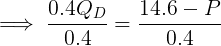

Above equation represents the normal demand function.
Price elasticity of demand can be determined as follows
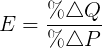
Applying the arc elasticity or mid point method to determine the elasticity
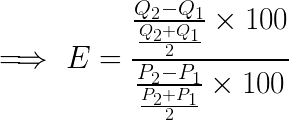
Simplifying above equation we get

When P1 = $ 11,

When P2 = $ 10

Plug in these values in the elasticity equation

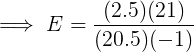
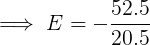

Elasticity of demand = - 2.56 (Elastic)
ii. The elasticity of demand is negative this means that with the increase in price the quantity demanded will decrease or, price is indirectly proportional to quantity demanded.
Further, the absolute value of elasticity of demand is greater than 1. Hence the elasticity of demand is relatively elastic.
iii. Humko bears price has been reduced from $ 12 to $ 10 due to which the quantity demanded of Cannabis has reduced by 0.75 million grams at every price.
Initial demand = 11.5 million grams
Change in demand = 0.75 million grams
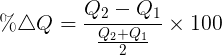

Now calculating the % ∆ Price of Humko bears
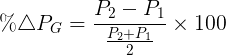

The cross elasticity of demand can be determined using the following formula
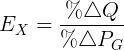
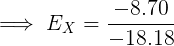

Cross elasticity of demand = 0.4785
iv. The cross elasticity of demand is positive therefore the two goods are substitute to each other.
By magnitude we mean, if there will be 1% change in price of gummi bears the quantity demanded of cannabis will change by 0.4785%. Both will move into the same direction. If the price increases by 1% quantity demanded will increase by 0.4785% and vice-versa.
Please contact if having any query will be obliged to you for your generous support. Your help mean a lot to me, please help. Thank you.
 Rahul Sunny answered 2 months ago
Related Solutions
Suppose that the (inverse) demand curve for Cranberries is given by P = 40 − 6Q...
Suppose that the (inverse) demand curve for Cranberries is given by P = 40 − 6Q...
Question #1 Suppose that the (inverse) demand curve for Cranberries is given by P = 40...
2. The inverse demand curve of a monopolist is given by: P = 200 −...
Suppose a firm's inverse demand curve is given by P = 120 - 0.5Q and its cost equation is
Suppose the inverse demand and inverse supply functions for a good are given as P= 200-0.5Q...
Consider a Monopolist where the inverse market demand curve for the produce is given by P...
The inverse demand curve for a product using resource X is given by P = 60...
Consider an oligopoly with 2 firms. The inverse demand curve is given by P = 100...
Your inverse demand curve for medical care is given by P = 220-20Q, where P is...
- Discuss the two estimation methods of classification-type data mining models while considering ANN as a classifier.
- For the equilibrium: CO2(g) + H2(g) ⇌ CO(g) + H2O(g), Kp = 10-5 at 25°C and...
- Sanyu Sony started a new business and completed these transactions during December. Dec. 1 Sanyu Sony...
- A crate rests on a frictionless incline, and is attached to a bucket of nails through...
- e) LIST the three effects that account for the downward slope of the AD curve.
- Complete a 1- to 2-page table using the template provided comparing your opinion of the rights...
- It’s April 2020. You are an oil distributor, planning to buy 500,000 barrels of crude oil...