Question
In: Physics
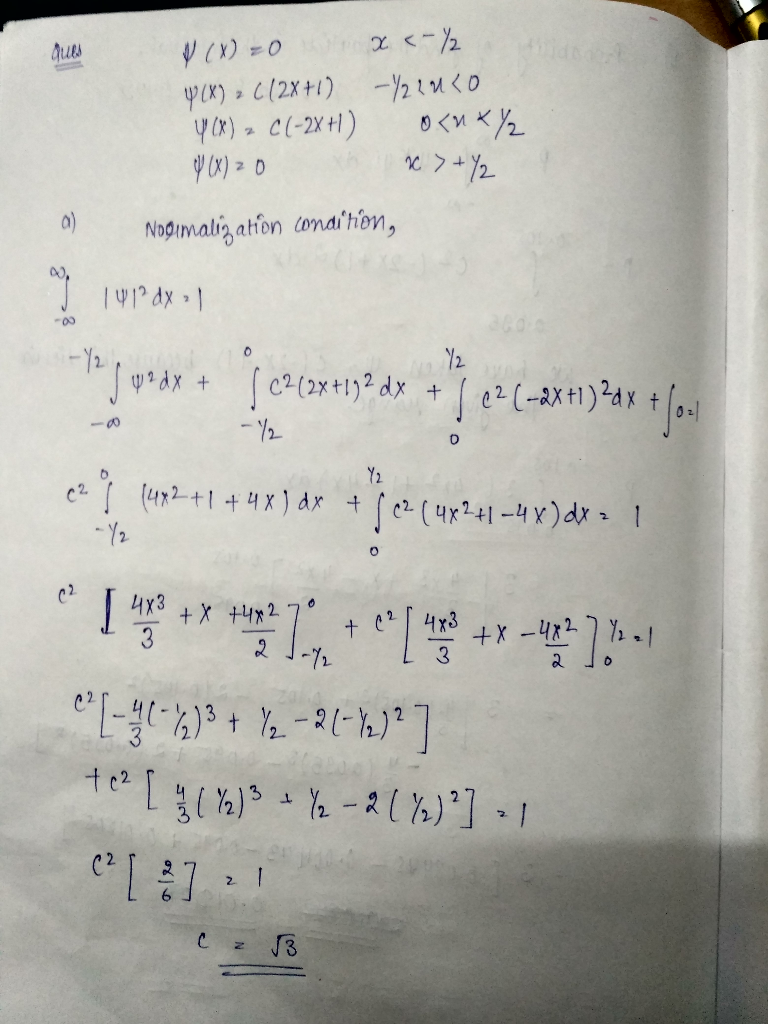
A particle is represented by the following wave function: ψ(x) =0 x<−1/2 ψ(x) =C(2x +...
A particle is represented by the following wave function:
| ψ(x) =0 | x<−1/2 | |
| ψ(x) =C(2x + 1) | −1/2 < x < 0 | |
| ψ(x) =C(−2x + 1) | 0 < x < +1/2 | |
| ψ(x) =0 | x > +1/2 |
(a) Use the normalization condition to find C ?
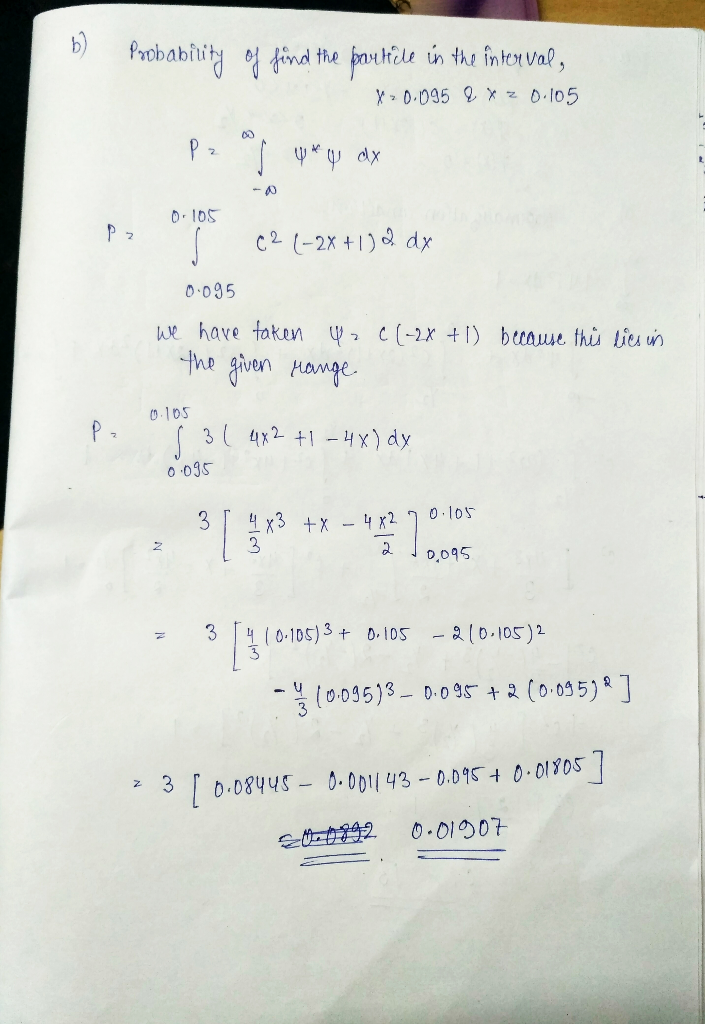
(b) Evaluate the probability to find the particle in an interval of
width 0.01 at x = 0.1 (that is, between x = 0.095 and x =
0.105.)(No integral is necessary for this calculation.)
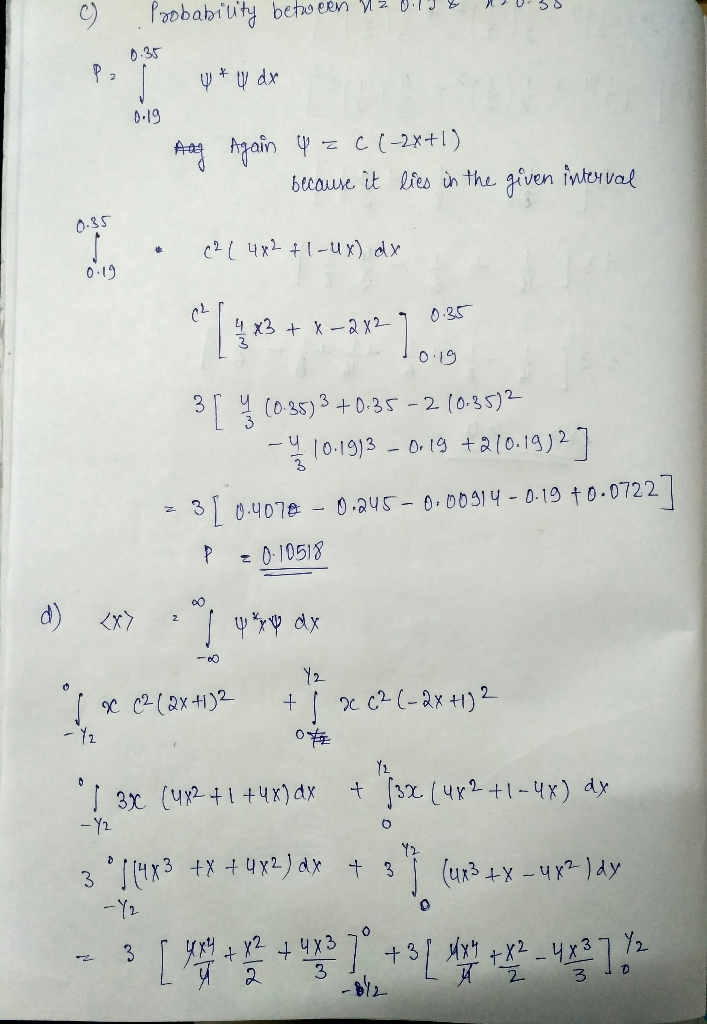
(c)Evaluate the probability to find the particle between x=0.19 and
x=0.35.
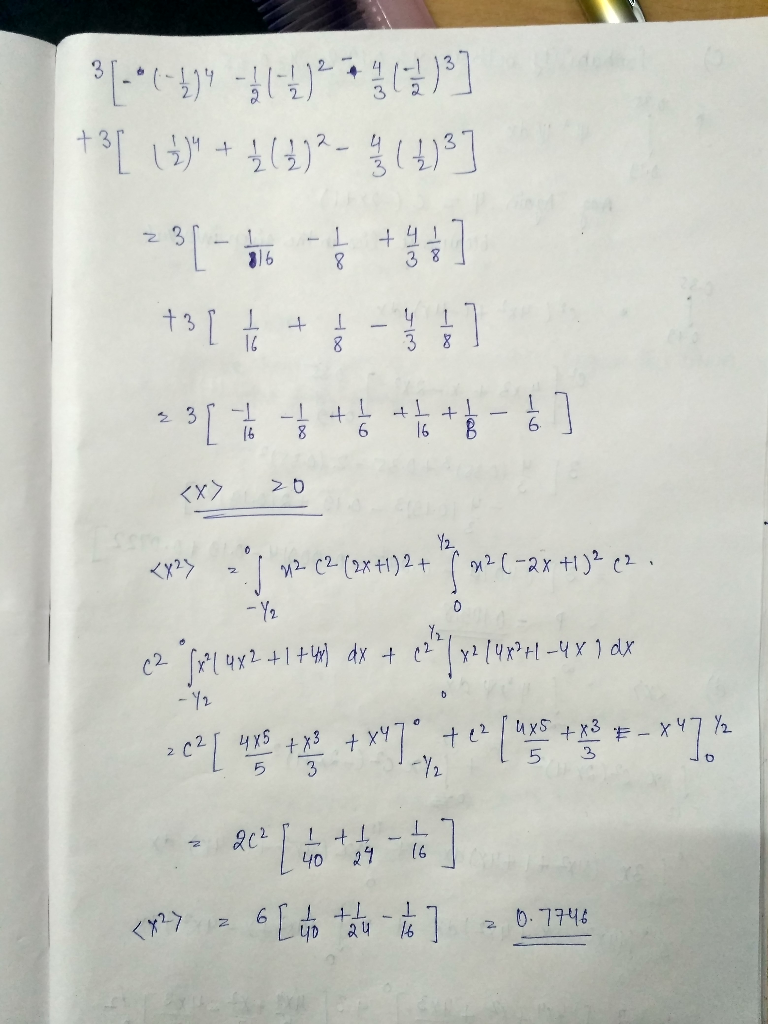
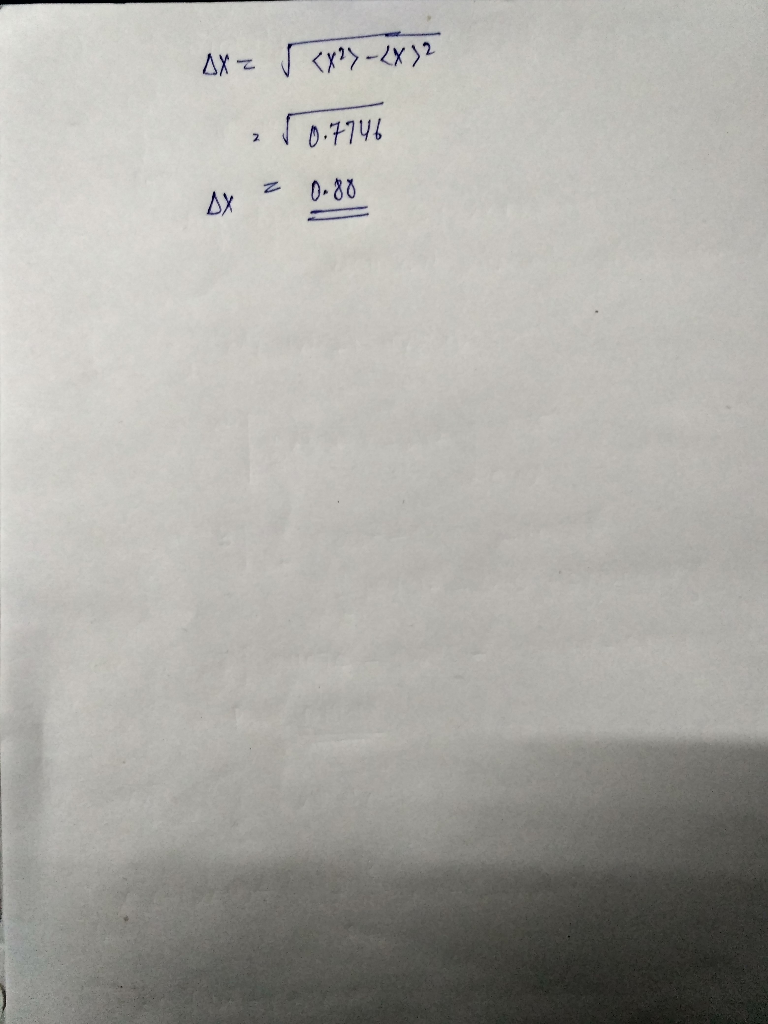
(d) Find the average values of x and x2, and the
uncertainty of x:
Δx=√(x2)av-(xav)2
| xav= | |
| (x2)av= | |
| Δx = |
Solutions
 genius_generous answered 2 months ago
Related Solutions
A particle is described by the wave function ψ(x) = b(a2 - x2) for -a ≤...
A particle is described by the wave function ψ(x) =
b(a2 - x2) for -a ≤ x ≤ a and ψ(x)=0 for x ≤
-a and x ≥ a, where a and b are positive real
constants.
(a) Using the normalization condition, find b in terms of
a.
(b) What is the probability to find the particle at x =
0.21a in a small interval of width 0.01a?
(c) What is the probability for the particle to be found between x...
A particle is described by the wave function ψ(x) = b(a2 - x2) for -a ≤...
A particle is described by the wave function ψ(x) = b(a2 - x2)
for -a ≤ x ≤ a and ψ(x)=0 for x ≤ -a and x ≥ a , where a and b are
positive real constants.
(a) Using the normalization condition, find b in terms of a.
(b) What is the probability to find the particle at x = 0.33a in
a small interval of width 0.01a?
(c) What is the probability for the particle to be found...
A particle's wave function is ψ(x) = Ae−c(x−b)2 where A = 1.95 nm−1/2 and b =...
A particle's wave function is ψ(x) = Ae−c(x−b)2 where A = 1.95
nm−1/2 and b = 0.600 nm.
(a) What is the value of the constant c (in nm−2)? nm−2
(b) What is the expectation value for the position of this
particle (in nm)? nm
A traveling wave along the x-axis is given by the following wave function ψ(x, t) =...
A traveling wave along the x-axis is given by the following wave
function ψ(x, t) = 4.5 cos(2.1x - 11.8t + 0.52),where x in meter, t
in seconds, and ψ in meters. Find
a) the frequency, in hertz
b)The wavelength in meters.
c) The wave speed, in meters per second.
d) The phase constant in radians.
Asume the wave function Ψ(x) = A/(x²+a²) whith x real, A and a constants a) find...
Asume the wave function Ψ(x) = A/(x²+a²) whith x real,
A and a constants
a) find the normalized wave function Φ(p) un the
momentum space associated to Ψ(x)
b) use Φ(p) yo compute the expected values for p, p²,
and σ_p
c) verify if this state fulfills the Heisenberg
uncertainty principle
Problem 1. At time t = 0 the state of a particle in one dimension (1D) is given by ψ(x, 0) = A x 2 + a 2 Here a and A are some positive constants.
Problem 1. At time t = 0 the state of a particle in one dimension (1D) is given by ψ(x, 0) = A x 2 + a 2 Here a and A are some positive constants.
i) Find A
ii) Sketch the graph of the probability density of ψ
iii) Find the probability that the particle is within −a < x < a and − √ 2a < x < √ 2a
iv) Find the expectation value of the...
Consider the wave function Ψ = Ae−α|x| Which of the following boundary conditions are satisfied by...
Consider the wave function
Ψ = Ae−α|x|
Which of the following boundary conditions are satisfied by the
wave function?
Group of answer choices
Ψ approaches zero as x approaches ±∞
Ψ is single valued.
Ψ is finite everywhere.
None of the boundary conditions are satisfied.
a. For the following probability density function: f(X)= 3/4 (2X-X^2 ) 0 ≤ X ≤ 2  
a. For the following probability density
function:
f(X)=
3/4 (2X-X^2 ) 0 ≤ X ≤ 2
=
0 otherwise
find
its expectation and variance.
b. The two regression lines are 2X - 3Y + 6 = 0 and 4Y – 5X- 8
=0 , compute mean of X and mean of Y. Find correlation coefficient
r , estimate y for x =3 and x for y = 3.
1. Consider the following function F(x) = {2x / 25 0<x<5 {0 otherwise a) Prove...
1. Consider the following function
F(x) = {2x / 25 0<x<5
{0
otherwise
a) Prove that f(x) is a valid probability function.
b) Develop an inverse-transformation for this function.
c) Assume a multiplicative congruential random number generator
with parameters:
a: 23, m: 100, and xo: 17. Generate two random variates from the
function for (x).
Solve for x x^4 + 2x^3 + 2x^2 + 3x + 1 = 0
Solve for x
x^4 + 2x^3 + 2x^2 + 3x + 1 = 0
ADVERTISEMENT
ADVERTISEMENT
Latest Questions
- IT Project Management: Explain in detail and give 3 references: What are some ways to manage...
- “A working mother receives $300,000 salary, while spends $30,000 for hiring baby-sitter.” What's the impact on...
- In a women's 100-m race, accelerating uniformly, Laura takes 1.90 s and Healan 3.15 s to...
- The HUANG Company currently has one bond issue outstanding. This bond pays a coupon rate of...
- These two waves travel along the same string: y1 = (3.52 mm) sin(1.75?x - 470?t) y2...
- An analyte has been discovered ( so it's new) in the Tobago population. Define the term...
- A freestyle skier is training for the Olympics. In this sport the skier starts at the...
ADVERTISEMENT