Question

In: Economics

League Competition: Suppose the demand for soccer teams in the US is given by: P(Q) =...

League Competition: Suppose the demand for soccer teams in the US is given by: P(Q) = 320−10Q where Q is the total number of soccer teams and Pi s the marginal willingness to pay for the Qth team (in millions). The cost to start a new team is c= 20

Two Leagues: First, suppose are two leagues (Major League Soccer and the National Soccer League) that are choosing how many teams to have, so that Q=qm+qn.

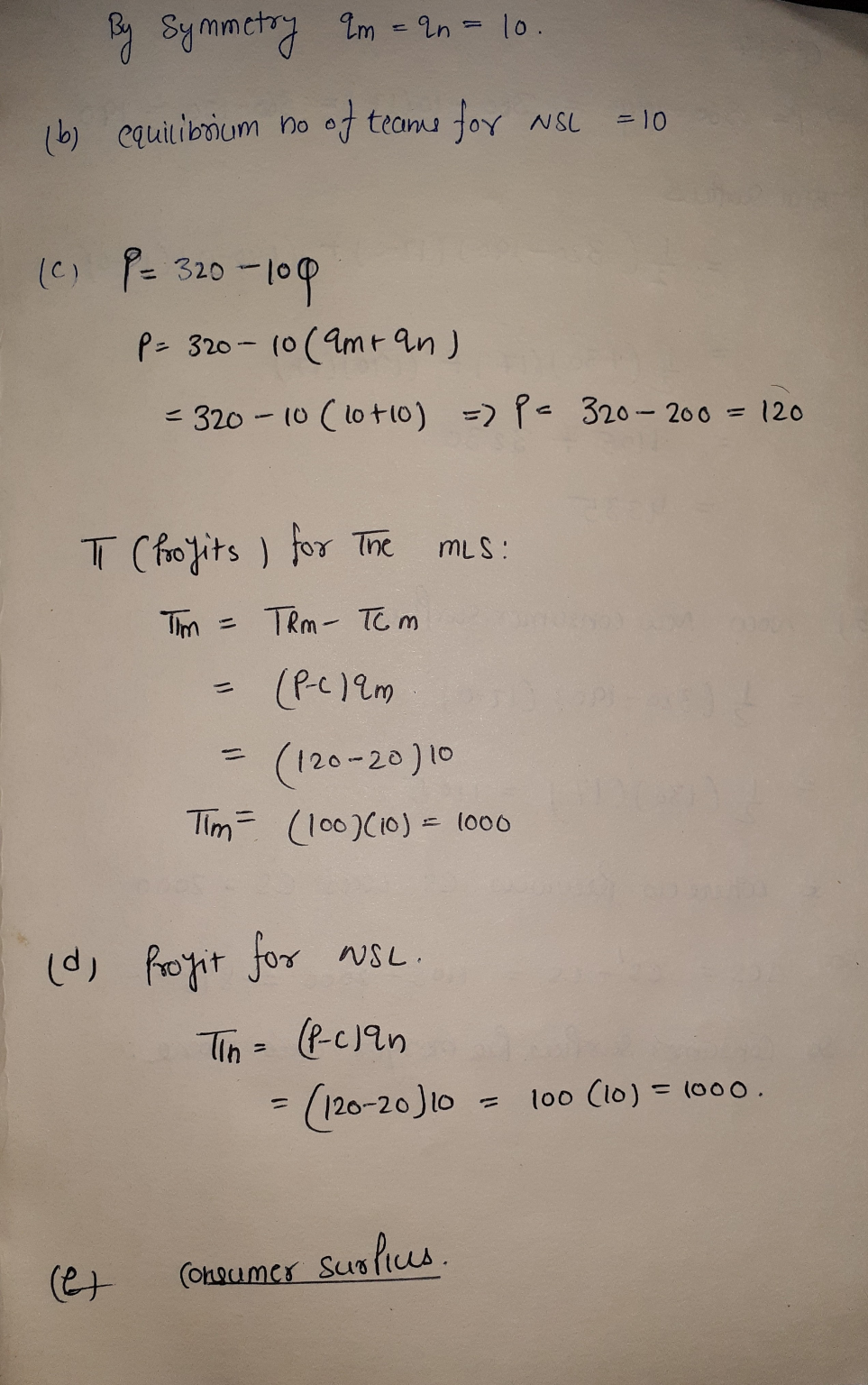
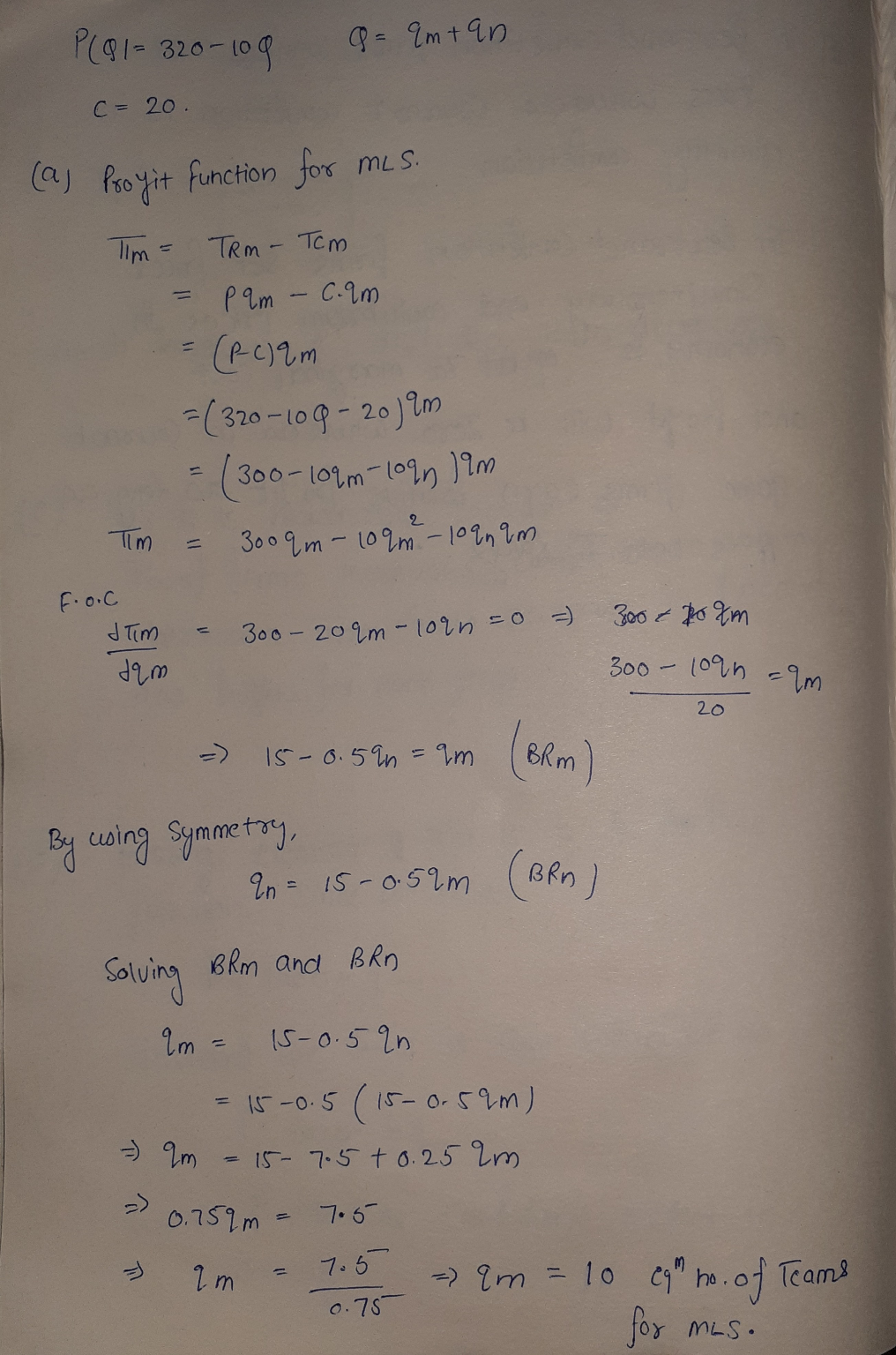
a Find the equilibrium number of teams for the MLS.

b Find the equilibrium number of teams for the NSL.

c What are profits for the MLS?

d What are profits for the NSL?

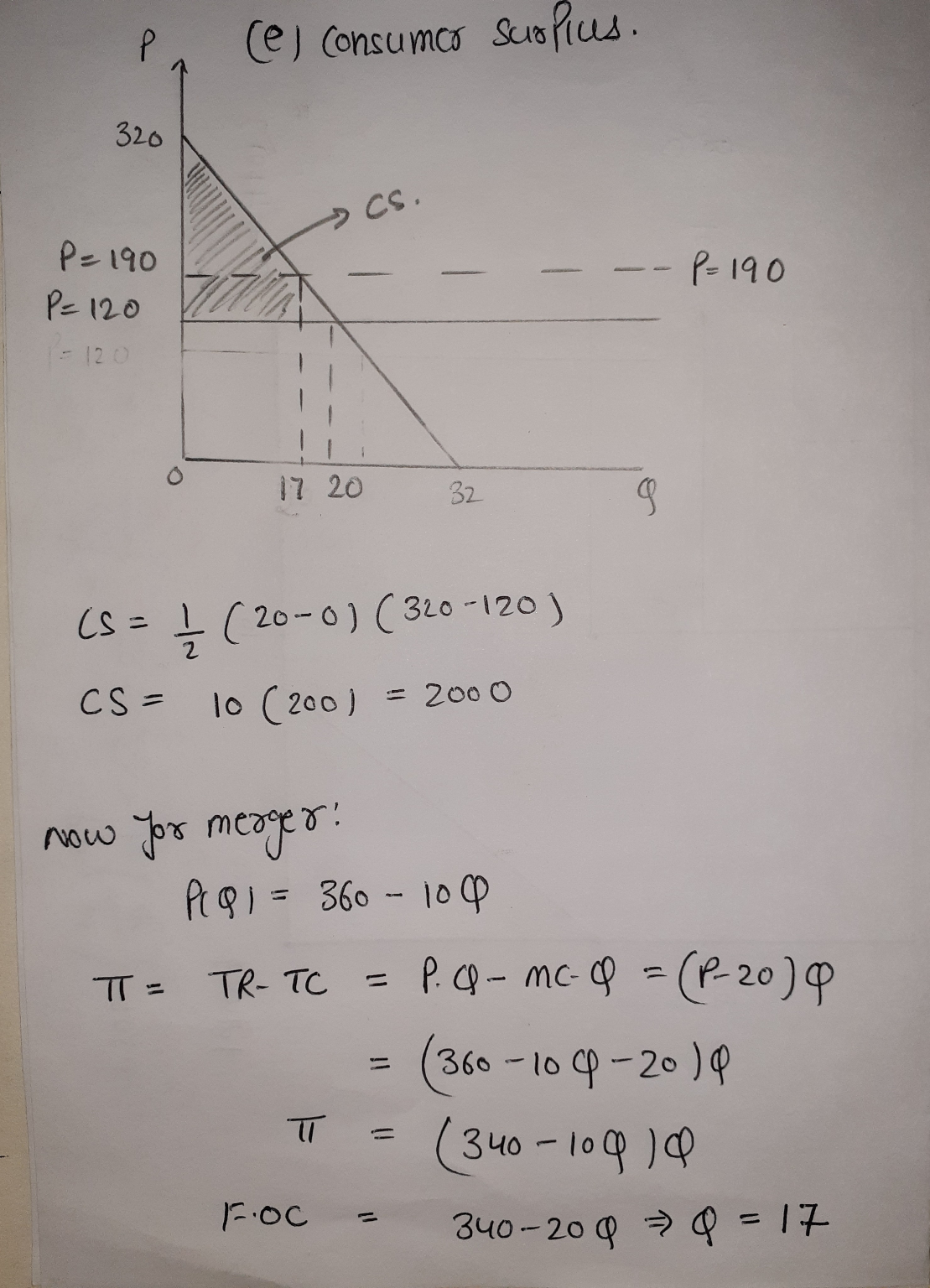
e What is consumer surplus?

Merger: Now assume the leagues merge to form one league (Premier USA). After the merger demand increases to:P(Q) = 360−10Q

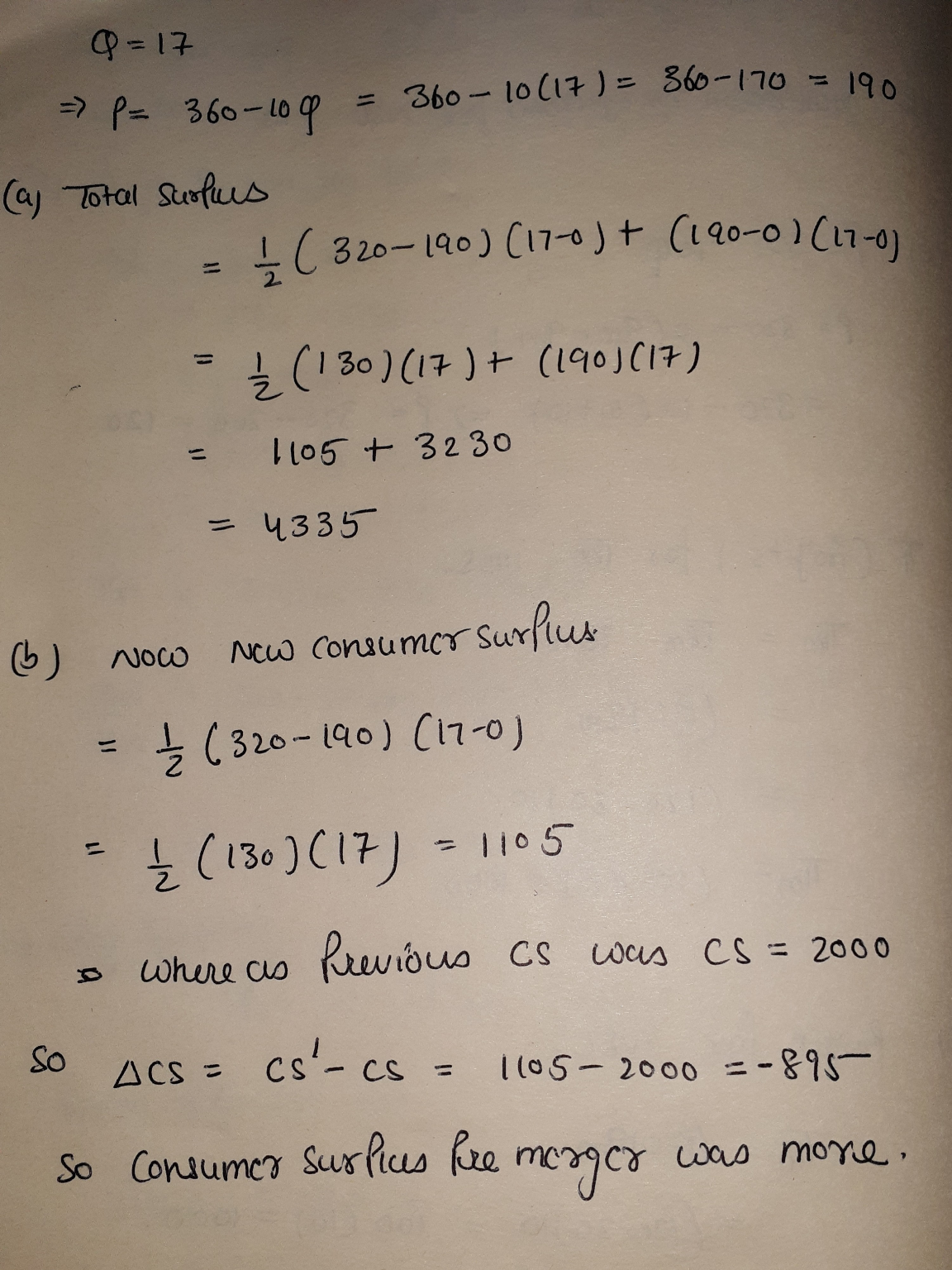
a What is total surplus (consumer surplus and profit)?

b Is consumer surplus more or less than the pre-merger surplus?

Solutions
Expert Solution


Related Solutions

The demand curve for TVs in the US is given by Q = 80 – P,...
The demand curve for TVs in the US is given by Q = 80 – P, where Q indicates the number of TVs purchased and P is the price. Suppose that there are no TVs produced in the US, but they can be imported either from Mexico or from the rest of the world. The price of TVs in Mexico is $10, and the price from the lowest‐cost supplier in the rest of the world is $5. In each case,...
Suppose that demand for a cigarettes (in millions of cartons) is given by Q=20 - ½ *P. Supply of cigarettes is given by Q=P.
Suppose that demand for a cigarettes (in millions of cartons) is given by Q=20 - ½ *P. Supply of cigarettes is given by Q=P. There is a negative consumption externality from cigarettes, in the amount of $2 per box.a. Draw the market for cigarettes, labeling the private marginal cost (PMC), social marginal cost (SMC), private marginal benefit (PMB) and social marginal benefit (SMB).b. What quantity of the good is consumed under the private market equilibrium?c. What is the socially optimal...
(Perfect Competition and consumer Surplus) Suppose the demand function for widgets is Q(p) = 60 –...
(Perfect Competition and consumer Surplus) Suppose the demand function for widgets is Q(p) = 60 – p, and all firms that produce widgets have total cost function C(q) = 16 + q^3 . a) Suppose that the market is perfectly competitive and there is free entry and exit. All firms that enter use the same technology. A firm that decides to stay out of the market can avoid paying the fixed cost and has a profit of zero. Solve for...
Suppose Demand for Apples (in bushels) is given by Q = 90-P and Supply is given...
Suppose Demand for Apples (in bushels) is given by Q = 90-P and Supply is given by Q = P. The market for apples is dominated by a single, monopolistic firm "NYC Apples". a) What is NYC Apples profit at the monopoly price? b) How much more will consumers pay for Apples with NYC Apples being a monopoly compared to if it were a perfectly competitive market? c) Suppose you could regulate the market for Apples and impose a price...
Suppose that the market demand is given by Q(p)=200-5p. Let p(q) be the maximal price at...
Suppose that the market demand is given by Q(p)=200-5p. Let p(q) be the maximal price at which the agents would buy q units, i.e., the inverse demand function. Then? a. p(q)=40-5q b. p(q)=40-0.2q c. p(q)=40-0.4q d. p(q)=200-10q e. p(q)=200-5q
The demand curve for T-shirts in the US is given by Q = 100 – 2*P....
The demand curve for T-shirts in the US is given by Q = 100 – 2*P. Suppose that there are no T-shirts produced in the US, but they can be imported either from Mexico or from the rest of the world. The price of T-shirts in Mexico is $20, and the price from the lowest-cost supplier in the rest of the world is $15. The US charges a tariff of $10 per unit imported. a) Consider the case where there...
Suppose that consumer​ (retail) demand for a product is given​ by: Q=100−P​, where Q is the...
Suppose that consumer​ (retail) demand for a product is given​ by: Q=100−P​, where Q is the quantity demanded and P is the price. The inverse demand curve​ (which gives the price as a function of the quantity​ demanded) is: P=100−Q. The marginal cost of production and average total cost of production are $26 per​ unit, and the marginal cost of distribution and average total cost of distribution are ​$10 per unit. Suppose the retail distribution is monopolized by another firm....
Suppose the supply curve for steel is given by P=Q and the demand for steel is...
Suppose the supply curve for steel is given by P=Q and the demand for steel is given by P=100- 2Q. The production of steel is associated with a constant external cost of $10 per unit. a. Calculate the private equilibrium. What are equilibrium price and quantity? b. What is the deadweight loss associated with the private equilibrium. Calculate and draw a sketch.
Suppose the domestic demand for coffee is given by the equation Q = 100 - P,...
Suppose the domestic demand for coffee is given by the equation Q = 100 - P, domestic supply by the equation Q = P. The world price for coffee is $20 per unit. The government decides to impose an import quota limiting imports to 10 units. How much deadweight loss will this generate? Please explain clearly using graphs.
Suppose the demand function for a given product is q = 5,400 - 2p2, where p...
Suppose the demand function for a given product is q = 5,400 - 2p2, where p is the price in dollars. Find the price interval(s) where demand is elastic: Find the price interval(s) where demand is inelastic: show work
ADVERTISEMENT
ADVERTISEMENT
ADVERTISEMENT