Question
In: Physics
An object (A) of mass m A = 28.0 kg is moving in a direction that...
An object (A) of mass m A = 28.0 kg is moving in a direction that makes angle of 50° south of west with a speed v A = 4.90 m/s, while object (B) of mass m B = 18.0 kg is moving due south with a speed v B = 7.85 m/s. The two objects collide and stick together in a completely inelastic collision. Find the magnitude of the final velocity of the two-object system after the collision.
Solutions
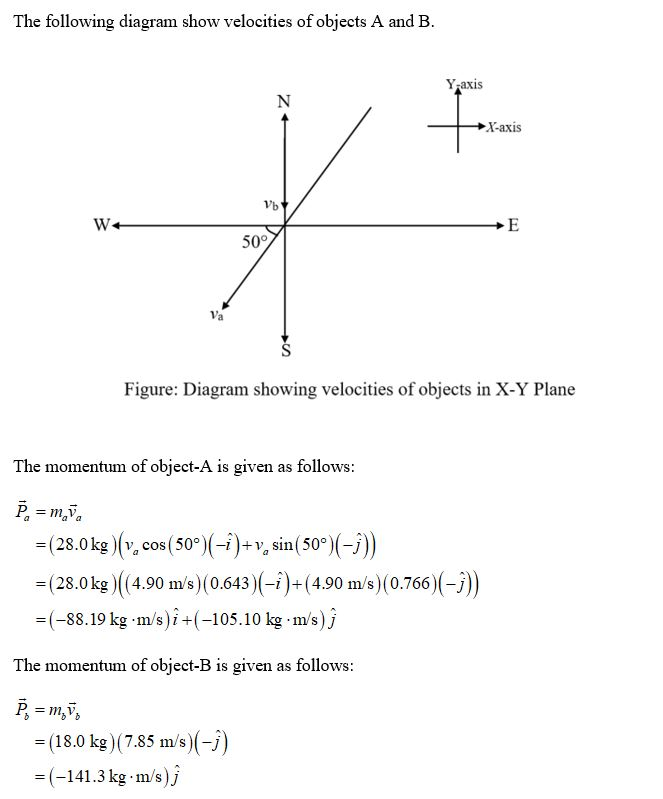
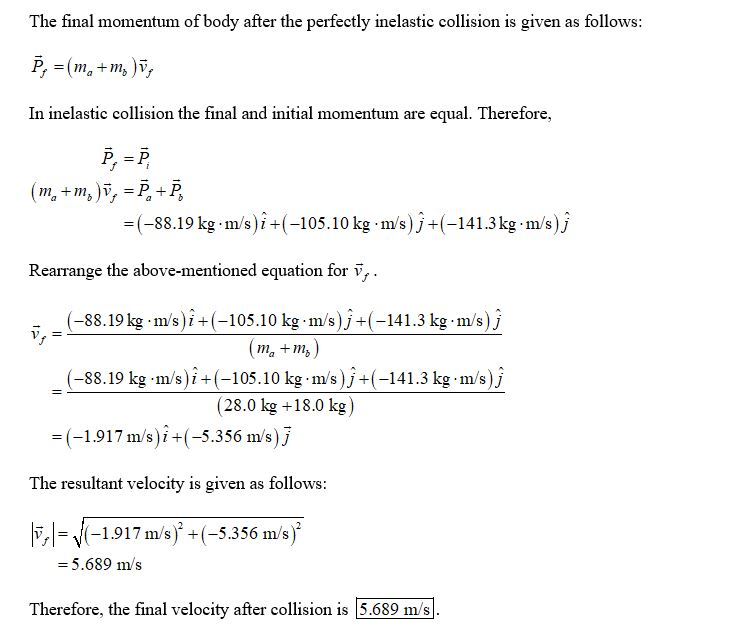
 genius_generous answered 1 month ago
Related Solutions
An object of mass m is moving in +x direction at u velocity and collides elastically...
An object of mass m is moving in +x direction at u velocity and
collides elastically with a stationery object in the x direction
having a mass M.
after the collision the object with mass m travels in +y
direction and the object with mass M travels in a direction with an
angle theeta to the
x axes. find the value of theeta?
A 15.0 kg object moving in the +x direction at 5.5 m/s collides head-on with a...
A 15.0 kg object moving in the +x direction at 5.5 m/s collides
head-on with a 11.5 kg object moving in the −x direction at 4.0 m/s
.
Part A-
Find the final velocity of each mass if the objects stick
together.
Express your answers using two significant figures. Enter your
answers numerically separated by a comma.
Part B-
Find the final velocity of each mass if the collision is
elastic.
Express your answers using two significant figures. Enter your...
8) 3 kg mass moving with 10 m/s in the x-direction hits a 5 kg mass...
8) 3 kg mass moving with 10 m/s in the x-direction hits a 5 kg
mass at rest. After the collision 3 kg is deflected by 30 degree
while the 5 kg is deflected by 45 degrees. a) Draw a diagram for
the initial and final motion including the directions of the
velocities b) Find the final velocities of each mass c) Determine
if the collision is elastic or not. d) Qualitatively, show the
direction of the impulse (or the...
A 3 kg object is moving along the +y+y direction with a speed of 4 m/s...
A 3 kg object is moving along the +y+y direction with a
speed of 4 m/s when it experiences an impulse of
5i^−8j^5i^−8j^ Ns. What is the object's speed
after the impulse is applied?
A charged particle of mass m = 7.3X10⁻⁸ kg, moving with constant velocity in the y-direction...
A charged particle of mass m = 7.3X10⁻⁸ kg, moving
with constant velocity in the y-direction enters a region
containing a constant magnetic field B = 1.8T aligned with the
positive z-axis as shown. The particle enters the region at (x,y) =
(0.5 m, 0) and leaves the region at (x,y) = 0, 0.5 m a time t = 463
μs after it entered the region.
1. With what speed v did the particle enter the region
containing the magnetic...
An object of mass 3.05 kg, moving with an initial velocity of 4.90 i hat m/s,...
An object of mass 3.05 kg, moving with an initial velocity of
4.90 i hat m/s, collides with and sticks to an object of mass 2.01
kg with an initial velocity of -3.62 j hat m/s. Find the final
velocity of the composite object.
v=(......i+.....j)
Consider a conical pendulum with a bob of mass m = 28.0 kg on a string...
Consider a conical pendulum with a bob of mass m = 28.0 kg on a
string of length L = 7.00 m that makes an angle of θ = 4.00° with
the vertical. a) Draw the direction of the acceleration of the ball
b) What force(s) cause this acceleration? c) Determine the
centripetal acceleration of the bob. d) Determine the speed of the
ball.
A puck with a mass m1 = 28.0 g moving at 1.00 m/s approaches a stationary...
A puck with a mass m1 = 28.0 g moving at 1.00 m/s approaches a
stationary puck with a mass m2 = 102 g on an air table and they
undergo a two-dimensional elastic collision. As a result of their
interaction, the incident puck moves away with a speed v1 = 0.785
m/s and the other puck moves away with a speed v2 in a different
direction. What is the angle between the velocities v1 and v2 ?
Explain please!!!
A ball of mass 0.440 kg moving east ( + x direction) with a speed of...
A ball of mass 0.440 kg moving east ( + x direction) with a
speed of 3.8 m/s collides head-on with a 0.220-kg ball at rest. If
the collision is perfectly elastic, what will be the speed and
direction of each ball after the collision?
A mass is moving at 10 m/s in the +x direction and it collides in a...
A mass is moving at 10 m/s in the +x direction and it collides
in a perfectly elastic collision with a mass of 4 kg moving in the
-x direction. The collision takes places in 0.22 seconds and after
the collision the mass that was moving in the +x direction is
moving in the -x direction at 8 m/s and the mass that was moving in
the -x direction is moving in the +x direction at 14 m/s. What is...
ADVERTISEMENT
ADVERTISEMENT
Latest Questions
- Metallic vanadium, V, can be obtained from its oxide from the reaction below. V2O5(s) + 5Ca(l)...
- Consider the following reaction A(aq) <=> 2B(aq) Kc= 9.07x10^-6 at 500K If a 4.90 M sample...
- (C++ program) Write and Design a Star Class definition. Attribute of a Star are : -...
- , you will be writing a simple calculator program that gets input from the user, does...
- Questions 28-35 are related to the following The following table is the regression summary output for...
- Solve the following programming problems using object-oriented programming in Java. Provide the problem code and screenshot...
- Recall that a conflict of interest scenario was presented to a sample of 219 marketing researchers...
ADVERTISEMENT