Question
In: Physics
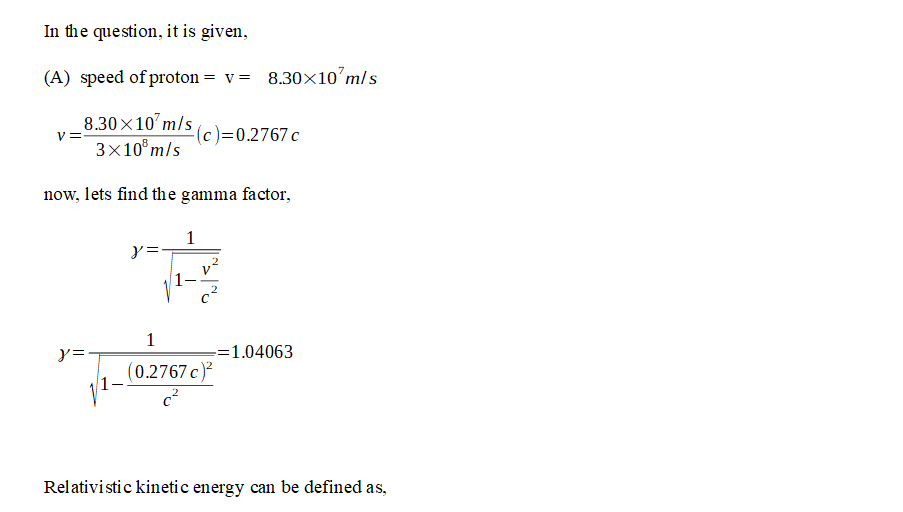
A) Calculate the kinetic energy of a proton (1.67×10⁻²⁷kg) traveling 8.30×10⁷ m/s . B) Calculate the...
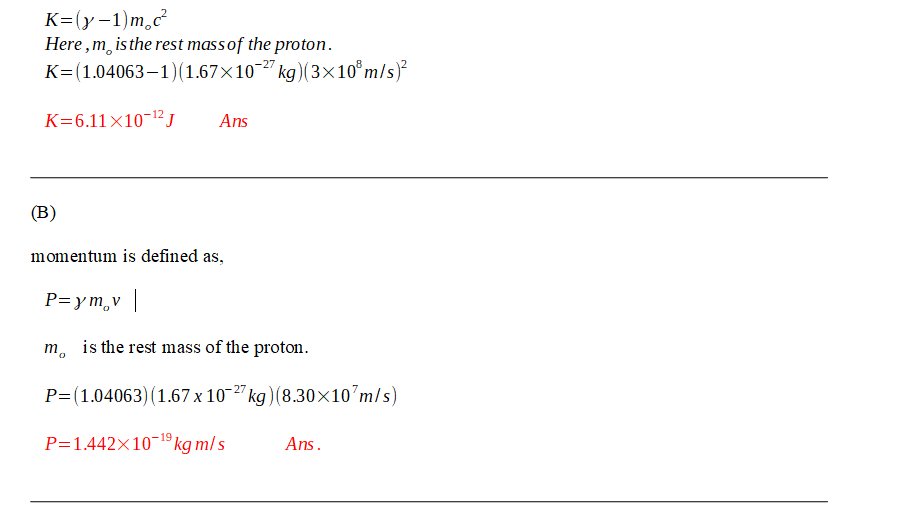
A) Calculate the kinetic energy of a proton (1.67×10⁻²⁷kg) traveling 8.30×10⁷ m/s .
B) Calculate the momentum of a proton (1.67×10⁻²⁷kg) traveling 8.30×10⁷ m/s .
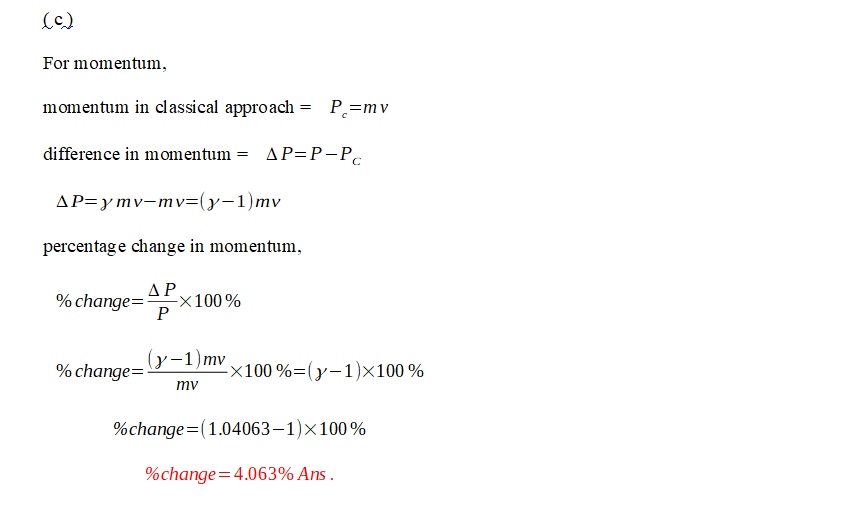
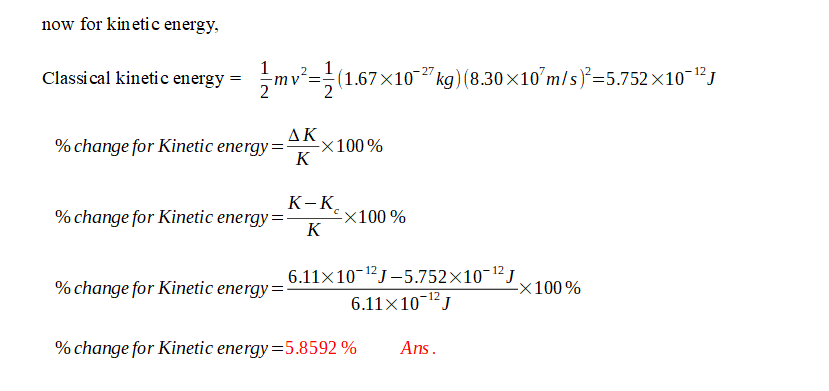
C) By what percentages would your calculations have been in error if you had used classical formulas?
Solutions
 genius_generous answered 2 months ago
Related Solutions
Calculate the speed (in m/s) of an electron and a proton with a kinetic energy of...
Calculate the speed (in m/s) of an electron and a proton with a
kinetic energy of 1.70 electron volt (eV). (The electron and proton
masses are me = 9.11 ✕ 10−31 kg and mp = 1.67 ✕ 10−27 kg.
Boltzmann's constant is kB = 1.38 ✕ 10−23 J/K.)
(a) an electron m/s
(b) a proton m/s
(c) Calculate the average translational kinetic energy in eV of
a 3.15 ✕ 102 K ideal gas particle. (Recall from Topic 10 that 1...
A proton is traveling with a speed of (4.010±0.018)× 10 5 m/s . Part A With...
A proton is traveling with a speed of (4.010±0.018)× 10 5 m/s
.
Part A
With what maximum precision can its position be ascertained?
Express your answer using two significant figures. ?x?
____ m
A proton is traveling horizontally to the right at 5.00×10⁶ m/s Part A, B: Find (a)the...
A proton is traveling horizontally to the right at
5.00×10⁶ m/s
Part A, B:
Find (a)the magnitude and (b) direction of the weakest electric
field that can bring the proton uniformly to rest over a distance
of 3.40 cm .
Part C:
How much time does it take the proton to stop after entering the
field?
Part D, E:
What minimum field ((a)magnitude and (b)direction) would be
needed to stop an electron under the conditions of part (a)?
Calculate the momentum p, kinetic energy K, and total energy E of an electron traveling at...
Calculate the momentum p, kinetic energy K,
and total energy E of an electron traveling at each of the
speeds tabulated below.
v
p (keV/c)
K (keV)
E (keV)
(a) 0.03c
(b) 0.4c
(c) 0.9c
A proton (mass m = 1.67 × 10⁻²⁷ kg) is being accelerated along a straight line...
A proton (mass m = 1.67 × 10⁻²⁷ kg) is being accelerated along a
straight line at 5.70 × 10¹² m/s2 in a machine. If the proton has
an initial speed of 5.30 × 10⁴ m/s and travels 3.90 cm, what then
is (a) its speed and (b) the increase in its kinetic energy
1. A cosmic ray proton moving toward the Earth at 5.5 × 10⁷ m/s experiences a...
1. A cosmic ray proton moving toward the Earth at 5.5 × 10⁷ m/s
experiences a magnetic force of 1.65 × 10⁻¹⁶ N .
What is the strength of the magnetic field if there is a 45º
angle between it and the proton’s velocity?
2. A 2.25 m segment of wire supplying current
to the motor of a submerged submarine carries 950 A and feels a 3.9
N repulsive force from a parallel wire 5.00 cm away.
What is the magnitude...
A proton is located at a distance of 0.049 m from a point charge of +8.30...
A proton is located at a distance of 0.049 m from a point charge
of +8.30 ?C. The repulsive electric force moves the proton until it
is at a distance of 0.16 m from the charge. Suppose that the
electric potential energy lost by the system were carried off by a
photon. What would be its wavelength?
A proton is traveling horizontally to the right at 4.80×10⁶ m/s . Part A Find (a)the...
A proton is traveling horizontally to the right at 4.80×10⁶ m/s
. Part A Find (a)the magnitude and (b) direction of the weakest
electric field that can bring the proton uniformly to rest over a
distance of 3.50 cm . E = N/C SubmitRequest Answer Part B θ = ∘
counterclockwise from the left direction SubmitRequest Answer Part
C How much time does it take the proton to stop after entering the
field? t = s SubmitRequest Answer Part D...
(A) A deuteron (one proton and one neutron) is traveling at 3 · 105 m/s. The...
(A) A deuteron (one proton and one neutron) is traveling at 3 ·
105 m/s.
The deuteron is in a uniform electric field which causes it to
come to a stop.
(a) How much work is done by the electric field (in Joules)?
(b) Draw a diagram showing the direction of the velocity of the
particle and the force on the particle. Include the direction of
the external electric field.
(c) Draw the same diagram for an electron with the...
A proton is traveling horizontally to the right at 4.70×10⁶ m/s . a. Find (a)the magnitude...
A proton is traveling horizontally to the right at 4.70×10⁶ m/s
. a. Find (a)the magnitude and (b) direction of the weakest
electric field that can bring the proton uniformly to rest over a
distance of 3.40 cm . b. θ = 0 ∘ counterclockwise from the left
direction c. How much time does it take the proton to stop after
entering the field? d. What minimum field ((a)magnitude and
(b)direction) would be needed to stop an electron under the...
ADVERTISEMENT
ADVERTISEMENT
Latest Questions
- Two 10-cm-diameter charged rings face each other, 15cm apart. The left ring is charged to -29nC...
- Under what conditions would it be possible for an excise tax to have no efficiency cost...
- explain the difference between activities and financial statements of service businesses and merchandising businesses.
- 2. Compare and compare the matrix multiplication algorithm and the Floyd-Warshall algorithm to find all pairs...
- Q: 50.00 ml of 0.5216 M copper(II) nitrate solution is combined with 100.0 ml of 0.5580...
- This is a business law question. Explain how environmental laws regulate the use of toxic substances...
- A sky diver and her parachute system weigh a total of 800 N. She is falling...
ADVERTISEMENT