Question
In: Computer Science
Q: Assistance in understanding and solving this example from Data Structure & Algorithms (Computer Science) with...
Q: Assistance in understanding and solving this example from Data Structure & Algorithms (Computer Science) with the steps of the solution to better understand, thanks.
##Using R studio language and code to use provided below, thanks.
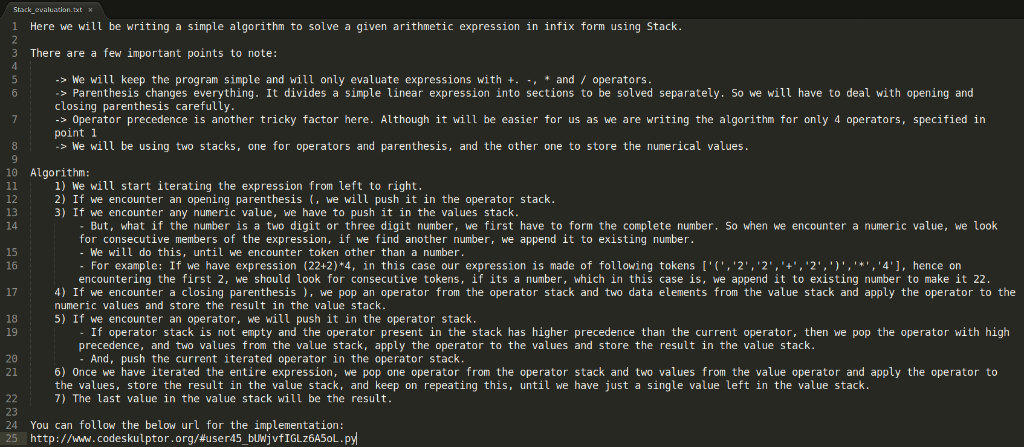
In this assignment, we will implement a function to evaluate an
arithmetic expression. You will use two stacks to keep track of
things. The function is named ‘evaluate’, it takes a string as
input parameter, and returns an integer. The input string
represents an arithmetic expression, with each character in the
string being a token, while the returned value should be the value
of the expression.
Examples:
• evaluate ('1+2*3') ➔ 7
• evaluate ('1*2+3') ➔ 5
##This is the code provided to use
"""Basic example of an adapter class to provide a stack interface to
Python's list."""
class ArrayStack:
"""LIFO Stack implementation using a Python list as underlying
storage."""
def __init__ (self):
"""Create an empty stack."""
self._data = [] # nonpublic list instance
def __len__ (self):
"""Return the number of elements in the stack."""
return len (self._data)
def is_empty (self):
"""Return True if the stack is empty."""
return len (self._data) == 0
def push (self, e):
"""Add element e to the top of the stack."""
self._data.append (e) # new item stored at end of
list
def top (self):
"""Return (but do not remove) the element at the top of the stack.
Raise Empty exception if the stack is empty.
"""
if self.is_empty ():
raise Empty ('Stack is empty')
return self._data [-1] # the last item in the list
def pop (self):
"""Remove and return the element from the top of the stack (i.e.,
LIFO).
Raise Empty exception if the stack is empty.
"""
if self.is_empty ():
raise Empty ('Stack is empty')
return self._data.pop () # remove last item from list
class Empty (Exception):
"""Error attempting to access an element from an empty container."""
pass
if __name__ == '__main__':
S = ArrayStack () # contents: [ ]
S.push (5) # contents: [5]
S.push (3) # contents: [5, 3]
print (len (S)) # contents: [5, 3]; outputs 2
print (S.pop ()) # contents: [5]; outputs 3
print (S.is_empty ()) # contents: [5]; outputs False
print (S.pop ()) # contents: [ ]; outputs 5
print (S.is_empty ()) # contents: [ ]; outputs True
S.push (7) # contents: [7]
S.push (9) # contents: [7, 9]
print (S.top ()) # contents: [7, 9]; outputs 9
S.push (4) # contents: [7, 9, 4]
print (len (S)) # contents: [7, 9, 4]; outputs 3
print (S.pop ()) # contents: [7, 9]; outputs 4
S.push (6) # contents: [7, 9, 6]
S.push (8) # contents: [7, 9, 6, 8]
print (S.pop ()) # contents: [7, 9, 6]; outputs 8
Solutions
 venereology answered 3 months ago
Related Solutions
Q: Asking for assistance in understanding and solving this example on Modern Algebra II with the...
Computer Science: Data Structures and Algorithms Practice: Construct a C++ program that takes two SQUARE matrices,...
Q: Assistance to understand clearly and solve this example from Probability and Statistical Inference with the...
Thoroughly explain the impacts of data structures and algorithms in the development and implementation of computer...
4. Gradient descent. Gradient descent is one of the most popular algorithms in data science and...
WRITE USING C++ CODE, TOPIC :Analysis of Algorithms Computer Science. PLEASE DONT FORGET RUNNING TIME In...
WRITE USING C++ CODE, TOPIC :Analysis of Algorithms Computer Science. PLEASE DONT FORGET RUNNING TIME In...
WRITE USING C++ CODE, TOPIC :Analysis of Algorithms Computer Science. PLEASE DONT FORGET RUNNING TIME In...
Describe different types of data structures in Computer Science with examples.
Using classes and array data structure write methods with algorithms for a software that an airline...
- mr. smith completed 9 years of fixed monthly payments of 3,333.28 on a 30 year loan...
- during the experiment, a student did not follow the procedure exactly as directed how will eact...
- Assume all temperatures to be exact, and neglect significant figures for small changes in dimension. When...
- why is Argentina a developing country ?
- Calculate the enthalpy of the reaction 4B(s)+3O2(g)?2B2O3(s) given the following pertinent information: B2O3(s)+3H2O(g)?3O2(g)+B2H6(g), ?H?A=+2035 kJ 2B(s)+3H2(g)?B2H6(g),  
- Do you think that CAFTA will have a major impact on the U.S. economy? Why?
- Assignment 4, Fraction Comparable Instructions For this assignment, you will be updating the Fraction class from...