Question
In: Physics
Suppose that in the same Atwood setup another string is attached to the bottom of m1...
Suppose that in the same Atwood setup another string is attached to the bottom of m1 and a constant force f is applied, retarding the upward motion of m1. If m1 = 5.70 kg and m2 = 11.40 kg, what value of f will reduce the acceleration of the system by 50%?
Solutions
Expert Solution
I have solved this question earlier with different figures. Please workout using yours figures. If you need any further help just PM me. If I have helped you please rate me 5 stars first (before you rate anyone else).
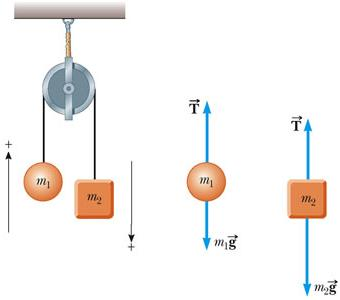
Suppose that another string is attached to the bottom of
m1 and a constant force f is applied, retarding
the upward motion of m1. If m1 = 6.75 kg and
m2 = 11.25 kg, what value of f will reduce the
acceleration of the system by 55%?
From Newtons' laws
m1a = T - m1g
and
m2a = m2g - T
Then
m1a = m2g - m2a - m1g
then acceleration
(m1 + m2 ) a = m2 g -m1g
a = (m2 - m1)g / m1 + m2
= (11.25 - 6.75) 9.8 / 11.25+6.75
= 2.45m/s^2
when the acceleration becomes a = 0.55a = 1.35m/s^2
m1a = T - m1g - f
and
m2a = m2g - T
T = m2g - m2a
then
m1a = m2g - m2a - m1g - f
(m1 + m2)a = (m2 - m1)g - f
therefore the applied force
f = (m2 - m1)g - (m1 + m2)a
= (11.25 - 6.75) (9.8) - ( 11.25 + 6.75) (1.35)
= 19.8 N
m1a = T - m1g
and
m2a = m2g - T
Then
m1a = m2g - m2a - m1g
then acceleration
(m1 + m2 ) a = m2 g -m1g
a = (m2 - m1)g / m1 + m2
= (11.25 - 6.75) 9.8 / 11.25+6.75
= 2.45m/s^2
when the acceleration becomes a = 0.55a = 1.35m/s^2
m1a = T - m1g - f
and
m2a = m2g - T
T = m2g - m2a
then
m1a = m2g - m2a - m1g - f
(m1 + m2)a = (m2 - m1)g - f
therefore the applied force
f = (m2 - m1)g - (m1 + m2)a
= (11.25 - 6.75) (9.8) - ( 11.25 + 6.75) (1.35)
= 19.8 N
 genius_generous answered 3 months ago
Related Solutions
A mass m1 on a horizontal shelf is attached by a thin string that passes over...
A mass m1 on a horizontal shelf is attached by a thin string
that passes over a frictionless pulley to a 2.4 kg mass (m2) that
hangs over the side of the shelf 1.2 m above the ground. The system
is released from rest at t = 0 and the 2.4 kg mass strikes the
ground at t = 0.86 s. The system is now placed in its initial
position and a 1.2 kg mass is placed on top of...
Suppose a 1 kg mass is attached to the end of a string that is stretched...
Suppose a 1 kg mass is attached to the end of a string that is
stretched 0.2 m by a force of 500 N (newtons). An exterior force F0
cos 50t acts on the mass. Find the position function x(t) if the
initial conditions are given by x(0) = 0, x′(0) = 50.
an atwood machine has a mass of 3.50kg connected by a light string to a mass...
an atwood machine has a mass of 3.50kg connected by a light
string to a mass of 6kg over a pulley with a moment of interia of
0.0352 kg m2 and a radius of 12.5 cm . if the system is released
from rest, what is the masses after they have moved through
1.25m?
(a)One end of a string is attached to a wall and the other end is attached...
(a)One end of a string is attached to a wall and the
other end is attached to a mass sitting on a ramp tilted at an
angle of 35 degrees. It takes a pulse 10 ms to travel the length of
the 1 m string. The string has a mass 1.5 g. What is the mass that
is attached to the string?
(b) The string is replaced by two strings that are
knotted together, L1 has a length 60...
Suppose that two blocks are positioned on an Atwood machine so that the block on the...
Suppose that two blocks are positioned on an Atwood machine so
that the block on the right of mass m1 hangs at a lower elevation
than the block on the left of mass m2. Both blocks are at rest.
Based on this observation, what can you conclude? A) m1>m2 B)
m1<m2 C) m1=m2 D) You cannot conclude anything with the given
information.
An object is attached to the bottom of a glass plate with index of refraction 1.5....
An object is attached to the bottom of a glass plate with index
of refraction 1.5. Three light rays (a, b, c) emanating from the
object are shown; they make angles of 0o (a), 30o (b), and 60o (c)
with the normal. An air-filled gap separates the glass plate from
the front lens of an optical instrument that is used to view the
object. The lens is also made of glass with index of refraction 1.5
We are interested in...
A mass; m1 = 64 g, sits on a frictionless horizontal surface, and is attached to...
A mass; m1 = 64 g, sits on a frictionless horizontal surface,
and is attached to a spring of spring constant k = 51 N/m. The
other end of the horizontal spring is attached to a wall; the
system is in equilibrium. Another mass; m2 = 18 g, strikes the
stationary mass m1, and sticks to it. As a result, the spring is
compressed by a distance of 24.5 cm before the masses come to a
momentary stop.
a) How...
An object with m1 = 5kg is attached to a spring of negligible mass. This mass/spring...
An object with m1 = 5kg is attached to a spring of
negligible mass. This mass/spring combination is then slid
horizontally on a frictionless surface with a velocity of 5m/s
towards a stationary object with m2 = 6kg. Upon impact,
the spring compresses, then we examine two cases. First, find the
velocities of the two objects assuming the spring completely
relaxes again after the interaction. Second, assume that
m2, after they separate, slides up a frictionless
incline.
(a) What is...
SEE ATTACHED IMAGE AT BOTTOM -------- Sale of Equipment Equipment was acquired at the beginning of...
SEE ATTACHED IMAGE AT BOTTOM
--------
Sale of Equipment
Equipment was acquired at the beginning of the year at a cost of
$637,500. The equipment was depreciated using the straight-line
method based on an estimated useful life of 9 years and an
estimated residual value of $43,305.
a. What was the depreciation for the first
year? Round your answer to the nearest cent.
$
b. Using the rounded amount from Part a in your
computation, determine the gain(loss) on the...
A ball is attached to a string and swung in a horizontal circle at a constant...
A ball is attached to a string and swung in a horizontal circle
at a constant speed. Assume air resistance is negligible. If the
string tripled in length but the speed of the ball remained the
same, show mathematically how the inward force on the ball would
change.
ADVERTISEMENT
ADVERTISEMENT
Latest Questions
- Python previous function: wrtie a function that takes one argument. The function returns True if the...
- A professional couple wishes to purchase a new home costing $750,000, make a 20 percent down...
- Padre holds 100 percent of the outstanding shares of Sonora. On January 1, 2016, Padre transferred...
- Question: Use backtracking algorithm design to write Java code to solve the subset problem: given a...
- Patsy Ltd. produces ice-cream and would like to accurately forecast sales so that it can meet...
- Power Music owns five music stores, where it sells music, instruments, and supplies. In addition, it...
- 4) A client wants to finance the purchase of a house costing $50,000 over a period...
ADVERTISEMENT