Question
In: Physics
When the three blocks in the figure below are released from rest, they accelerate with a...
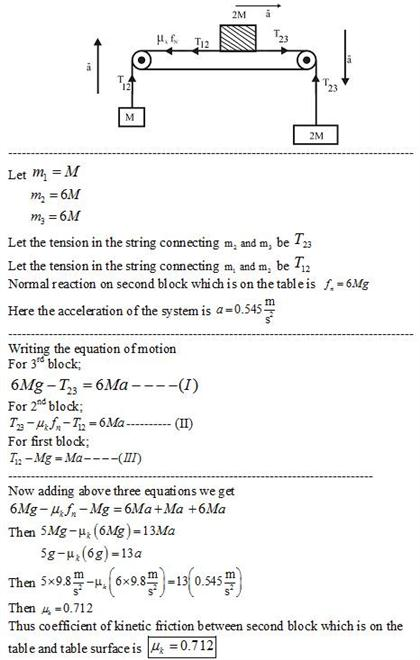
When the three blocks in the figure below are released from rest, they accelerate with a magnitude of 0.680 m/s2. Block 1 has mass M, block 2 has 3M, and block 3 has 3M. What is the coefficient of kinetic friction between block 2 and the table?
Solutions
Expert Solution
Here is what I solved before, please modify the figures as per your question. Please let me know if you have further questions. Ifthis helps then kindly rate 5-stars.
When the three blocks in the figure below are released from rest, they accelerate with a magnitude of 0.545 m/s2. Block 1 has mass M, block 2 has 6M, and block 3 has 6M. What is the coefficient of kinetic friction between block 2 and the table?
answer
 genius_generous answered 4 months ago
Related Solutions
1)When the three blocks below are released from rest, they accelerate with a magnitude of 0.500m/s2....
1)When the three blocks below are released from rest, they
accelerate with a magnitude of 0.500m/s2. Block 1 has mass M, block
2 has 2M, and block 3 has 2M. What is the coefficient of kinetic
friction
2)A block of mass m is held stationary on a ramp by the
frictional force on it from the ramp. A force ?,directed up the
ramp, is then applied to the block and gradually increased in
magnitude from zero. During the increase, what...
As shown in the figure below, two blocks (m1 and m2) are each released from rest...
As shown in the figure below, two blocks (m1
and m2) are each released from rest at a height
of
h = 4.68 m
on a frictionless track and when they meet on the horizontal
section of the track they undergo an elastic collision. If
m1 = 2.50 kg
and
m2 = 4.05 kg,
determine the maximum heights to which they rise after the
collision. Use the coordinate system shown in the figure.
y1f
=
m
y2f
=
m.
A 15.0 kg block is released from rest at point A in the figure below. The...
A 15.0 kg block is released from rest at point A in the figure
below. The track is frictionless except for the portion between
points B and C, which has a length of 6.00 m. The block travels
down the track, hits a spring of force constant 2,300 N/m, and
compresses the spring 0.200 m from its equilibrium position before
coming to rest momentarily. Determine the coefficient of kinetic
friction between the block and the rough surface between points B...
1.) In the figure, a block of mass m = 13 kg is released from rest...
1.) In the figure, a block of mass m = 13 kg is
released from rest on a frictionless incline of angle θ =
30°. Below the block is a spring that can be compressed 3.7 cm by a
force of 210 N. The block momentarily stops when it compresses the
spring by 6.0 cm. (a) How far does the block move
down the incline from its rest position to this stopping point?
(b) What is the speed of the...
Two blocks of masses m1= 2.00 kgand m2= 4.10 kg are released from rest at a...
Two
blocks of masses m1= 2.00 kgand m2= 4.10 kg are released from rest
at a height of h= 4.40 m on a frictionless track. When they meet on
the level portion of the track, they undergo a head-on, elastic
collision. Determine the maximum heights to which m1 and m2 rise on
the curved portion of the track after the collision.
The figure shows a 100-kg block being released from rest from a height of 1.0 m.
The figure shows a 100-kg block being released from rest from a height of 1.0 m. It then takes it 0.90 s to reach the floor. What is the mass of the other block? The pulley has no appreciable mass or friction.
A. 60 kg
B. 48 kg
C. 54 kg
D. 42 kg
The figure shows a 100 - kg block being released from rest from a height of 1.0 m. It then takes it 0.90 s to reach...
A system of two blocks connected by a light rope is released from rest with the 12.0 kg block 2.00 m above the floor as shown below.
A system of two blocks connected by a light rope is released from rest with the 12.0 kg block 2.00 m above the floor as shown below. Ignore friction and mass of the pulley. (a) Find the speed with which the 12.0 kg block strikes the floor; (b) How high will the 4.0 kg block travel upward with respect to the floor?
Collision derivation problem. A car is released from rest on a frictionless inclined plane (Figure 5.3)....
Collision derivation problem. A car is released from rest on a
frictionless inclined plane (Figure 5.3). EXAMPLES: Calculate the
momentum pi at the end of the plane in terms of the measured
quantities x, y, L, and m. Assume is very small so that h/L is
approximately equal to y/x. (Hint: use conservation of energy and
the fact that K=1 2mv2=p2 2m.)
[Answer: .]
If a car suffers a nearly elastic collision it will coast back up
the ramp a...
A pendulum 2.20 m long is released (from rest) at an angle ?0=30.0?. (Figure 1) Part...
A pendulum 2.20 m long is released (from rest) at an angle
?0=30.0?. (Figure 1)
Part A
Determine the speed of the 50.0 g bob at the lowest point
(?=0).
Express your answer with the appropriate units.
?1 =
SubmitRequest Answer
Part B
Determine the speed of the 50.0 g bob at ?=15.0?.
Express your answer with the appropriate units.
?2 =
SubmitRequest Answer
Part C
Determine the speed of the 50.0 g bob at ?=?15.0?
(i.e., on the opposite...
A proton and an alpha particle are released from rest when they are 0.210 nm apart....
A proton and an alpha particle are released from rest when they
are 0.210 nm apart. The alpha particle (a helium nucleus) has
essentially four times the mass and two times the charge of a
proton.
Find the maximum speed of proton.
Find the maximum speed of alpha particle.
Find the maximum acceleration of proton.
Find the maximum acceleration of alpha particle.
ADVERTISEMENT
ADVERTISEMENT
Latest Questions
- Problem 18-12 Various shareholders' equity topics; comprehensive [LO18-1, 18-4, 18-5, 18-6, 18-7, 18-8] Part A In...
- Hello There, This is discussion Question For Advanced Database Systems Question: (a) Please define what a...
- Physicians at a clinic gave what they thought were drugs to 860860 patients. Although the doctors...
- On January 1, 2018, bonds with a face value of $ 79,000 were sold. The bonds...
- How do I make this sort in true alphabetical order instead of ascii(ABCabc) order? I am...
- As a healthcare provider in physical therapy, athletic training, or as an exercise scientist and personal...
- in the market for makeup artists, what happens after the invention of high-definition tv allowing viewers...
ADVERTISEMENT