Question
In: Math
When would you use FPC? Please list an example. Remember, if we have a large, but...
When would you use FPC? Please list an example.
Remember, if we have a large, but finite population and we are taking a small sample of it, we need to use the FPC.
For example: let's say 1,000 students took this class in the last 3 years in all ways, i.e. on-line, in a traditional classroom during a normal semester, and during the summer terms. Let's say that since Finance majors have a lot more math in many of their courses, I would expect them to have higher grades. Let's say that there were 100 Finance majors that took the course. Should I use the FPC? Yes. The sample is small relative to the population.
Can you think of an example?
Solutions
Expert Solution
The Finite Population Correction Factor (FPC) is used when you sample without replacement from more than 5% of a finite population. It’s needed because under these circumstances, the Central Limit Theorem doesn’t hold and the standard error of the estimate (e.g. the mean or proportion) will be too big. In basic terms, the FPC captures the difference between sampling with replacement and sampling without replacement.
Most real-life surveys involve finite populations sampled without replacement. For example, you might perform a telephone survey of 10,000 people; once a person has been called, they won’t be called again
A downside of using the FPC is that it can cause uncertainty when applying the results to a larger population, so you should be careful when making inferences.
The general formula is:
FPC = ((N-n)/(N-1))1/2
- N = population size,
- n = sample size.
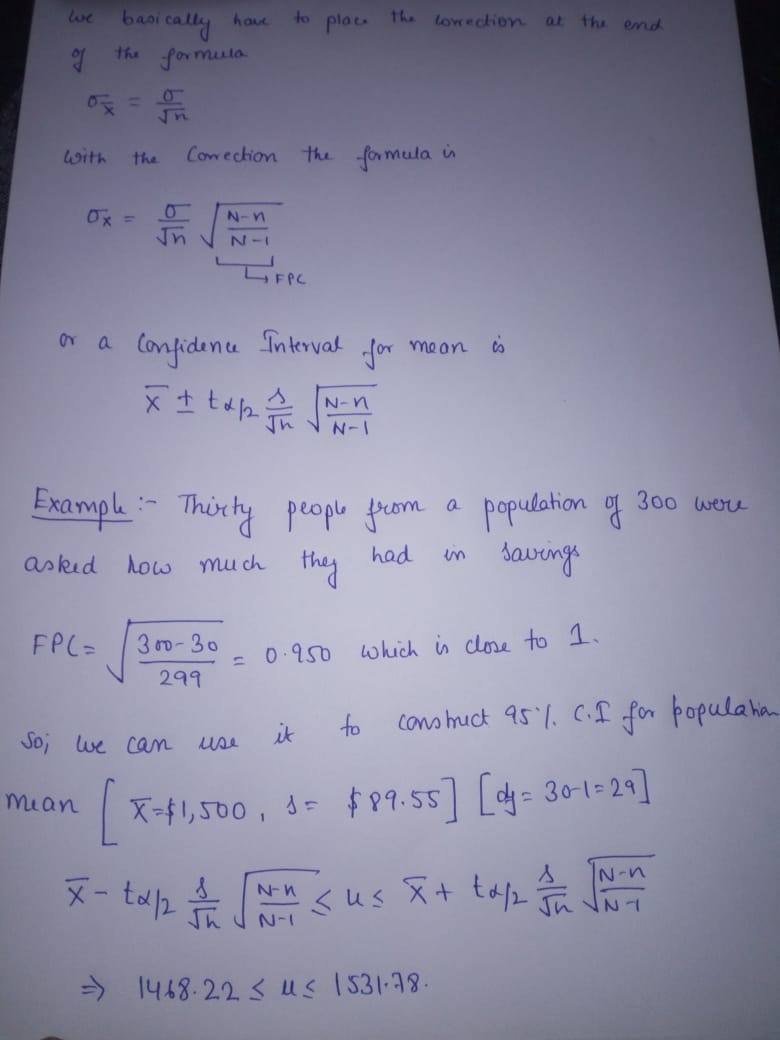
If the calculated value for the FPC is close to 1, it can be ignored. As the sample size falls under 5%, the value becomes somewhat insignificant (an FPC is .998 for a sample of 50).
 milcah answered 3 months ago
Related Solutions
Please use an example to explain when we should use the test. The example should specify...
Provide an example of when you would use modifier TC
For acid woke up, when do we use H2O or H3O+. Please give example. Thank you.
Please remember to choose the ethical provision you believe would address the issue and remember your...
give an example when you would use both experimental and correlational study?
Please use Isoquant-isocost graph to explain. Thank You! remember: isoquant curve would not change, just need...
Remember a few months ago when I mentioned that we would really like to open another...
Provide an example of how a business you know (large or small) would have benefited from...
- Recall a recent argument or misunderstanding you have had about memory (for example, you remember...
What is an example of when you would use a template? Name at least three benefits...
- Use the internet to read more about journaling file systems such as NTFS, extfs2, and extfs3....
- Consider the quick sort algorithm. The quick sort algorithm is a divide and conquer approach which...
- Tesla 1. How to make these weaknesses into strengths? Burn through cash, high prices, bottlenecking/product delays,...
- Assignment # 12: Email Presentation Learning Objectives and Outcomes Design a PowerPoint presentation appropriate for middle...
- Identify which of the perspectives you believe is the BEST for accurately explaining human behavior and...
- What trade policies should a country adopt? why? Explain. Also, find some reference materials on this...
- In Java: Suppose you want to implement a Sudoku game that consists of 9x9 rows and...