Question

In: Math

In this problem, assume that the distribution of differences is approximately normal. Note: For degrees of...

In this problem, assume that the distribution of differences is approximately normal. Note: For degrees of freedom d.f. not in the Student's t table, use the closest d.f. that is smaller. In some situations, this choice of d.f. may increase the P-value by a small amount and therefore produce a slightly more "conservative" answer. In the following data pairs, A represents birth rate and B represents death rate per 1000 resident population. The data are paired by counties in the Midwest. A random sample of 16 counties gave the following information. A: 11.6 12.4 12.8 13.0 13.4 12.0 14.2 15.1 B: 11.1 12.7 12.7 11.1 13.9 13.1 10.9 10.0 A: 12.5 12.3 13.1 15.8 10.3 12.7 11.1 15.7 B: 14.1 13.6 9.1 10.2 17.9 11.8 7.0 9.2 Do the data indicate a difference (either way) between population average birth rate and death rate in this region? Use α = 0.01. (Let d = A − B.)

What is the value of the sample test statistic? (Round your answer to three decimal places.)

(c) Find (or estimate) the P-value. (Round your answer to four decimal places.)

Solutions

Expert Solution

Solution :

for the analysis we have to use t- test for calculating difference between two sample mean i.e birth rate and death rate

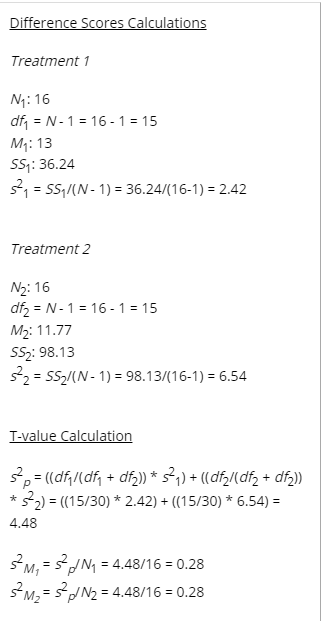
for calculation we take A = birth rate = Treatment 1 and B = deat rate = Treatment 2 now we do the following calculation  for t- test
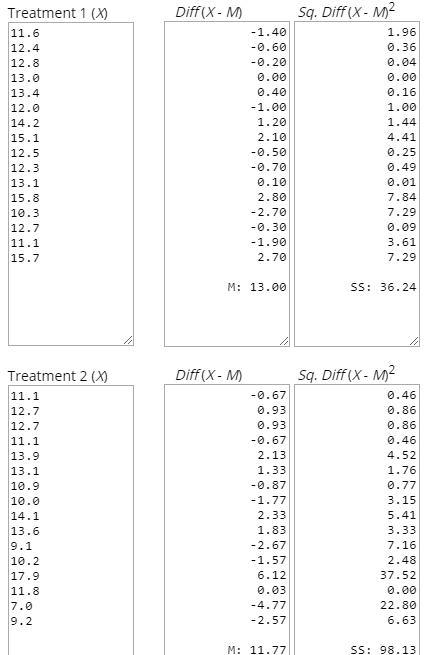
therefore t = 1.637

and p-value is 0.1120

hence we say that the p-value is not less than 0.01

therefore using p-value we sat that tha average of two sample is not same i.e average for birth rate and death rate is different

Thank you..!!

please like it ..


Related Solutions

In this problem, assume that the distribution of differences is approximately normal. Note: For degrees of...
In this problem, assume that the distribution of differences is approximately normal. Note: For degrees of freedom d.f. not in the Student's t table, use the closest d.f. that is smaller. In some situations, this choice of d.f. may increase the P-value by a small amount and therefore produce a slightly more "conservative" answer. Are America's top chief executive officers (CEOs) really worth all that money? One way to answer this question is to look at row B, the annual...
In this problem, assume that the distribution of differences is approximately normal. Note: For degrees of...
In this problem, assume that the distribution of differences is approximately normal. Note: For degrees of freedom d.f. not in the Student's t table, use the closest d.f. that is smaller. In some situations, this choice of d.f. may increase the P-value by a small amount and therefore produce a slightly more "conservative" answer. In the following data pairs, A represents the cost of living index for utilities and B represents the cost of living index for transportation. The data...
In this problem, assume that the distribution of differences is approximately normal. Note: For degrees of...
In this problem, assume that the distribution of differences is approximately normal. Note: For degrees of freedom d.f. not in the Student's t table, use the closest d.f. that is smaller. In some situations, this choice of d.f. may increase the P-value by a small amount and therefore produce a slightly more "conservative" answer. Are America's top chief executive officers (CEOs) really worth all that money? One way to answer this question is to look at row B, the annual...
In this problem, assume that the distribution of differences is approximately normal. Note: For degrees of...
In this problem, assume that the distribution of differences is approximately normal. Note: For degrees of freedom d.f. not in the Student's t table, use the closest d.f. that is smaller. In some situations, this choice of d.f. may increase the P-value by a small amount and therefore produce a slightly more "conservative" answer. In environmental studies, sex ratios are of great importance. Wolf society, packs, and ecology have been studied extensively at different locations in the U.S. and foreign...
In this problem, assume that the distribution of differences is approximately normal. Note: For degrees of...
In this problem, assume that the distribution of differences is approximately normal. Note: For degrees of freedom d.f. not in the Student's t table, use the closest d.f. that is smaller. In some situations, this choice of d.f. may increase the P-value by a small amount and therefore produce a slightly more "conservative" answer. Are America's top chief executive officers (CEOs) really worth all that money? One way to answer this question is to look at row B, the annual...
In this problem, assume that the distribution of differences is approximately normal. Note: For degrees of...
In this problem, assume that the distribution of differences is approximately normal. Note: For degrees of freedom d.f. not in the Student's t table, use the closest d.f. that is smaller. In some situations, this choice of d.f. may increase the P-value by a small amount and therefore produce a slightly more "conservative" answer. Are America's top chief executive officers (CEOs) really worth all that money? One way to answer this question is to look at row B, the annual...
In this problem, assume that the distribution of differences is approximately normal. Note: For degrees of...
In this problem, assume that the distribution of differences is approximately normal. Note: For degrees of freedom d.f. not in the Student's t table, use the closest d.f. that is smaller. In some situations, this choice of d.f. may increase the P-value by a small amount and therefore produce a slightly more "conservative" answer. Are America's top chief executive officers (CEOs) really worth all that money? One way to answer this question is to look at row B, the annual...
In this problem, assume that the distribution of differences is approximately normal. Note: For degrees of...
In this problem, assume that the distribution of differences is approximately normal. Note: For degrees of freedom d.f. not in the Student's t table, use the closest d.f. that is smaller. In some situations, this choice of d.f. may increase the P-value by a small amount and therefore produce a slightly more "conservative" answer. Are America's top chief executive officers (CEOs) really worth all that money? One way to answer this question is to look at row B, the annual...
In this problem, assume that the distribution of differences is approximately normal. Note: For degrees of...
In this problem, assume that the distribution of differences is approximately normal. Note: For degrees of freedom d.f. not in the Student's t table, use the closest d.f. that is smaller. In some situations, this choice of d.f. may increase the P-value by a small amount and therefore produce a slightly more "conservative" answer. In an effort to determine if rats perform certain tasks more quickly if offered larger rewards, the following experiment was performed. On day 1, a group...
In this problem, assume that the distribution of differences is approximately normal. Note: For degrees of...
In this problem, assume that the distribution of differences is approximately normal. Note: For degrees of freedom d.f. not in the Student's t table, use the closest d.f. that is smaller. In some situations, this choice of d.f. may increase the P-value by a small amount and therefore produce a slightly more "conservative" answer. Are America's top chief executive officers (CEOs) really worth all that money? One way to answer this question is to look at row B, the annual...
ADVERTISEMENT
ADVERTISEMENT
ADVERTISEMENT