Question
In: Computer Science
Byzantine Generals Problem and Solutions Based on the proposed solutions use any code you want to...
Byzantine Generals Problem and Solutions
Based on the proposed solutions use any code you want to demonstrate one of the solutions.
Include documentation describing your code
include comments in your code describing each step
Solutions
Expert Solution
Python code screenshot
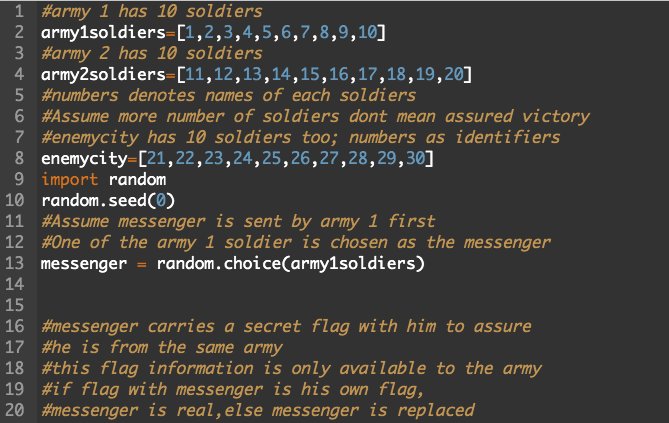
#army 1 has 10 soldiers
army1soldiers=[1,2,3,4,5,6,7,8,9,10]
#army 2 has 10 soldiers
army2soldiers=[11,12,13,14,15,16,17,18,19,20]
#numbers denotes names of each soldiers
#Assume more number of soldiers dont mean assured victory
#enemycity has 10 soldiers too; numbers as identifiers
enemycity=[21,22,23,24,25,26,27,28,29,30]
import random
random.seed(0)
#Assume messenger is sent by army 1 first
#One of the army 1 soldier is chosen as the messenger
messenger = random.choice(army1soldiers)
#messenger carries a secret flag with him to assure
#he is from the same army
#this flag information is only available to the army
#if flag with messenger is his own flag,
#messenger is real,else messenger is replaced
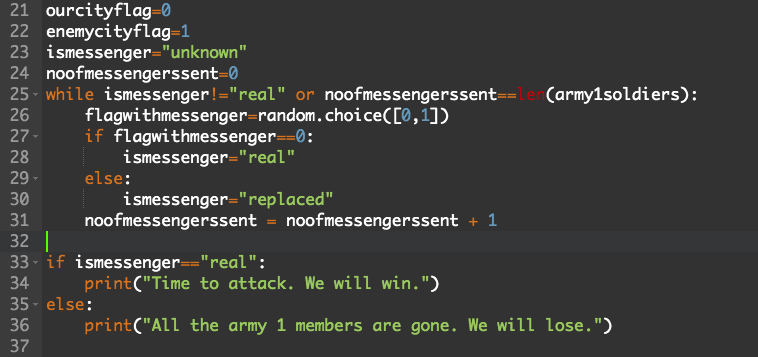
ourcityflag=0
enemycityflag=1
ismessenger="unknown"
noofmessengerssent=0
while ismessenger!="real" or
noofmessengerssent==len(army1soldiers):
flagwithmessenger=random.choice([0,1])
if flagwithmessenger==0:
ismessenger="real"
else:
ismessenger="replaced"
noofmessengerssent = noofmessengerssent + 1
if ismessenger=="real":
print("Time to attack. We will win.")
else:
print("All the army 1 members are gone. We will lose.")
Side note
If we simulate this solution to the 2 generals problem, the probability of the army to win are very high.
But 100% guarantee to winning cannot be assured with this solution.
 venereology answered 5 months ago
Related Solutions
You cna hand write this if you want, Please code this in C Thank you PROBLEM...
PLEASE DO IN C++ AND USE REPL TO WRITE CODE The following problem statement is based...
PART 1 You will want to solve this problem as a Punnett square and use that...
Write the pseudo code for this problem based on what you learned from the video. The...
I want the code in the following three PHP files without any CSS. Thank you Create...
HI.... just I want the <tags> of this scenario .... Scenario-based Problem: You are assigned to...
You want to study ribosomes in plant cells and plan to use a protocol based on...
(In C) Note: Can you create an example code of these tasks. use any variables you...
Problem 4 ..... you can use Matlab Using the same initial code fragment as in Problem...
Directions: Below you will find a series of proposed solutions to problems. For each one, you...
- Two 10-cm-diameter charged rings face each other, 15cm apart. The left ring is charged to -29nC...
- Under what conditions would it be possible for an excise tax to have no efficiency cost...
- explain the difference between activities and financial statements of service businesses and merchandising businesses.
- 2. Compare and compare the matrix multiplication algorithm and the Floyd-Warshall algorithm to find all pairs...
- Q: 50.00 ml of 0.5216 M copper(II) nitrate solution is combined with 100.0 ml of 0.5580...
- This is a business law question. Explain how environmental laws regulate the use of toxic substances...
- A sky diver and her parachute system weigh a total of 800 N. She is falling...