Question
In: Economics
Consider the following: C= 116 + 0.8 (Y - T) - 1000r I= 140 - 2000r...
Consider the following: C= 116 + 0.8 (Y - T) - 1000r
I= 140 - 2000r G= 165 T= 30 + 0.25Y
EX= 100; IM= 110 + 0.2Y
L= 5Y - 100000r M= 60000 P= 100 rrr= 0.2
IS: Y = 1/0.6 (387 - 3000r) Y = 645 - 5000r
LM: Y = 1/5 (600 + 100000r) Y = 120 + 20000r
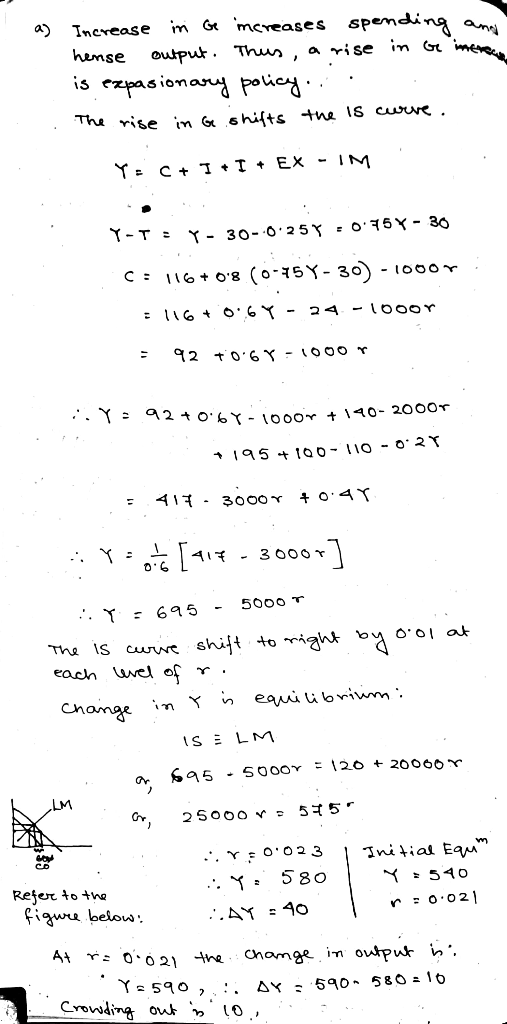
a) If G increases by 30, is it an expansionary, or a contractionary (pick one) fiscal policy? By how much does the IS and LM curves shift and by how much does Y change?
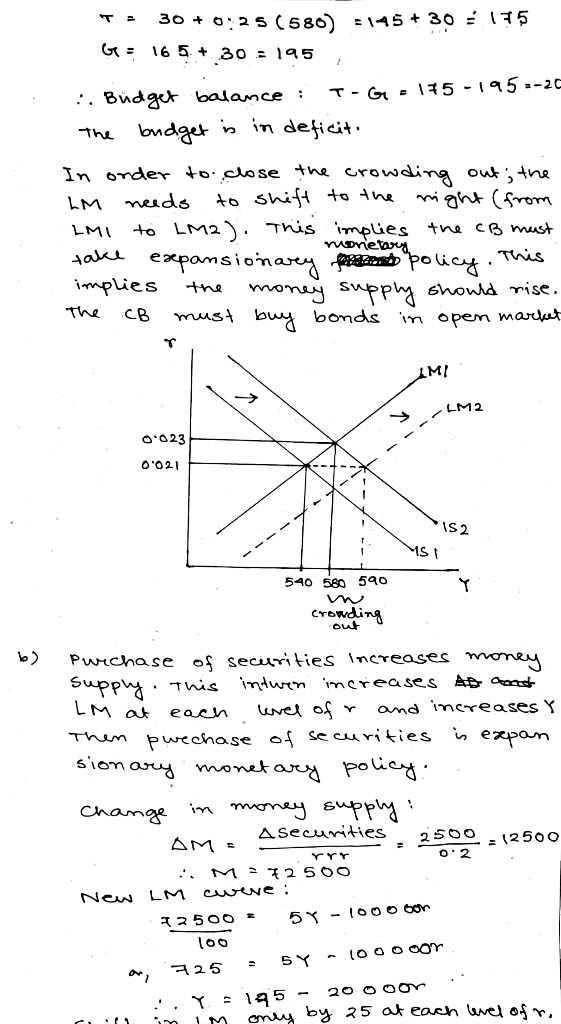
How much is the crowding out effect? Is the budget balanced? If Fed monetizes the additional budget deficit to eliminate crowding out, do they need to buy bonds, or sell bonds?
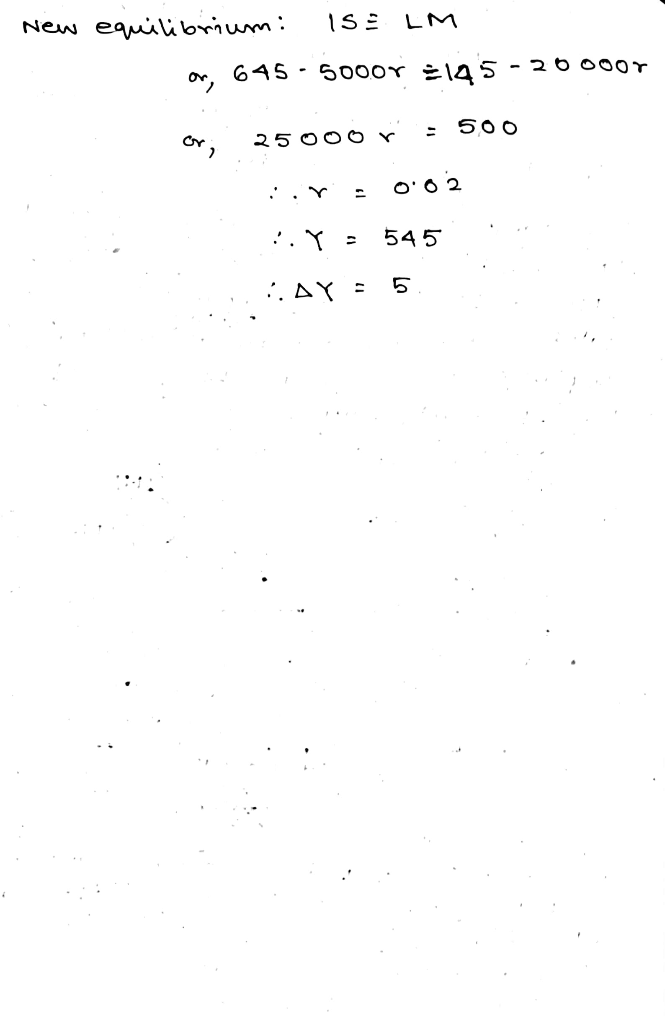
b) If the Fed purchases securities worth of 2500; is it an expansionary, or a contractionary (pick one) monetary policy? If there is no leakage of excess reserves, then by how much does it change the money supply? By how much do the IS and LM curves shift and by how much does Y change?
Solutions
 Rahul Sunny answered 4 months ago
Related Solutions
Consider the following macroeconomic model: C(t) + I(t) = Y (t) I(t) = 0.8 dC(t) dt...
18. Consider the following closed economy: C = 60 +0.8(Y-T) I = 150-1000i G = 250...
c = 100 + 0.8 (y - t) i = 500 - 50r g = 400...
Consider a hypothetical economy where: • C(Yd) = 105 + 0.8 × (Y − T) •...
Consider a hypothetical economy where: • C(Yd) = 105 + 0.8 × (Y − T) •...
An economy is described by the following equations: C = 40 + 0.8 (Y – T)...
An economy is described by the following equations: C = 100 + 0.8 (Y – T)...
. Consider the following model: C = 500 + .3(Y − T) I = 150 +...
Given the following economy: Y = C(Y - T) + I(r) + G C(Y - T)...
Let the following equations characterize an economy: C = 400 + 0.8*(Y-T) G = 300 T...
- Students performed a procedure similar to Part III of this experiment (Analyzing a Vitamin Supplement for...
- The output of the function is a dictionary whose keys represent the bins and whose values...
- The shape of a graph of a binomial distribution depends on the value of both n...
- In 2012, cost per Medicare beneficiary did what?
- 3. A. What techniques can a firm use to optimize demand deposit holdings? B. How do...
- The half-life of mercury-197 is 64.1 hours. If a patient undergoing a kidney scan is given...
- Double bonds react with Br2 to form a dibromide. Isobutylene undergoes cationic polymerization under conditions where...