Question
In: Physics
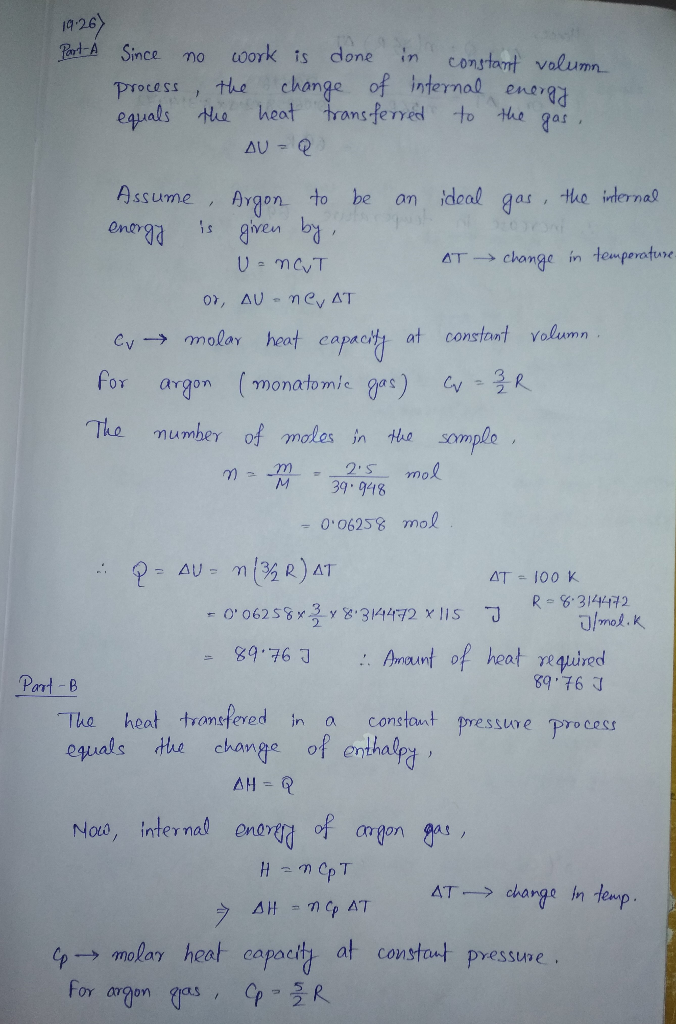
19.26 A container holds 2.5 g of argon at a pressure of 8.0atm. Part A How...
19.26 A container holds 2.5 g of argon at a pressure of
8.0atm.
Part A
How much heat is required to increase the temperature by 100∘C at constant volume?
Express your answer to two decimal places and include the appropriate units.
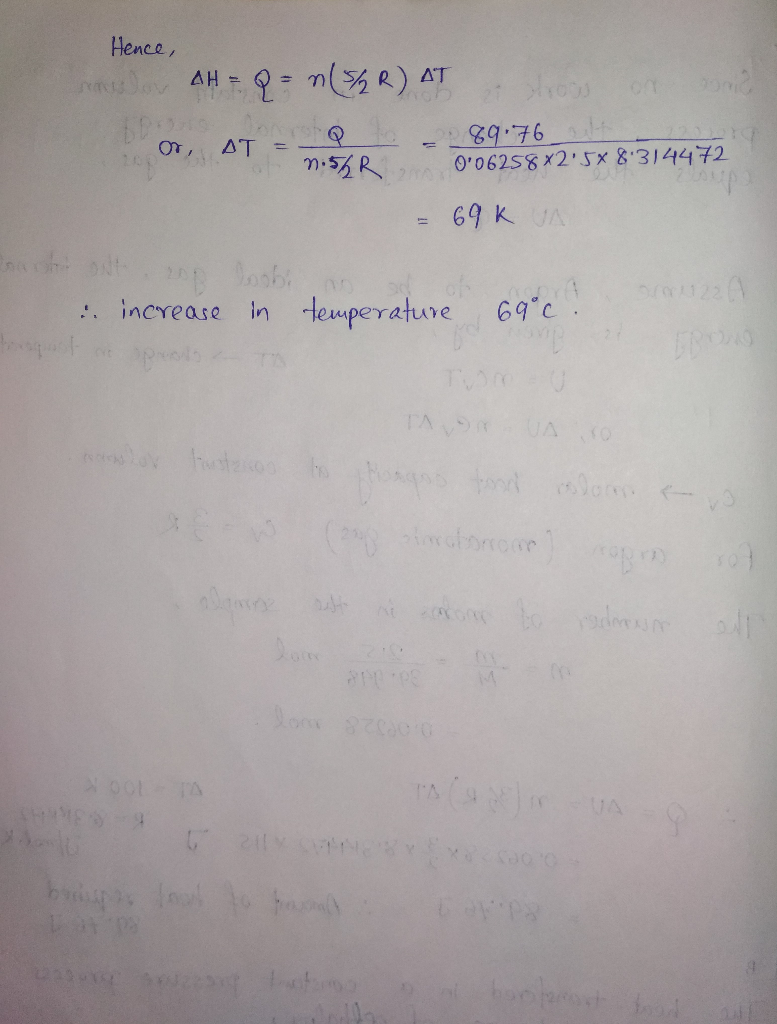
Part B
How much will the temperature increase if this amount of heat energy is transferred to the gas at constant pressure?
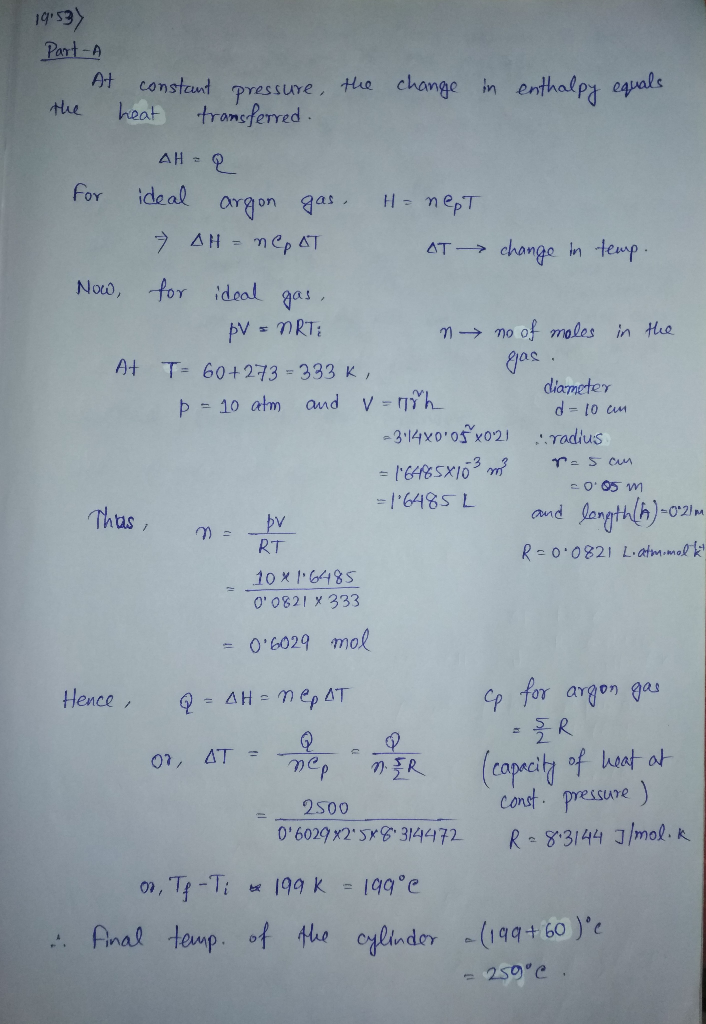
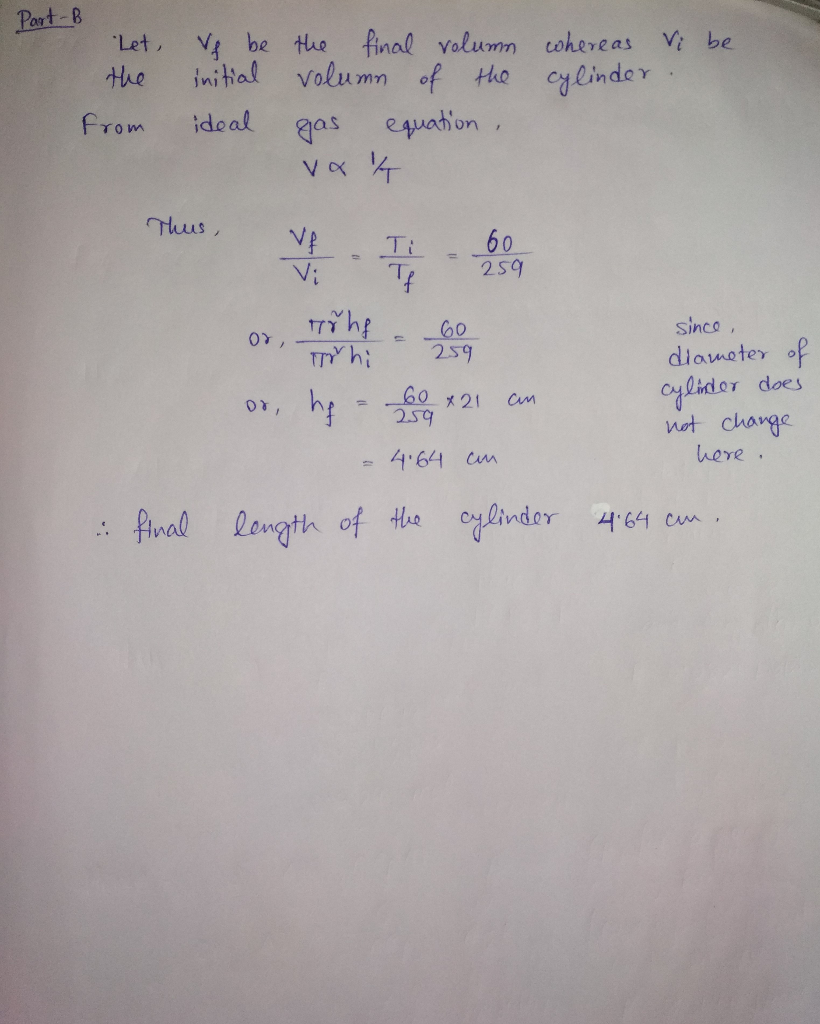
19.53 A 10 cm -diameter cylinder contains argon gas at 10 atm pressure and a temperature of 60 ∘C . A piston can slide in and out of the cylinder. The cylinder's initial length is 21 cm . 2500 J of heat are transferred to the gas, causing the gas to expand at constant pressure.
Part A
What is the final temperature of the cylinder?
Part B
What is the final length of the cylinder?
Solutions
 genius_generous answered 4 months ago
Related Solutions
A Compartment A holds helium at pressure 5 atm, and compartment B holds argon at pressure...
A Compartment A holds helium at pressure 5 atm, and compartment
B holds argon at pressure 10atm. the partition between the gases is
removed and the gases are allowed to mix. The mole fraction of
helium in the mixture is 0.40 and the total volume of both
compartments is 30.0 L . Temperature of helium and argon before and
after mixing was 500K. Find volume of compartment A and B.
a 374 ml container holds 0.146g of Ne and an unknown amount of argon at 35°C...
a 374 ml container holds 0.146g of Ne and an unknown
amount of argon at 35°C total pressure =638mmHg calculate moles of
Ar present
A 1-m^3 container holds 50 g of hydrogen. The temperature is 20°C. Determine the pressure
A 1-m^3 container holds 50 g of hydrogen. The temperature is
20°C. Determine the pressure
part a.) A sample of argon gas at a pressure of 1.05 atm and a temperature...
part a.) A sample of argon gas at a pressure of 1.05 atm and a
temperature of 21.0 °C, occupies a volume of 11.0 liters. If the
gas is allowed to expand at constant temperature to a volume of
15.6 liters, the pressure of the gas sample will be atm.
part b.) A sample of xenon gas at a pressure of
0.763 atm and a temperature of 29.9
°C, occupies a volume of 12.9 liters. If
the gas is allowed...
1) What is the pressure inside a 32.8 m3 container holding 103.4 kg of argon gas...
1) What is the pressure inside a 32.8 m3 container
holding 103.4 kg of argon gas at 395
K(MAr=40x10-3kg/mol)?
2) A 10kg object floats with 5/7 of its volume under the surface
of the water. What is the density of the object? The density of
water is 1000 kg/m3.
PART A A sample of ideal gas is in a sealed container. The pressure of the...
PART A
A sample of ideal gas is in a sealed container. The pressure of
the gas is 735 torr , and the temperature is 22 ∘C . If the
temperature changes to 76 ∘C with no change in volume or amount of
gas, what is the new pressure, P2, of the gas inside the container?
Express your answer with the appropriate units.
PART B
Using the same sample of gas (P1 = 735 torr , T1 = 22 ∘C...
Container A holds 1600 mL of ideal gas at 4.6 atm, 29 °C. Container B holds...
Container A holds 1600 mL of ideal gas at 4.6 atm, 29 °C.
Container B holds 400 mL of ideal gas at 7.0 atm, 47 °C. If the
gases are allowed to mix together, and the final temperature is 35
°C, what is the pressure (in atm) of the mixed gas? R = 0.0821 (L
atm/K mol).
Container A holds 732 mL of ideal gas at 2.30 atm. Container B holds 114 mL...
Container A holds 732 mL of ideal gas at 2.30 atm. Container B
holds 114 mL of ideal gas at 4.30 atm. If the gases are allowed to
mix together, what is the resulting pressure?
1. 3.49 g of a gas in a 4.61 L container exerts a pressure of 0.357...
1. 3.49 g of a gas in a 4.61 L container exerts a pressure of
0.357 atm at 209.1°C. Calculate the molar mass of the gas.
2. A balloon contains 393 mL of gas at 22.75°C. A student places
the balloon outside, where it sits for several hours at a
temperature of 5.65°C. Assuming there is no change in pressure for
the balloon, use Charles' law to determine the new volume of the
gas.
3. A sample of carbon dioxide...
The partial pressure of argon in the atmosphere is 7.10torr . Calculate the partial pressure in...
The partial pressure of argon in the atmosphere is 7.10torr .
Calculate the partial pressure in mmHg and atm . Round each of your
answers to 3 significant digits.
ADVERTISEMENT
ADVERTISEMENT
Latest Questions
- Students performed a procedure similar to Part III of this experiment (Analyzing a Vitamin Supplement for...
- The output of the function is a dictionary whose keys represent the bins and whose values...
- The shape of a graph of a binomial distribution depends on the value of both n...
- In 2012, cost per Medicare beneficiary did what?
- 3. A. What techniques can a firm use to optimize demand deposit holdings? B. How do...
- The half-life of mercury-197 is 64.1 hours. If a patient undergoing a kidney scan is given...
- Double bonds react with Br2 to form a dibromide. Isobutylene undergoes cationic polymerization under conditions where...
ADVERTISEMENT