Question
In: Economics
Microeconomics Assignment 1 Dua 1. In Japan each unit of labor can produce 2 computers or...
Microeconomics Assignment 1 Dua
1. In Japan each unit of labor can produce 2 computers or 4 cell phones. In Canada each unit of labor can produce 3 computers or 5 cellphones.
a) Which country has absolute advantage of trade in producing cell phones?
b) Which country has absolute advantage of trade in producing computers?
c) Which country has a comparative advantage in producing computers?
d) Which country has comparative advantage in producing cell phones?
2. Label each of the following statements as a positive or a normative statement.
a) The minimum wage ought to be abolished.
b) A little bit of inflation is worse for society than a little bit of unemployment.
c) Society should take measures to prevent people from engaging in dangerous personal behavior.
d) The inflation rate has been rising for the last two years.
e) The government should not be running a budget deficit.
f) Per capita income in the United States has gone down in 2017.
Solutions
Expert Solution
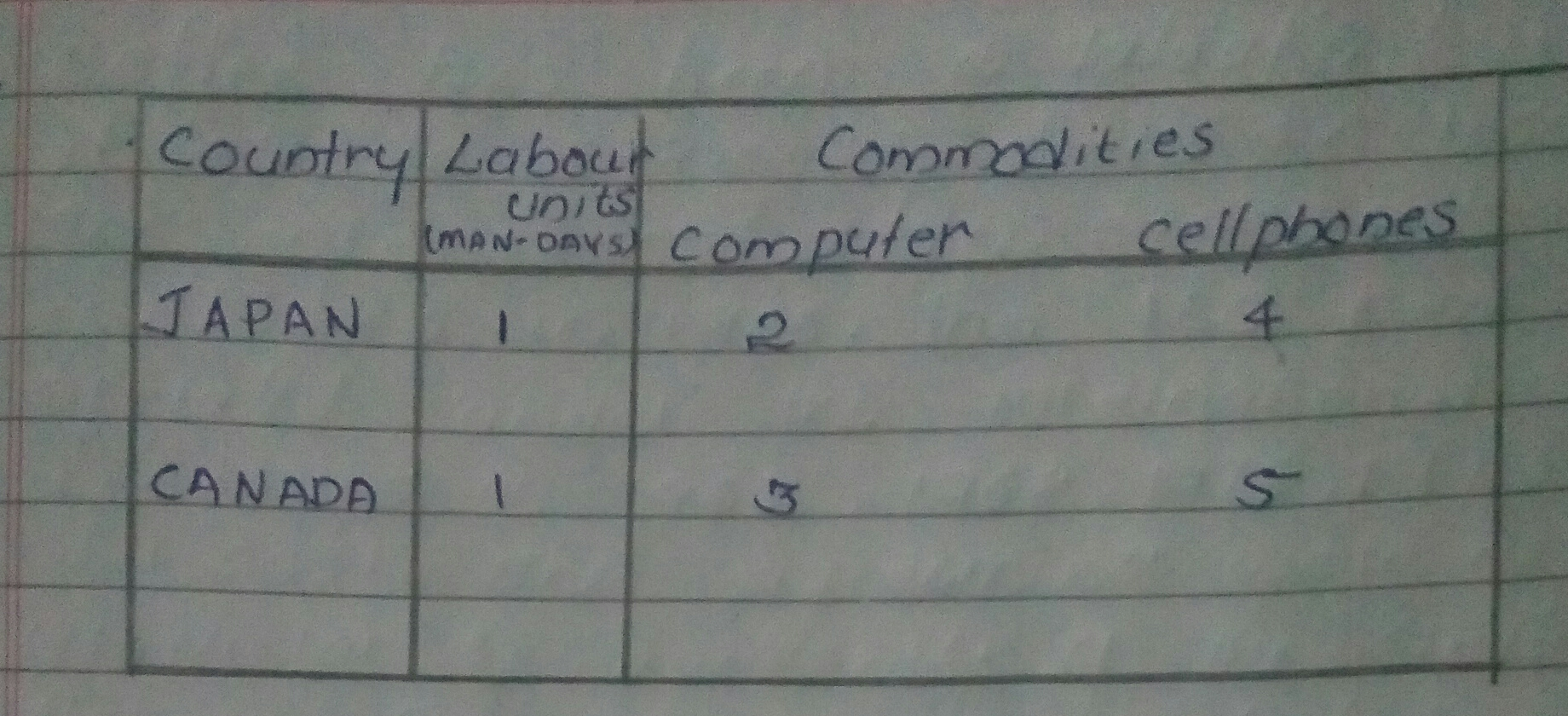
From the above table we can see that Canada has an absolute advantage in producing both Computer and Cellphones.
For analyzing the comparative advantage, we need to make the domestic exchange ratios between computer and cellphones in both countries.
In Japan, domestic exchange ratio between computer and cellphones is 2:4 i.e 1 unit of computer = 2/4 or 0.5 units of cellphones. Alternatively, 1 unit of cellphones= 4/2 or 2 units of computer.
In Canada, domestic exchange ratio between computer and cellphones is 3 : 5, i.e , 1 unit of computer = 3/5 or 0.6 units of cellphones. Alternatively, 1 unit of cellphones= 5/3 or 1.6 units of computer.
From the above exchange ratio, we can see that Japan has a comparative advantage in the production of computer. Because, for producing one unit of computer Japan has to give up only 0.5 units of cellphones, while Canada has to give up 0.6 units of cellphones.
On the other side, Canada has a comparative advantage in the production of cellphones, because they need to give up only 1.6 units of computer to produce 1 unit of cellphones. At the same time in Japan they need to give up 2 units of computer to produce one unit of cellphones.
Question 1,
a, Canada has an absolute advantage in producing Cellphones
b, Canada has an absolute advantage in producing computer.
c, Japan has the comparative advantage in the production of computer.
d, Canada has the comparative advantage in the production of cell phones.
Question 2,
Firstly we need to understand the concepts of positive economics and normative economics.
Positive economics deals with the various economic phenomena or the "what is" scenario. Normative economics deals with the value of economic fairness, or what the economy "should be" or "ought to be."
a) The minimum wage ought to be abolished. - Normative Economics
b) A little bit of inflation is worse for society than a little bit of unemployment. - Positive Economics
c) Society should take measures to prevent people from engaging in dangerous personal behavior. - Normative Economics
d) The inflation rate has been rising for the last two years. - Positive Economics
e) The government should not be running a budget deficit. - Normative Economics
f) Per capita income in the United States has gone down in 2017. - Positive Economics
 Rahul Sunny answered 5 months ago
Related Solutions
Mac and Izzie each produce computers and television sets. Mac can produce 60 computers per month...
Country A requires 1 unit of labor to produce 1 unit of good X, and 6...
The table below is for questions 1-3. In one day, one unit of labor can produce...
Using the same amount of resources, China and Japan can each produce oranges and salmonberries as...
The following table shows the number of weeks of labor required to produce 1 unit of...
The following table shows the number of weeks of labor required to produce 1 unit of...
Agnes can produce either 1 unit of X or 1 unit of Y in an hour,...
In Village A, one farmer, i.e., one unit of labor, can produce either 10 bottles of...
A firm can produce orange juice in the US and ship it to Japan at a...
Donald and Hillary each have 10 hours of labor (L) that can be used to produce...
- Question 3 (a) What do you understand by a time series forecasting approach? Describe each of...
- 1 Which of the following overflow values clips all content that extends beyond the containing element’s...
- What are the key environmental and biological controls over decomposition rate in ecosystems?
- describe why independent oversight is important to taxpayers.
- Graph a Monopoly. Compare the price, quantity, and ATC of a monopoly with a perfectly competitive...
- Problem 18-12 Various shareholders' equity topics; comprehensive [LO18-1, 18-4, 18-5, 18-6, 18-7, 18-8] Part A In...
- Hello There, This is discussion Question For Advanced Database Systems Question: (a) Please define what a...