Question
In: Chemistry
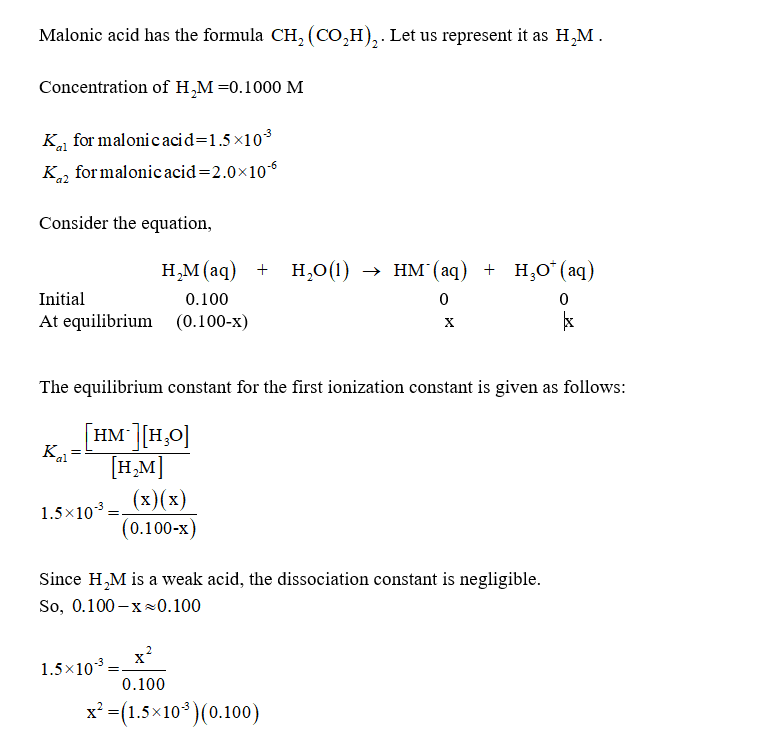
We will abbreviate Malonic acid, CH2(CO2H)2 as H2M. Find the pH and concentrations of H2M, HM-,...
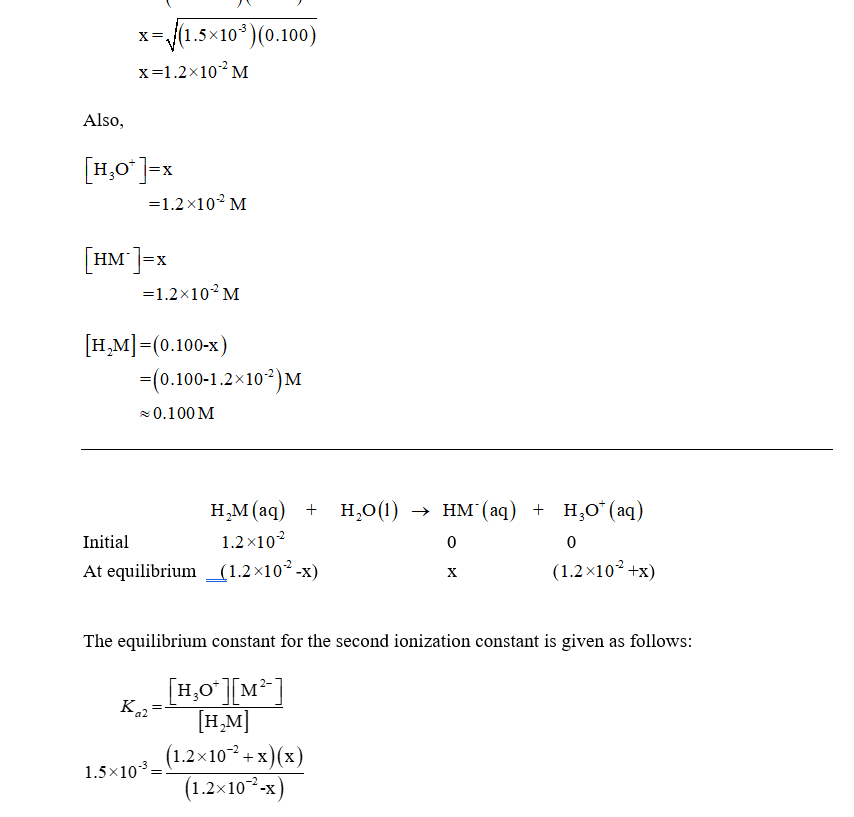
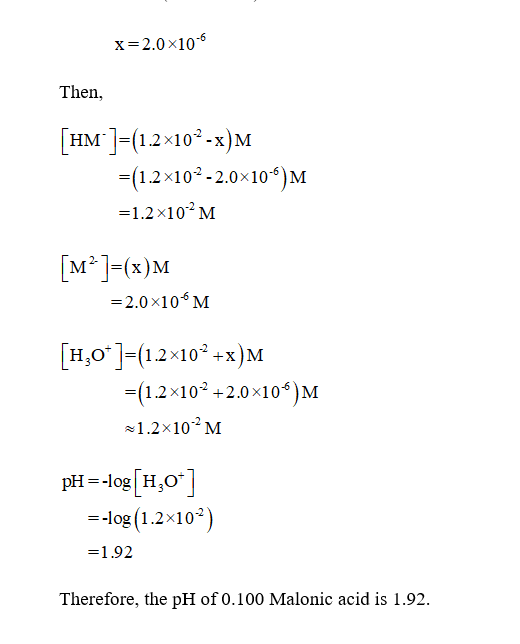
We will abbreviate Malonic acid, CH2(CO2H)2 as H2M. Find the pH and concentrations of H2M, HM-, and M^2- in a) .1 M H2M b) .1 M NaHM c) .1 M Na2M
Solutions
 queen_honey_blossom answered 5 months ago
Related Solutions
We will abbreviate malonic acid, CH2(CO2H)2, as H2M. Find the pH and concentrations of H2M, HM+
We will abbreviate malonic acid, CH2(CO2H)2, as H2M. Find the pH and concentrations of H2M, HM+, and M2+ in (a) 0.100 M H2M; (b) 0.100 M NaHM; (c) 0.100 M Na2M.
Malonic acid (H2M) is a diprotic acid. You wish to prepare a buffer of malonic acid...
Malonic acid (H2M) is a diprotic acid. You wish to prepare a
buffer of malonic acid (pKa1 = 2.847, pKa2= 5.696) with a final pH
of 2.90 but you only have disodium malonate (M2-) in your
laboratory shelf. You dissolve 100 mmol of this salt in 1 L of
water. Assume both dissociation processes are decoupled.
What is the initial pH of the solution? State any assumptions
you make.
How many equivalents of strong acid must you add to your...
Malonic acid (FW = 104.06) is a diprotic acid of the form CH2(COOH)2, with pKa1 =...
Malonic acid (FW = 104.06) is a diprotic acid of the form
CH2(COOH)2, with pKa1 = 2.847
and pKa2 = 5.696. Assume all solutions are
ideal.
(a) If 15.000 g of malonic acid is added to 100 mL of pure water,
what will the pH of the
solution be?
(b) You add 18 mL of 5 M NaOH to the solution in part (a). What
will the new pH be?
(c) You then add 5.000 g of sodium malonate (Na2CH2(COO),...
A 25.00 mL sample of 0.120 M of the diprotic malonic acid, HOOC-CH2-COOH, was titrated with...
A 25.00 mL sample of 0.120 M of the diprotic malonic acid,
HOOC-CH2-COOH, was titrated with 0.250 M NaOH. If the following
results were obtained, calculate Ka1 and Ka2.
mL NaOH added: 5.00 6.00 10.00 12.00 15.00 18.00 20.00 24.00
pH: 2.68 2.83 3.53 4.26 5.21 5.69 6.00 9.24
What is the pH of a solution that is 0.0924 M in malonic acid? What will...
What is the pH of a solution that is 0.0924 M in malonic acid?
What will be the equilibrium concentration of each of the three
malonic acid species? pKa1 = 2.85 pKa2 = 5.70
pH: _________________
[H2A]: ____________________ [HA-]: _________________ [A2-]:
_________________
The net equation for the Briggs-Rauscher reaction is: IO3- + 2H2O2 + H+ + CH2(CO2H)2 ------->...
The net equation for the Briggs-Rauscher reaction is:
IO3- + 2H2O2 +
H+ + CH2(CO2H)2
-------> ICH(CO2H)2 + 2O2 +
3H2O
From the exact concentrations and amounts of reagents you
created and worked with (i.e the volumes when performing the
reaction), calculate the grams of oxygen that have been formed when
the reaction is complete. What reagent is limiting? Show all work.
(NOTE: Volume of Malonic Acid 10mL, volume of Manganese Sulfate
Monohydrate 10mL, Potassium Iodate 10mL, 1mL of starch).
Calculate the pH and concentration of all species of malonic acid (C3H4O4) in each of the...
Calculate the pH and concentration of all species of malonic
acid (C3H4O4) in each of the follwing solutions.
K1=1.42*10^-3, K2=2.01*10^-6
0.100 M NaC3H3O4 solution
0.100 M Na2C3H2O4 solution
Initial pH: 2.54 malonic acid (C3H4O4) sodium malonate (NaC3H3O4) Addition of HCl (drop in pH) mL...
Initial pH: 2.54
malonic acid (C3H4O4)
sodium malonate (NaC3H3O4)
Addition of HCl (drop in
pH)
mL of HCl added
ΔpH
4.12
-0.51
6.93
-0.69
11.59
-0.89
25.63
-1.09
49.9
-1.24
Addition of NaOH (increase in pH)
mL of NaOH added
ΔpH
1.91
2.77
2.61
3.00
3.56
3.21
4.43
3.48
4.98
3.69
5.39
3.96
5.87
4.25
6.36
4.51
6.9
4.71
Clearly outline how you made your assigned buffer with its
target pH.
Assuming no volume change, how many mL of 0.1...
Phosphoric acid, H3PO4(aq), is a triprotic acid. Calculate the pH and concentrations of H3O + (aq),...
Phosphoric acid, H3PO4(aq), is a triprotic acid. Calculate the
pH and concentrations of H3O + (aq), H3PO4(aq), H2PO4 − (aq), HPO4
2− (aq), PO4 3− (aq), and OH− (aq) in a 0.100-M phosphoric acid
solution at 25°C.
Consider the diprotic acid h2a with k1=1.00x10⁻⁴ and k2=1.00x10⁻⁸. find the pH and concentrations of h2a,...
Consider the diprotic acid h2a with k1=1.00x10⁻⁴ and
k2=1.00x10⁻⁸. find the pH and concentrations of h2a, ha-, and a2-
in (a) 0.100 M H2A (b) 0.100 M NaHA (c) 0.100 M Na2A
ADVERTISEMENT
ADVERTISEMENT
Latest Questions
- Problem 18-12 Various shareholders' equity topics; comprehensive [LO18-1, 18-4, 18-5, 18-6, 18-7, 18-8] Part A In...
- Hello There, This is discussion Question For Advanced Database Systems Question: (a) Please define what a...
- Physicians at a clinic gave what they thought were drugs to 860860 patients. Although the doctors...
- On January 1, 2018, bonds with a face value of $ 79,000 were sold. The bonds...
- How do I make this sort in true alphabetical order instead of ascii(ABCabc) order? I am...
- As a healthcare provider in physical therapy, athletic training, or as an exercise scientist and personal...
- in the market for makeup artists, what happens after the invention of high-definition tv allowing viewers...
ADVERTISEMENT