Question

In: Economics

Firms x, y, and z produce and sell an identical product and operate in an oligopolistic...

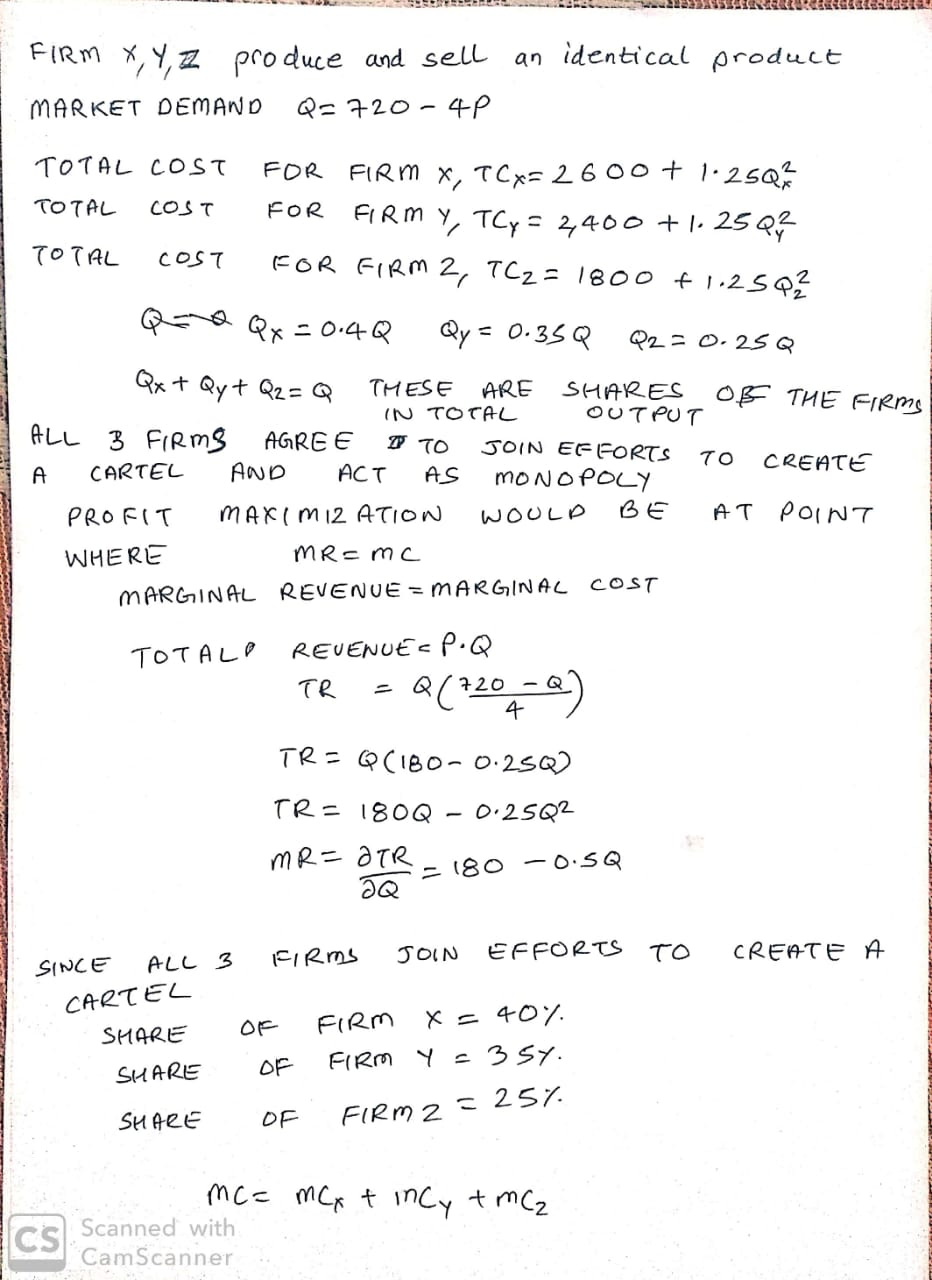
Firms x, y, and z produce and sell an identical product and operate in an oligopolistic market whose daily demand is

Q = 720 – 4P. Their respective T.C. functions per day are:

T.C.x = 2,600 + 1.25Q2, T.C.y = 2,400 + 1,25Q2, and T.C.z = 1,800 + 1.25Q2

Assume that these three firms agree to join efforts to create a cartel and act as a monopoly and agree to the following market shares of the artificially created monopoly’s optimum output or Q*: Firm x: 40%, Firm y: 35%, and Firm z: 25%. They also agree to charge the same price. Please show your work clearly in answering the following questions:

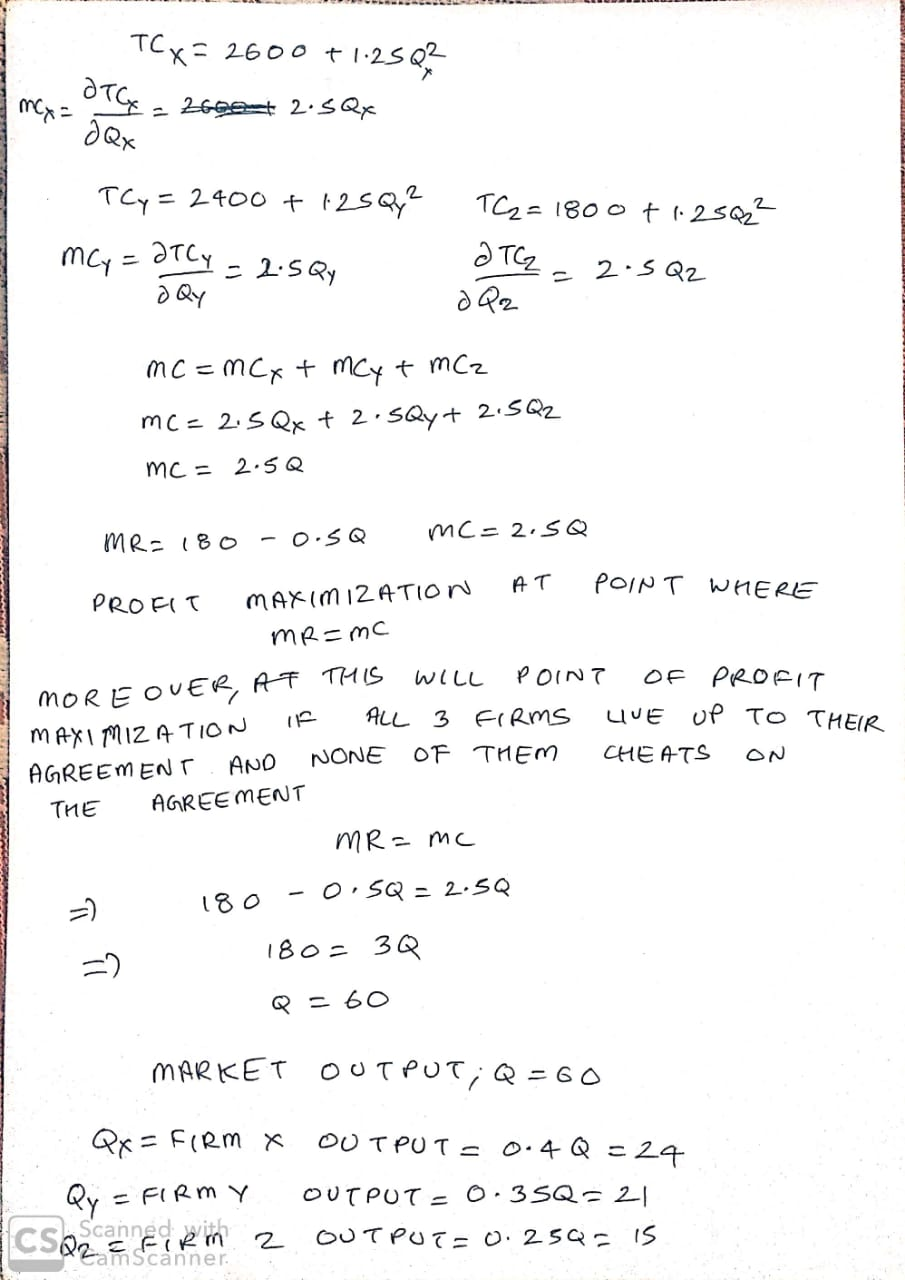
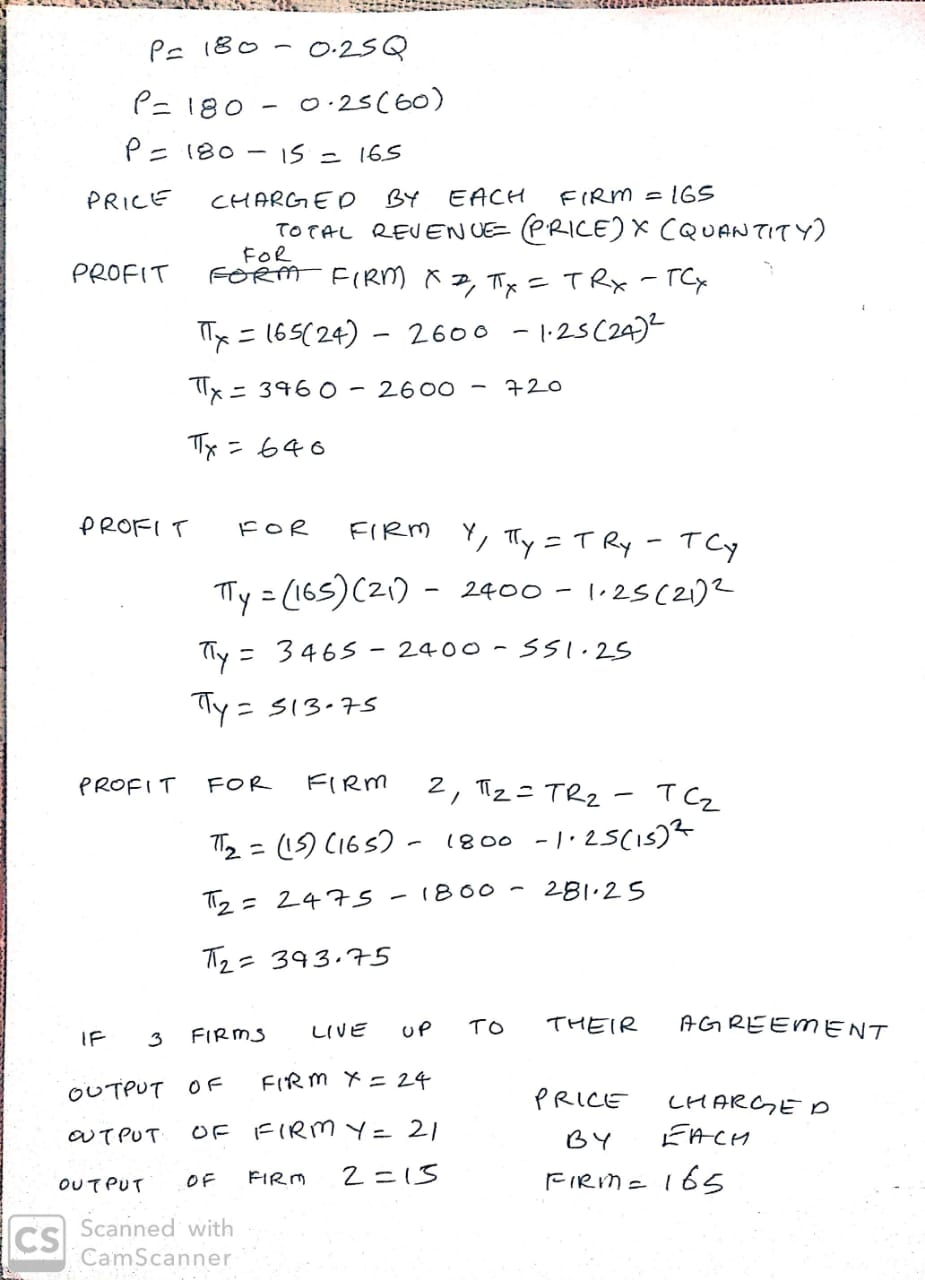
If the three firms live up to their agreement, how many units will each firm produce and what price will each firm charge?

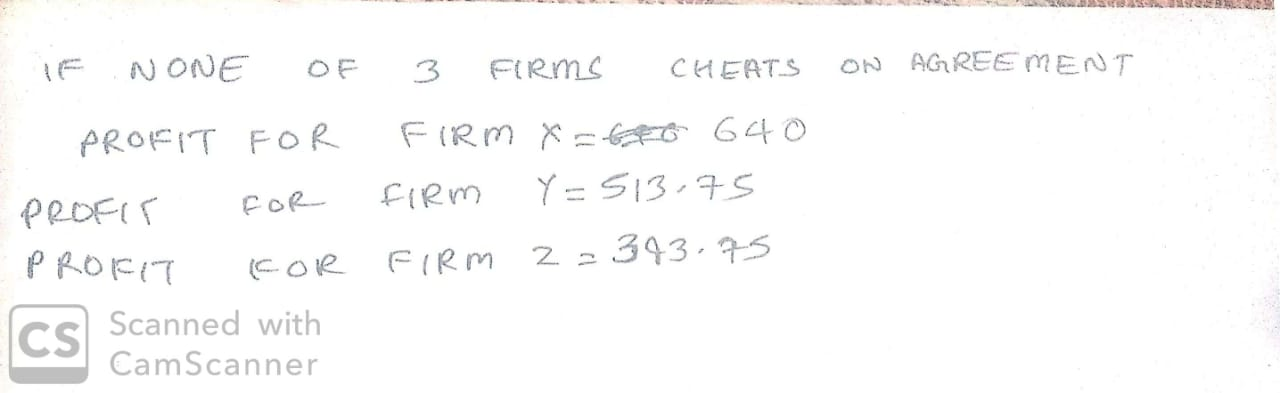
If none of the three firms cheats on the agreement, what will profits be for each of these firms?

Solutions
Expert Solution


Related Solutions

Suppose there are two firms that produce an identical product. The demand curve for their product...
Suppose there are two firms that produce an identical product. The demand curve for their product is represented by P=60-2Q, where Q is the total quantity produced by the two firms. The marginal cost of production is zero and there are no fixed costs. A. Refer to Scenario: Oligopoly. Suppose both firms choose their individual quantities q1 (firm 1) and q2 (firm 2) simultaneously and independently (so Q = q1 + q2). What is the unique Nash equilibrium price? B....
Consider two firms, X and Y, that have identical assets and generate identical cash flows. X...
Consider two firms, X and Y, that have identical assets and generate identical cash flows. X is an all-equity firm, with 1 million shares outstanding that trade for a price of $24 per share. Y has 2 million shares outstanding and $12 million dollars in debt at an interest rate of 5%. According to MM proposition 1, share price of y is $6. a) If the annual earnings before interest and taxes for each firm are $5 million, what would...
There are two companies, X and Y, that produce two identical products, A and B. If...
There are two companies, X and Y, that produce two identical products, A and B. If their labor productivity of the respective products is as follows, determine the following advantages: Product A Product B Company X 100 units per labor hour 30 units per labor hour Company Y 40 units per labor hour 60 units per labor hour Who has the absolute advantage in producing A: ______; Who has the absolute advantage in producing B: ______; Who has the comparative...
Let X and Y be independent and identical uniform distribution on [0, 1]. Let Z=min(X, Y)....
Let X and Y be independent and identical uniform distribution on [0, 1]. Let Z=min(X, Y). Find E[Y-Z]. Hint: condition on whether Y=Z or not. What is the probability Y=Z?
Two identical firms compete in a Bertrand duopoly. The firms produce identical products at the same...
Two identical firms compete in a Bertrand duopoly. The firms produce identical products at the same constant marginal cost of MC = $10. There are 2000 identical consumers, each with the same reservation price of $30 for a single unit of the product (and $0 for any additional units). Under all of the standard assumptions made for the Bertrand model, the equilibrium prices would be Group of answer choices $10 for both firms $30 for both firms $50 for both...
Consider the following one-shot Bertrand game. Two identical firms produce an identical product at zero cost....
Consider the following one-shot Bertrand game. Two identical firms produce an identical product at zero cost. The aggregate market demand curve is given by 6 − p , where p is the price facing the consumers. The two firms simultaneously choose prices once. Suppose further that the firm that charges the lower price gets the entire market and if both charge the same price they share the market equally. Assume that prices can only be quoted in integer units (only...
Consider a market where two firms sell an identical product to consumers and face the following...
Consider a market where two firms sell an identical product to consumers and face the following inverse demand function p = 100 - q1 - q2 but the firms face different marginal costs. Firm 1 has a constant marginal cost of MC1 = 10 and firrm 2 has a constant marginal cost of MC2 = 40. a) What is firm 1s best response function? b) What is firm 2's best response function? c) What are the equilibrium quantities, price and...
Perfect competition exists when •Many firms sell an identical product to many buyers. •There are no...
Perfect competition exists when •Many firms sell an identical product to many buyers. •There are no restrictions on entry into (or exit from) the market. (QUESTION: EXAMPLES IN OMAN) •Established firms have no advantage over new firms. •Sellers and buyers are well informed about prices. (QUESTION: SITUATION IN OMAN) <Other Market Types (QUESTION: EXAMPLES IN OMAN for each type) Monopoly is a market for a good or service that has no close substitutes and in which there is one supplier...
The curried version of let f (x,y,z) = (x,(y,z)) is let f (x,(y,z)) = (x,(y,z)) Just...
The curried version of let f (x,y,z) = (x,(y,z)) is let f (x,(y,z)) = (x,(y,z)) Just f (because f is already curried) let f x y z = (x,(y,z)) let f x y z = x (y z)
Suppose there are N firms who produce an identical product and face the demand curve P...
Suppose there are N firms who produce an identical product and face the demand curve P = 170 – 3Q, where P is the price of the good (in dollars) and Q is the total quantity supplied by the firms. The marginal cost of production per firm is $20; there are no fixed costs. If there is only one firm in the market (a monopolist), what is this firm's optimal output? If there are four firms in the market (N=4),...
ADVERTISEMENT
ADVERTISEMENT
ADVERTISEMENT