Question
In: Economics
If Mamata was able to work 24 hours a day she could produce 4 tonnes of...
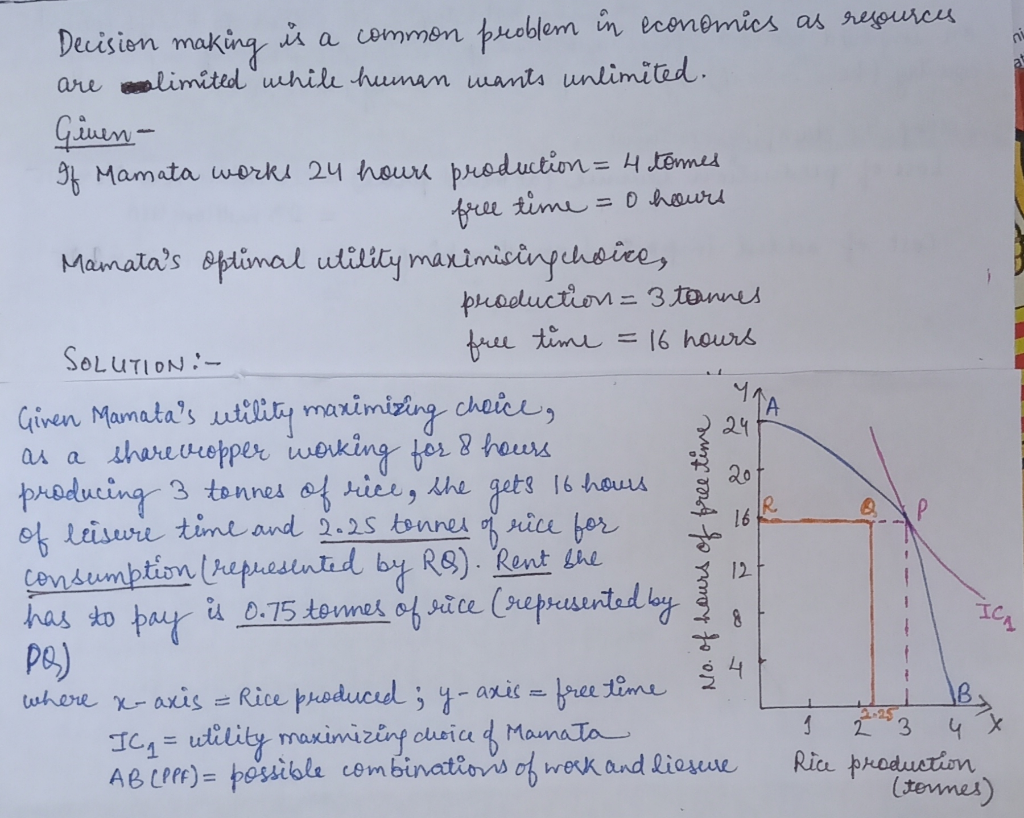
If Mamata was able to work 24 hours a day she could produce 4 tonnes of rice (the principal food crop cultivated in West Bengal) each day. You are told that Mamata’s utility maximising choice is to work for 8 hours and produce 3 tonnes of rice.
Now you are informed that Mamata is no longer an independent farmer. Instead, she works as a bargadar and rents the land on which she works from a landowner and keeps 75% of the rice that she produces (as is the case after the adoption of Operation Barga).
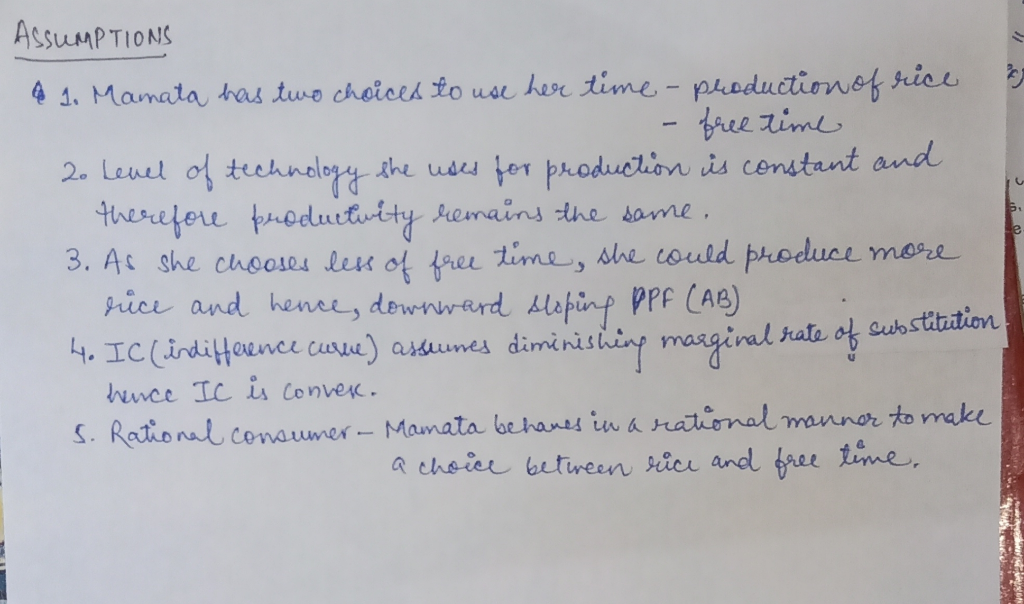
Q7 Using your answer to Q6 as a starting point, show (on a separate model) Mamata’s new optimal choice as a sharecropper. Again, be sure to label and define each of the relevant points and lines on your diagram. List each of the assumptions you made when developing your model.
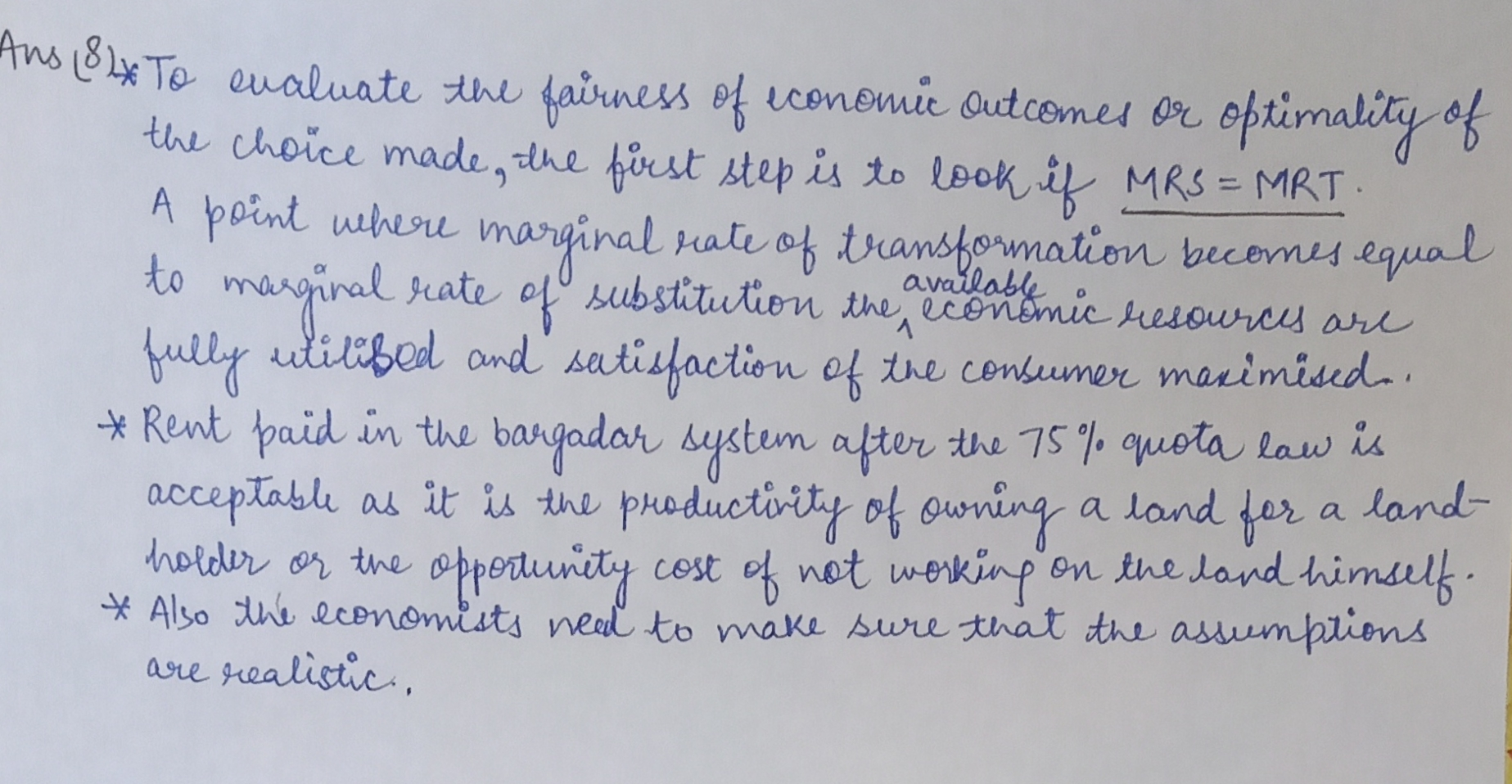
Q8 Discuss how the models developed in Q6 and Q7 can be used by economists to evaluate the fairness of economic outcomes?
Solutions
 Rahul Sunny answered 6 months ago
Related Solutions
Consider an individual with total hours o t=24 per day. She is paid $10 per hour...
A copy machine is available 24 hours a day. On a typical day, the machine produces...
24 hours a day, there are workers who use 16 hours of leisure (L) and labor...
Beth Corbin’s regular hourly wage rate is $16, and she receives an hourly rate of $24 for work in excess of 40 hours.
A grocery store is open 24 hours a day, seven days a week. It has the...
A hospital does many surgeries in a day. A standard hospital is open 24 hours with...
Suppose that workers are able to adjust the number of hours they work however they wish....
A ?firm's technology requires it to combine 4 labor hours with 3 machine hours to produce...
Trish must be at work exactly 40 hours/week where she earns $13/hour. While at work she...
-----A business owner makes 1000 items a day. Each day she spends 8 hours producing those...
- Graph a Monopoly. Compare the price, quantity, and ATC of a monopoly with a perfectly competitive...
- Problem 18-12 Various shareholders' equity topics; comprehensive [LO18-1, 18-4, 18-5, 18-6, 18-7, 18-8] Part A In...
- Hello There, This is discussion Question For Advanced Database Systems Question: (a) Please define what a...
- Physicians at a clinic gave what they thought were drugs to 860860 patients. Although the doctors...
- On January 1, 2018, bonds with a face value of $ 79,000 were sold. The bonds...
- How do I make this sort in true alphabetical order instead of ascii(ABCabc) order? I am...
- As a healthcare provider in physical therapy, athletic training, or as an exercise scientist and personal...