Question
In: Physics
Consider an object with a mass of 3.5 kg located at R1 = (0.0 m, 2.5...
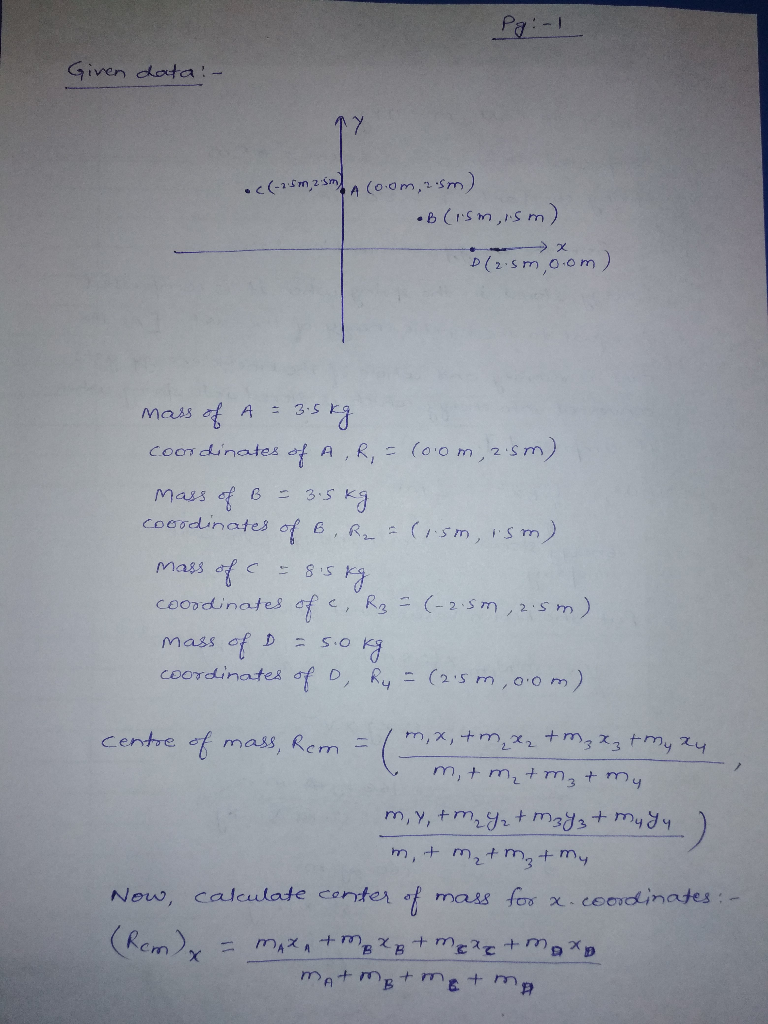
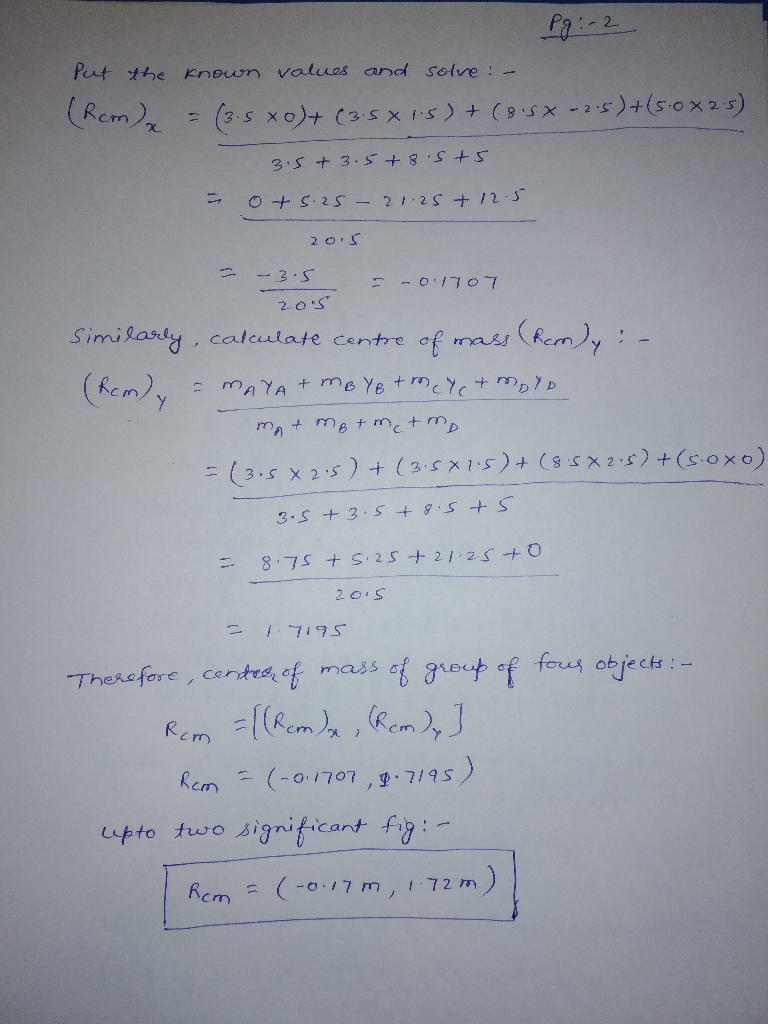
Consider an object with a mass of 3.5 kg located at R1 = (0.0 m, 2.5 m), another object with a mass of 3.5 kg located at R2 = (1.5 m, 1.5 m), and a third object with a mass of 8.5 kg located at R3 = (– 2.5 m, 2.5 m), and a fourth object with a mass of 5.0 kg located at R4 = (2.5 m, 0.0 m). Calculate the center of mass of this group of four objects. Give your answer in the form Rcm = (xcm, ycm) and with 2 significant figures.
Solutions
 genius_generous answered 6 months ago
Related Solutions
An object of mass 4.15 kg undergoes an acceleration of 3.5 m/s^2 for a period of...
An object of mass 4.15 kg undergoes an acceleration of 3.5 m/s^2
for a period of 7.0 seconds. It then undergoes an acceleration of
-4.2 m/s^2 for a period of 18.0 seconds. If the initial velocity of
the object is 4.01 m/s and it first experiences the acceleration
when it is at the origin, plot by hand on graph paper (to scale)
the force, velocity, and position graphs as functions of time.
Explain why your graphs look the way they...
An object with mass 3.5 kg is attached to a spring with spring stiffness constant k...
An object with mass 3.5 kg is attached to a spring with spring stiffness constant k = 270 N/m and is executing simple harmonic motion. When the object is 0.020 m from its equilibrium position, it is moving with a speed of 0.55 m/s.(a) Calculate the amplitude of the motion._____ m(b) Calculate the maximum velocity attained by the object. [Hint: Use conservation of energy.]______ m/s
A block of mass m = 3.5 kg is on an inclined plane with a coefficient...
A block of mass m = 3.5 kg is on an inclined plane with
a coefficient of friction μ1 = 0.23, at an
initial height h = 0.46 m above the ground. The plane is
inclined at an angle θ = 42°. The block is then compressed
against a spring a distance Δx = 0.11 m from its
equilibrium point (the spring has a spring constant of
k1 = 39 N/m) and released. At the bottom of the
inclined plane...
An object (A) of mass m A = 28.0 kg is moving in a direction that...
An object (A) of mass m A = 28.0 kg is moving in a direction
that makes angle of 50° south of west with a speed v A = 4.90 m/s,
while object (B) of mass m B = 18.0 kg is moving due south with a
speed v B = 7.85 m/s. The two objects collide and stick together in
a completely inelastic collision. Find the magnitude of the final
velocity of the two-object system after the collision.
A 3.5-kg object is supported by an aluminum wire of length 1.8 m and diameter 2.0...
A 3.5-kg object is supported by an aluminum wire of length 1.8 m
and diameter 2.0 mm . How much will the wire stretch?
A block of mass m = 2.5 kg is attached to a spring with spring constant...
A block of mass m = 2.5 kg is attached to a spring with
spring constant k = 640 N/m. It is initially at rest on an
inclined plane that is at an angle of θ = 27° with respect
to the horizontal, and the coefficient of kinetic friction between
the block and the plane is μk = 0.11. In the
initial position, where the spring is compressed by a distance of
d = 0.19 m, the mass is at...
Consider a thin uniform disk of mass M and radius R. A mass m is located...
Consider a thin uniform disk of mass M and radius R. A mass m is
located along the axis of the disk at a distance z from the center
of the disk. The gravitational force on the mass m (in terms of m,
M, R, G, and z) is
A certain object has a mass m $ 100 kg and is acted on by a force
A certain object has a mass m $ 100 kg and is acted on by a force f (t) = 500[2 – e-t sin(5πt)] N. The mass is at rest at t = 0. Use MuPAD to compute the object’s velocity at t = 5 s. The equation of motion is mυ̇ = f(t).
An object with a mass of 4.15 kg undergoes an acceleration of 2.7 m/s2 for a...
An object with a mass of 4.15 kg undergoes an acceleration of
2.7 m/s2 for a period of 8.0 s. It then undergoes an acceleration
of -3.2 m/s2 for a period of 20.0 s If the initial velocity of the
object is 6.01 m/s and it first experiences the acceleration when
it is at the origin, plot by hand on graph paper (to scale) the
force, velocity, and position as functions of time. Explain why
your graphs look the way...
An object with mass m = 0.6 kg is dropped from the top of the building...
An object with mass m = 0.6 kg is dropped from the top
of the building and falls 21 m down in front of the
cafe.
1.1 Calculate the speed of the object as it
hits the ground and calculate the time for the fall. Neglect in
this question the air resistance.
In a more accurate calculation we need to take air resistance
into account. In a wind tunnel the air resistance of the object has
been measured giving rise...
ADVERTISEMENT
ADVERTISEMENT
Latest Questions
- Teen Smoking Project CHAPTER 0. Preliminary Discussion Question: 1. What conjectures (educated guesses) could be made...
- In reviewing firm liquidity situations, lenders often count on the Quick Ratio (or Acid-Test ratio). Why...
- code a Java program that: Requests from the user for a text filename to read the...
- Discuss how the ARIES algorithm must operate under the circumstances that the system crashes during recovery
- (a) Based on the information in the above table, what is the unemployment rate? What is...
- Question 3 (a) What do you understand by a time series forecasting approach? Describe each of...
- 1 Which of the following overflow values clips all content that extends beyond the containing element’s...
ADVERTISEMENT