Question
In: Physics
A solid disk has a total kinetic energy K. What is its rotational kinetic energy Krot...
A solid disk has a total kinetic energy K. What is its rotational kinetic energy Krot if it's rolling without slipping?
Solutions
Expert Solution
Mass of the solid disk = M
Radius of the solid disk = R
Moment of inertia of the solid disk = I

Speed of the center of mass of the solid disk = V
Angular speed of the solid disk =  = V/R
= V/R
Total kinetic energy of the solid disk = K
Translational kinetic energy of the solid disk = KT

Rotational kinetic energy of the solid disk = KR

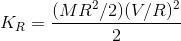


Total kinetic energy of the solid disk is the sum of the translational kinetic energy and the rotational kinetic energy.




Rotational kinetic energy of the solid disk if it is rolling without slipping = K/3
 genius_generous answered 6 months ago
Related Solutions
Rotational Inertia –Rolling Kinetic Energy. A solid sphere, a hollow sphere, a hollow cylinder, and a...
Rotational Inertia –Rolling Kinetic Energy.
A solid sphere, a hollow sphere, a hollow cylinder, and a solid
cylinder, all of with same mass (M=0.25 kg ) and radius(R= 0.20 m)
– are placed at the top of an incline at height (h= 1.5 m ). All
the objects are released from rest at the same moment to roll down
without slipping.
Hint: search for the rotational inertia formula for each of the
rolling object first. Then calculate each of them...
Two balls (solid spheres) have the same radius and the same rotational kinetic energy. If the...
Two balls (solid spheres) have the same radius and the same
rotational kinetic energy. If the ratio of their masses is
m1
m2
=
4
1
, what is the ratio of their angular velocities?
Calculate the momentum p, kinetic energy K, and total energy E of an electron traveling at...
Calculate the momentum p, kinetic energy K,
and total energy E of an electron traveling at each of the
speeds tabulated below.
v
p (keV/c)
K (keV)
E (keV)
(a) 0.03c
(b) 0.4c
(c) 0.9c
What is the abjective, goal, abstract, and purpose of rotational kinetic energy lab in physics
What is the abjective, goal, abstract, and purpose of rotational
kinetic energy lab in physics
How does the total Kinetic Energy before the collision compare to the total Kinetic Energy after...
How does the total Kinetic Energy before the collision compare
to the total Kinetic Energy after the collision, for the case of
inelastic collisions? How does it compare for elastic
collisions?
A car is designed to get its energy from a rotating flywheel (solid disk) with a...
A car is designed to get its energy from a rotating flywheel
(solid disk) with a radius of 1.50 m and a mass of 600 kg. Before a
trip, the flywheel is attached to an electric motor, which brings
the flywheel's rotational speed up to 4,000rev/min.
(a) Find the kinetic energy stored in the flywheel.
(b) If the flywheel is to supply energy to the car as a 15.0-hp
motor would, find the length of time the car could run...
Briefly explain the quantization of the rotational kinetic energy in two dimensions with a figure. And...
Briefly explain the quantization of the rotational kinetic energy in two dimensions with a figure.
And explain what it means to rotate electrons in a hydrogen atom.
1) An electron has a kinetic energy that is 50% larger than its classical kinetic energy....
1) An electron has a kinetic energy that is 50% larger than its
classical kinetic energy. Electron mass is 0.511 MeV/c^2.
a. What is the speed of the electron expressed in the unit of
speed of light c?
b. What is the total energy of the electron expressed in the
unit of MeV?
c. What is the kinetic energy of the electron expressed in the
unit of MeV?
b. Compare what happens to potential energy, kinetic energy, and total energy as the skater moves...
b. Compare what happens to potential energy, kinetic energy, and
total energy as the skater moves up and down the track. What
general statement can you make about the relationship between
potential and kinetic energy?
c. Notice that the bar entitled “Thermal” energy does not
deviate from zero. This represents an energy that is transformed
into "heat" energy. What must be true of this skate park for this
to remain at zero?
d. Vary the skater's Mass with the slider...
A bicycle has a kinetic energy of 124 J. What kinetic energy would the bicycle have...
A bicycle has a kinetic energy of 124 J. What kinetic energy
would the bicycle have if it had … Show how you got your answer on
your pdf copy. … twice the mass and was moving at the same speed? …
one-half the mass and was moving with twice the speed? … three
times the mass and was moving with one-half the speed? … the same
mass and was moving with one-half the speed? … the same mass and...
ADVERTISEMENT
ADVERTISEMENT
Latest Questions
- Two 10-cm-diameter charged rings face each other, 15cm apart. The left ring is charged to -29nC...
- Under what conditions would it be possible for an excise tax to have no efficiency cost...
- explain the difference between activities and financial statements of service businesses and merchandising businesses.
- 2. Compare and compare the matrix multiplication algorithm and the Floyd-Warshall algorithm to find all pairs...
- Q: 50.00 ml of 0.5216 M copper(II) nitrate solution is combined with 100.0 ml of 0.5580...
- This is a business law question. Explain how environmental laws regulate the use of toxic substances...
- A sky diver and her parachute system weigh a total of 800 N. She is falling...
ADVERTISEMENT