Question
In: Anatomy and Physiology
Discuss the parts of the pacemaker system, and give two examples of cardiac problems related to...
Discuss the parts of the pacemaker system, and give two examples of cardiac problems related to the disruption of the electrical communication between, at least, two components of the intrinsic conduction (pacemaker.)
Solutions
Expert Solution
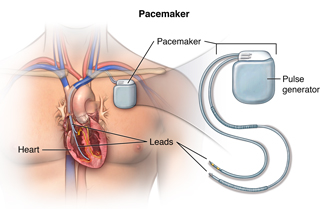
A pacemaker is composed of three parts. These are a pulse generator, one or more leads, and an electrode on each lead. A pacemaker signals the heart to beat when the heartbeat is too slow or irregular of heart.
A pulse generator is a small metal case which contains
electronic circuitry with a small computer and a battery that
regulate the impulses sent to the heart.
The lead (or leads) is an insulated wire that is connected to the
pulse generator on one end and the other end placed inside one of
the heart's chambers. The lead is almost always placed so that it
runs through a large vein in the chest leading directly to the
heart. The electrode on the end of a lead touches the heart wall.
The lead delivers the electrical impulses to the heart. It also
senses the heart's electrical activity and relays this information
back to the pulse generator. Pacemaker leads may be positioned in
the atrium (upper chamber) or ventricle (lower chamber) or both,
depending on the medical condition.
If the heart's rate is slower than the programmed limit, an electrical impulse is sent through the lead to the electrode and causes the heart to beat at a faster rate.
When the heart beats at a rate faster than the programmed limit, the pacemaker generally monitors the heart rate and will not pace. Modern pacemakers are programmed to work on demand only, so they do not compete with natural heartbeats. Generally, no electrical impulses will be sent to the heart unless the heart's natural rate falls below the pacemaker's lower limit.
A newer type of pacemaker, called a biventricular pacemaker, is currently used in the treatment of specific types of heart failure. Sometimes in heart failure, the two ventricles do not pump in a normal manner. Ventricular dyssynchrony is a common term used to describe this abnormal pumping pattern. When this happens, less blood is pumped by the heart. A biventricular pacemaker paces both ventricles at the same time, increasing the amount of blood pumped by the heart. This type of treatment is called cardiac resynchronization therapy or CRT.
After a pacemaker insertion, regularly scheduled appointments will be made to ensure the pacemaker is functioning properly. The doctor uses a special computer, called a programmer, to review the pacemaker's activity and adjust the settings when needed.
 Sydney Mullin answered 6 months ago
Related Solutions
Briefly discuss water pollution and give two examples of different sources, and the resulting problems they...
Discuss the cardiac conduction system and automaticity of heart Discuss cardiac output and the variables that...
-Describe circuits with current, resistors, and emf, and how to solve related problems. -Give examples of...
What are diversified companies? What accounting problems are related to diversified companies? Give examples of diversified...
Discuss the influence of the venous system and arterial system on cardiac function
explain social problems related to Jim Crow laws? Give me at least three examples of Jim...
Discuss the influence of the venous system and arterial system on cardiac function and the mechanisms...
Give and discuss particular examples of health related questions to employee or job-applications that are permeated...
Choose two parts of the brain and discuss how they might be related in function. How...
1. Discuss the autonomic nervous system and its parts. a. How do the two parts interact...
- 1. Explain the difference between inorganic and organic molecules. 2. Define: a. salt b. ...
- Veldre Company provides the following information about its defined benefit pension plan for the year 2014....
- One of the consequences of the economic meltdown in Great Recession has been a free fall...
- Please code the following prompt in python. Today you will be building a movie/actor lookup. The...
- In the context of software reliability and statistical testing: (a) Define operation profile and (b) Where...
- How to add and multiply two matrices in the following code? #include "My_matrix.h" #include <stdexcept> My_matrix::My_matrix()...
- Argentina Partners is concerned about the possible effects of inflation on its operations. Presently, the company...