Question

In: Physics

A 29.0-kg block is initially at rest on a horizontal surface. A horizontal force of 76.0...

A 29.0-kg block is initially at rest on a horizontal surface. A horizontal force of 76.0 N is required to set the block in motion, after which a horizontal force of 57.0 N is required to keep the block moving with constant speed.

(a) Find the coefficient of static friction between the block and the surface.

(b) Find the coefficient of kinetic friction between the block and the surface.

Solutions

Expert Solution
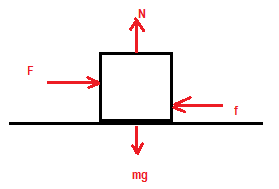
Given mass of block,

(a) Find the coefficient of static friction between the block and the surface.

When the block is about to move, frictional force acting is static friction force

Force applied,

Consider the block

Net force = Mass * Acceleration =0

Net Force = 0

(a) ANSWER :

=====================

(b) Find the coefficient of kinetic friction between the block and the surface.

When the block starts moving frictional force acting is kinetic friction force

Since the block is moving with constant speed, acceleration is zero

Net force =Mass * Acceleration =0

Net Force = 0

(b) ANSWER :

=====================


Related Solutions

A net force of 63.0 N acts on a 76.0 kg body initially at rest. Compute...
A net force of 63.0 N acts on a 76.0 kg body initially at rest. Compute the work (in joules) done by the force in the first second of time.
A 5.0 kg mass is initially at rest on a horizontal frictionless surface when a horizontal...
A 5.0 kg mass is initially at rest on a horizontal frictionless surface when a horizontal force along an x axis is applied to the block. The force is given by ? ⃗(?) = (6.0?2 − 2?3)?̂, where the force in in newtons, x is in meters, and the initial position of the block is x = 0. (a) What is the work done in moving the block from x = 1.0 m to x = 3.0 m? (b) What...
A 0.478 kg puck, initially at rest on a horizontal, frictionless surface, is struck by a...
A 0.478 kg puck, initially at rest on a horizontal, frictionless surface, is struck by a 0.129 kg puck moving initially along the x axis with a speed of 2.19 m/s. After the collision, the 0.129 kg puck has a speed of 1.19 m/s at an angle of 29◦ to the positive x axis. Determine the magnitude of the velocity of the 0.478 kg puck after the collision. Answer in units of m/s.
A 0.30 kg puck, initially at rest on a frictionless horizontal surface, is struck by a...
A 0.30 kg puck, initially at rest on a frictionless horizontal surface, is struck by a 0.20 kg puck that is initially moving along the x axis with a velocity of 2.4 m/s. After the collision, the 0.20 kg puck has a speed of 0.8 m/s at an angle of θ = 53° to the positive x axis. (a) Determine the velocity of the 0.30 kg puck after the collision. _ at _ ° from +x axis (b) This was...
A 890 g wooden block is initially at rest on a rough horizontal surface when a...
A 890 g wooden block is initially at rest on a rough horizontal surface when a 15.8 g bullet is fired horizontally into (but does not go through) it. After the impact, the block-bullet combination slides 6.50 m before coming to rest. If the coefficient of kinetic friction between block and surface is 0.750, determine the speed of the bullet immediately before impact. (No Response) m/s
A 0.300-kg puck, initially at rest on a horizontal, frictionless surface, is struck by a 0.200-kg...
A 0.300-kg puck, initially at rest on a horizontal, frictionless surface, is struck by a 0.200-kg puck moving initially along the x axis with a speed of 2.00 m/s. After the collision, the 0.200- kg puck has a speed of 1.00 m/s at an angle of θ = 53.0° to the positive x axis. (a) Determine the velocity of the 0.300-kg puck after the collision. (b) Find the fraction of kinetic energy lost in the collision. and please explain
A 0.300-kg puck, initially at rest on a horizontal, frictionless surface, is struck by a 0.200-kg...
A 0.300-kg puck, initially at rest on a horizontal, frictionless surface, is struck by a 0.200-kg puck moving initially along the x axis with a speed of 2.00 m/s. After the collision, the 0.200- kg puck has a speed of 1.00 m/s at an angle of θ = 53.0° to the positive x axis. (a) Determine the velocity of the 0.300-kg puck after the collision. (b) Find the fraction of kinetic energy lost in the collision. (4 points)
A 0.30-kg puck, initially at rest on a frictionless horizontal surface, is struck by a 0.20-kg...
A 0.30-kg puck, initially at rest on a frictionless horizontal surface, is struck by a 0.20-kg puck that is initially moving along the x-axis with a velocity of 9.0 m/s. After the collision, the 0.20-kg puck has a speed of 5.4 m/s at an angle of θ = 53° to the positive x-axis. a)Determine the velocity of the 0.30-kg puck after the collision. magnitude-? direction-? (from the positive X-axis) (b) Find the fraction of kinetic energy lost in the collision.
A 0.30-kg puck, initially at rest on a frictionless horizontal surface, is struck by a 0.20-kg...
A 0.30-kg puck, initially at rest on a frictionless horizontal surface, is struck by a 0.20-kg puck that is initially moving along the x-axis with a velocity of 8.6 m/s. After the collision, the 0.20-kg puck has a speed of 5.2 m/s at an angle of θ = 53° to the positive x-axis. (a) Determine the velocity of the 0.30-kg puck after the collision. (b) Find the fraction of kinetic energy lost in the collision.
A 4.00 kg block sits at rest on a rough horizontal surface. The coefficient of kinetic...
A 4.00 kg block sits at rest on a rough horizontal surface. The coefficient of kinetic friction between the block and the surface is 0.275. Attached to the right side of the block is a spring which is also attached to a wall farther to the right. The spring has a spring constant of 220 N/m and is initially neither compressed nor stretched. A bullet of mass 50.0 grams is fired at the block from the left side. The bullet...
ADVERTISEMENT
ADVERTISEMENT
ADVERTISEMENT