Question

In: Chemistry

On a plot of the number of neutrons versus the number of protons, a nucleus of...

On a plot of the number of neutrons versus the number of protons, a nucleus of aluminum-28 lies above the belt of stability. Write an equation for the radioactive decay of aluminum-28.

Solutions

Expert Solution

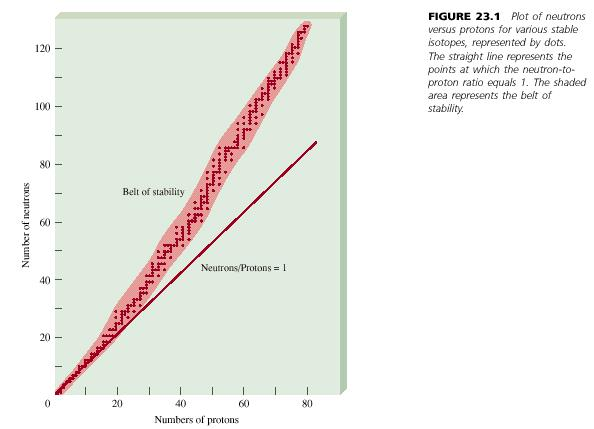
Figure 23.1 A graph showing all the stable isotopes when plotted as neutron number versus proton number. The shaded area represents the belt of stability. In order for isotopes with Z = 20 to be stable, the ratio of n : p must be about 1.1. For isotopes with Z = 40 to be stable, the ratio of n : p must be about 1.3 : 1.0. For isotopes with Z = 80 to be stable, the ratio of n : p must be about 1.5 : 1.0.

Isotopes with too many neutrons lie above the belt of stability. The nuclei of these isotopes decay in such a way as to lower their n : p ratio. Thus one of its neutrons may decay into a proton and a beta particle.
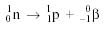
The proton remains in the nucleus, and the beta particle is emitted from the atom. The loss of a neutron and the gain of a proton produces a new isotope with two important properties. It has a lower n : p ratio, and thus is more likely to be stable. Also, the daughter product has an atomic number that is one greater than the decaying isotope due to the additional proton.

Now come to our problem. a nucleus of aluminum-28 lies above the belt of stability is given this means n/p ratio > 1, hence it loses a beta particle as follows


Related Solutions

A proton in an atomic nucleus is bound to other protons and neutrons in the nucleus...
A proton in an atomic nucleus is bound to other protons and neutrons in the nucleus by the strong nuclear force when it is within approximately 3 fm of another particle. What is the approximate kinetic energy of a proton that is localized to such a region? What would be the corresponding energy of an electron localized to within such a region? Compare this to typical beta energies for beta decay. Is a release of electrons
The nucleus of 8Be, which consists of 4 protons and 4 neutrons
The nucleus of 8Be, which consists of 4 protons and 4 neutrons, is very unstable and spontaneously breaks into two alpha particles(helium nuclei, each consisting of 2 protons and 2 neutrons). (a)What is the force between the two alpha particles when they are5.00 X 10-15m apart, and (b) what will be the magnitude of the acceleration of the alpha particles due to this force? Note that the mass of an alpha particle is 4.0026 u.
A Fe-56 atom (iron-56) contains 26 protons in its nucleus. Determine the number of neutrons in...
A Fe-56 atom (iron-56) contains 26 protons in its nucleus. Determine the number of neutrons in its nucleus and then calculate the nuclear binding energy per nucleon for Fe-56. The atomic mass of Fe-56 is 55.934939 u. 492 MeV 18.9 MeV 8.79 MeV 16.4 MeV 9.14 MeV
The neutral Helium atom is made of a nucleus (containing two protons and two neutrons) and...
The neutral Helium atom is made of a nucleus (containing two protons and two neutrons) and two electrons. The electrons have an average separation from the nucleus of r =31pm. Note: 1pm = 10-12m (pico-meter) Consider the average configuration of the Helium atom shown above, treating the nucleus as a single charge of the appropriate size. What is the magnitude of the total electric force acting on one of the electrons?
The nucleus of 8Be, which consists of 4 protons and 4 neutrons, is very unstable and...
The nucleus of 8Be, which consists of 4 protons and 4 neutrons, is very unstable and spontaneously breaks into two alpha particles (helium nuclei, each consisting of 2 protons and 2 neutrons). (a) What is the force between the two alpha particles when they are 3.40 10-15 m apart? Your response differs from the correct answer by more than 10%. Double check your calculations. N (b) What is the initial magnitude of the acceleration of the alpha particles due to...
A helium nucleus (called an alpha particle) contains 2 neutrons and 2 protons with no electrons....
A helium nucleus (called an alpha particle) contains 2 neutrons and 2 protons with no electrons. If any electrons are added, there is a negligible amount of mass added but obviously one negative charge per electron is added. Three particles are injected into a constant B-field of 2T at a velocity of 3×10⁶ms. The first particle is only the alpha particle (He++), the second particle is a nucleus with 1 electron (He+), and the third particle is a nucleus with...
An atom has 20 neutrons and 19 protons in its nucleus. How many electrons are in...
An atom has 20 neutrons and 19 protons in its nucleus. How many electrons are in its outer (valence) electron shell? How many shells does it have? What is its atomic mass in g/mol? What is the element? 1, 3, 39, K 1, 4, 19, Mg 2, 4, 19, Mg 2, 4, 39, K 1, 4, 39, K
Determine the number of protons, neutrons and electron for the element Sodium. The mass number for...
Determine the number of protons, neutrons and electron for the element Sodium. The mass number for the isotope of this element is 25. You must show your work for each determination: _______________ Diamond has a density of 3.52 g/mL. What is the volume in mL of a diamond with a mass of 4.6 g? Show your work. ______________________ Diamond has a density of 3.52 g/mL. What is the volume in mL of a diamond with a mass of 4.6 g?...
calculate the number protons, neutrons and electrons for K+, Cl-, and C
Problem 10.23 An alpha particle (a helium nucleus, containing 2 protons and 2 neutrons) starts out...
Problem 10.23 An alpha particle (a helium nucleus, containing 2 protons and 2 neutrons) starts out with kinetic energy of 10.0 MeV (10.0 × 10⁶ eV), and heads in the +x direction straight toward a gold nucleus (containing 79 protons and 118 neutrons). The particles are initially far apart, and the gold nucleus is initially at rest. Answer the following questions about the collision. What is the initial momentum of the alpha particle? (You may assume its speed is small...
ADVERTISEMENT
ADVERTISEMENT
ADVERTISEMENT