Question
In: Economics
4. Two firms face a market demand of p = 90 – Q, each firm with...
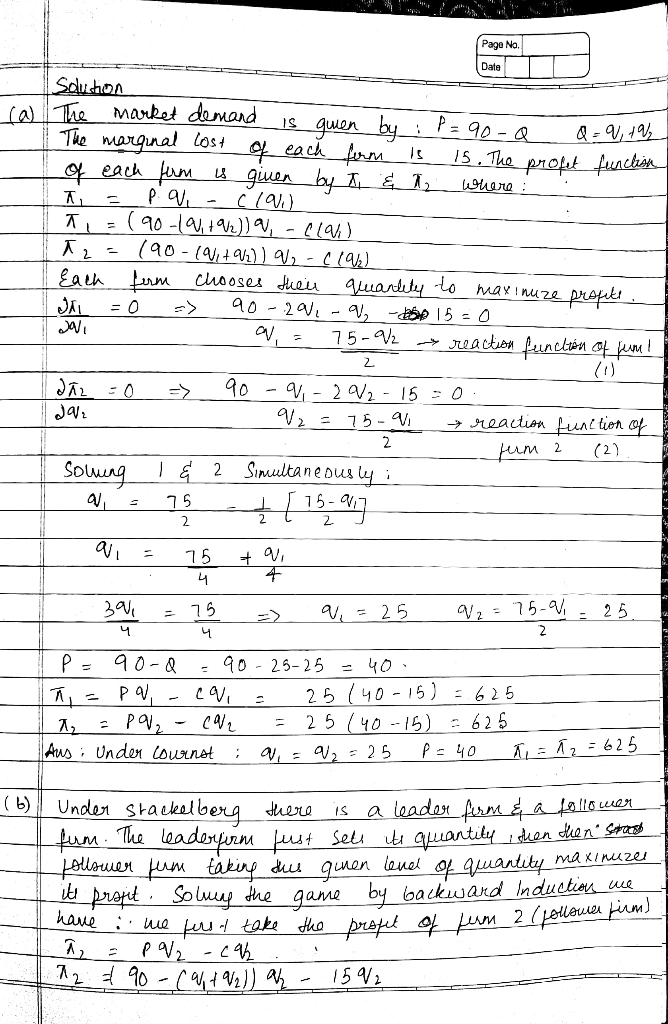
4. Two firms face a market demand of p = 90 – Q, each firm with a constant marginal cost of $15 per unit.
a. What are the Cournot equilibrium q1, q2, price and profits for each firm?
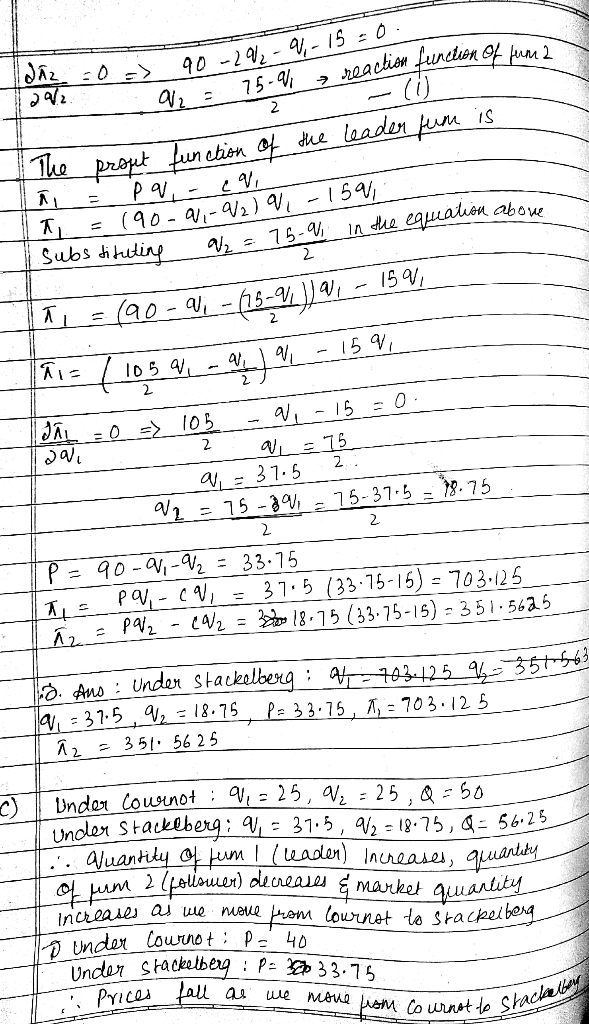
b. What are the Stackelberg equilibrium q1, q2, price and profits for each firm, assuming firm 1 moves first?
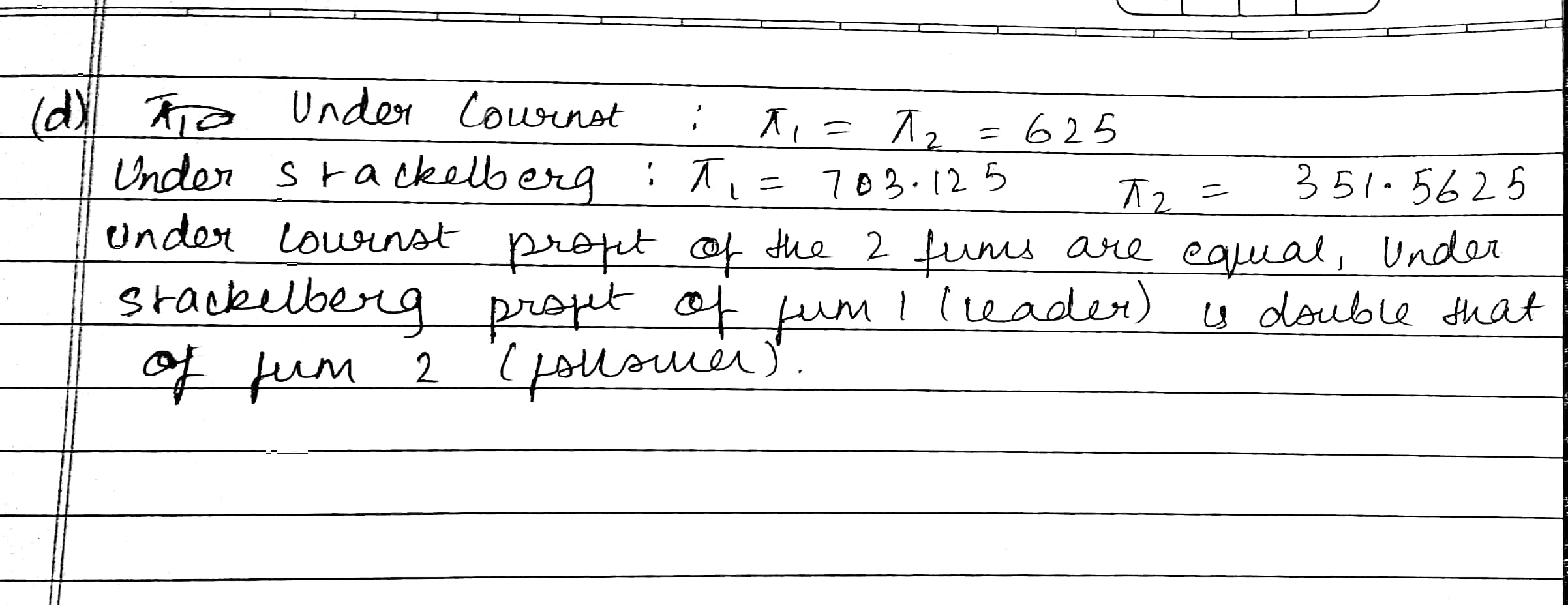
c. Compare the quantities, price and profits between the two models.
Solutions
 Rahul Sunny answered 2 hours ago
Related Solutions
Cournot duopolists face a market demand curve given by P = 90 -Q where Q is...
Cournot duopolists face a market demand curve given by P = 90 -Q
where Q is total market demand. Each firm can produce output at a
constant marginal cost of 30 per unit. There are no fixed costs.
Determine the (1) equilibrium price, (2) quantity, and (3) economic
profits for the total market,(4) the consumer surplus, and (5) dead
weight loss.Show Work
Cournot duopolists face a market demand curve given by P = 90 - Q where Q...
Cournot duopolists face a market demand curve given by P = 90 -
Q where Q is total market demand. Each firm can produce output at a
constant marginal cost of 30 per unit. There are no fixed costs.
Determine the (1) equilibrium price, (2) quantity, and (3) economic
profits for the total market, (4) the consumer surplus, and (5)
dead weight loss.
Cournot duopolists face a market demand curve given by P = 90 - Q where Q...
Cournot duopolists face a market demand curve given by P = 90 -
Q where Q is total market demand. Each firm can produce output at a
constant marginal cost of 30 per unit. There are no fixed cost.
(Just need B through C answer please)
a. Find the equilibrium price, quantity and economic profit for
the total market, consumer surplus and Dead weight loss
b. If the duopolists in question above behave, instead,
according to the Bertrand model, what...
25.) Duopolists face a market demand curve given by P = 90 - Q where Q...
25.) Duopolists face a market demand curve given by P = 90 - Q
where Q is total market demand. Each firm can produce output at a
constant marginal cost of 30 per unit. There are no fixed costs. If
the duopolists behave, according to the Bertrand model, determine
the (1) equilibrium price, (2) quantity, and (3) economic profits
for the total market and (4) the consumer surplus, and (5) dead
weight loss.
Two firms compete in a market with inverse demand P(Q) = a − Q, where the...
Two firms compete in a market with inverse demand P(Q) = a − Q,
where the aggregate quantity is Q = q1 + q2. The profit of firm i ∈
{1, 2} is πi(q1, q2) = P(Q)qi − cqi , where c is the constant
marginal cost, with a > c > 0. The timing of the game is: (1)
firm 1 chooses its quantity q1 ≥ 0; (2) firm 2 observes q1 and then
chooses its quantity q2 ≥...
The market demand is Q=120-P, there are two firms on the market that engage in Stackelber...
The market demand is Q=120-P, there are two firms on the market
that engage in Stackelber competition. Both firms have MC=0 and
FC=0. How much more profit does Stackelber leader made compared to
Cournot?
The market demand curve is given by p = 100 - Q Two firms, A and...
The market demand curve is given by
p = 100 - Q
Two firms, A and B, are competing in the Cournot fashion. Both
firms have the constant marginal cost of 70. Suppose firm A
receives a new innovation which reduces its marginal cost to c.
Find the cutoff value of c which makes this innovation
"drastic".
Consider an oligopolist market with demand: Q = 18 – P. There are two firms A...
Consider an oligopolist market with demand: Q = 18 – P. There
are two firms A and B. The cost function of each firm is given by
C(q) = 8 + 6q. The firms compete by simultaneously choosing
quantities.
a. Write down firm A’s profit function and derive firm A’s
reaction function.
b. Plot the reaction functions of both firms in a diagram.
c. What is the optimal quantity produced by firm A and firm
B?
d. Now suppose firm...
Consider a market with two firms, facing the demand function: p = 120 – Q. Firms...
Consider a market with two firms, facing the demand function: p
= 120 – Q. Firms are producing their output at constant
MC=AC=20.
If the firms are playing this game repetitively for infinite
number of times, find the discount factor that will enable
cooperation given the firms are playing grim trigger strategy.
Q1.Two firms produce in a market with demand P=100-Q. The marginal cost for firm 1 is...
Q1.Two firms produce in a market with demand P=100-Q. The
marginal cost for firm 1 is constant and equals 10. The marginal
cost of firm 2 is also constant and it equals 25. Firm 1 sets
output first. After observing firm 1's output, firm 2 sets its
output. (Please pay attention. Read the brackets correctly.)
1a. For firm 2, the best response is R₂(q₁)=(A-q₁)/2. The value
for A is?
1b. Solve for the Stackelberg equilibrium. The quantity sold by
firm...
ADVERTISEMENT
ADVERTISEMENT
Latest Questions
- 5. Using terms a layperson would understand, state the differences between Congenital and Genetic disorders...
- 4. Two firms face a market demand of p = 90 – Q, each firm with...
- For this lab you will write a Java program that plays a simple Guess The Word...
- what effect did Sutton's discovery that chromosomes come in pairs have on his life?
- Sulfur and fluorine react to form sulfur hexafluoride: S(s)+3F2(g)→SF6(g) Part A If 50.0 g S is...
- Explain how naproxen sodium and ibuprofen are structurally similar.
- For the t test , one uses ----------------instead of σ a. n b. s c. χ²...
ADVERTISEMENT