Question
In: Math
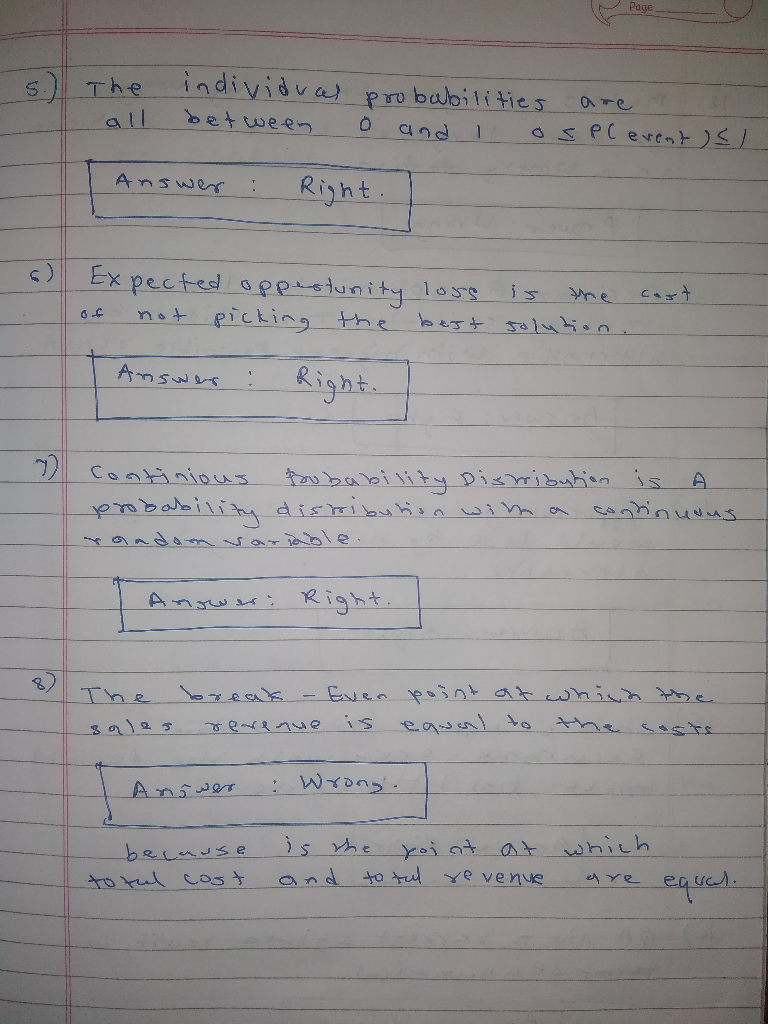
5. the individual probabilities are all between 0 and 1 0 ≤ P (event) ≤ 1 ...
|
5. the individual probabilities are all between 0 and 1 0 ≤ P (event) ≤ 1 o Right or o Wrong |
|
6. Expected opportunity loss (EOL) is the cost of not picking the best solution. o Right or o Wrong |
|
7. Continuous Probability Distribution is A probability distribution with a continuous random variable. o Right or o Wrong |
|
8. The Break-Even Point (BEP) is the price point at which the sales revenue is equal to the costs, |
|
generating zero profit. o Right or o Wrong |
|
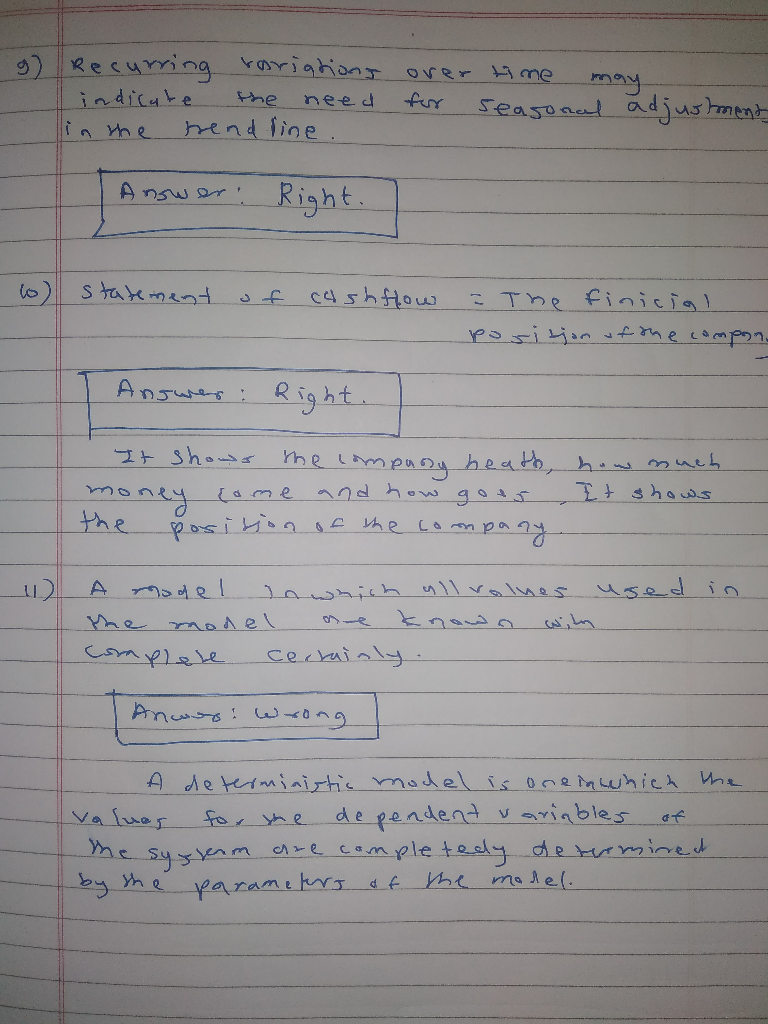
9. Recurring variations over time may indicate the need for seasonal adjustments in the trend line o Right or o Wrong |
|
10. Statement of Cash flow = The financial position of the company o Right or o Wrong |
|
11. Deterministic Model A model in which all values used in the model are known with complete certainty. o Right or o Wrong |
|
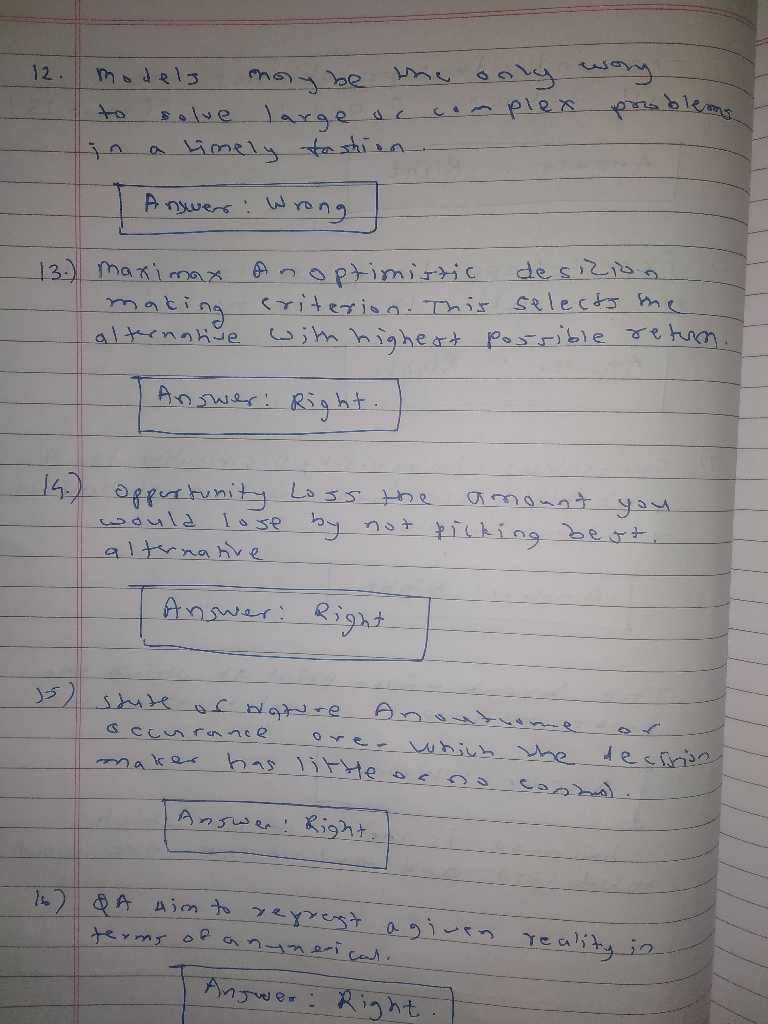
12. Models may be the only way to solve large or complex problems in a timely fashion o Right or o Wrong |
|
13. Maximax An optimistic decision-making criterion. This selects the alternative with the highest possible return. o Right or o Wrong |
|
14. Opportunity Loss The amount you would lose by not picking the best alternative. o Right or o Wrong |
|
15. State of Nature An outcome or occurrence over which the decision maker has little or no control. o Right or o Wrong |
|
16. QA aim to represent a given reality in terms of a numerical value. o Right or o Wrong |
Solutions
 milcah answered 3 weeks ago
Related Solutions
A vector A with |A| = 5 at P (0, 1, 1) and directed towards the...
find the probabilities for each using the standard normal distribution. p(0<z<0.95), p(0<z<1.96), p(-1.38<z<0), p(z>2.33), p(z<-1.51), p(1.56<z<2.13),...
If p is any positive number between 0 and 1, then p4 + C(4,3) p3(1–p) +...
1.- Find the following probabilities. (a) P(Z > 1.4) (b) P(−1 < Z < 1)...
1. Let W be the collection of polynomials, p(x), for which p'(5)=0 (the derivative of the...
Task 1 Calculate the following probabilities: a) P (| X | <1.5), P (X> 2), P...
If the p-value has to be between 1 and 0, how do we approximate the p-value?...
Please answer all parts of the problem, if possible. Let X ~ Binomial (1, p) 0 <p<1...
please be very specific on showing work done!! If Z∼N(μ=0,σ2=1)Z∼N(μ=0,σ2=1), find the following probabilities: P(Z<1.58)=P(Z<1.58)= P(Z=1.58)=P(Z=1.58)=...
probabilities Find the probabilities for each event. Consider rolling a pair of fair dice two times....
- A 244 g mass is hung on a spring. As a result the spring stretches 20.5...
- I'm trying to Generate number every 3 seconds and update the currenet number.I'm able to generate...
- a sulfide of iron, containing 36.5% S by mass, is heated in O2(g), and the products...
- Python previous function: wrtie a function that takes one argument. The function returns True if the...
- A professional couple wishes to purchase a new home costing $750,000, make a 20 percent down...
- Padre holds 100 percent of the outstanding shares of Sonora. On January 1, 2016, Padre transferred...
- Question: Use backtracking algorithm design to write Java code to solve the subset problem: given a...