Question
In: Computer Science
Consider the following code. Explain what this code does and determine the output. Let us discuss....
Consider the following code. Explain what this code does and determine the output. Let us discuss.
#include <iostream>
using namespace std;
int top;
void check (char str[ ], int n, char stack [ ])
{
for(int i = 0 ; i < n ; i++ )
{
if (str [ i ] == ‘(’)
{
top = top + 1;
stack[ top ] = ‘ ( ’;
}
if(str[ i ] == ‘)’ )
{
if(top == -1 )
{
top = top -1 ;
break ;
}
else
{
top = top -1 ;
}
}
}
if(top == -1)
cout << “String is balanced!” << endl;
else
cout << “String is unbalanced!” << endl ;
}
int main ( )
{
char str[ ] = { ‘(‘ , ‘a’ , ‘+’, ‘ ( ’, ‘b ’ , ‘-’ , ‘ c’ ,‘)’ , ‘
) ’} ;
char str1 [ ] = { ‘(’ , ‘(’ , ‘a’ , ‘ + ’ , ‘ b’ , ‘)’ } ;
char stack [ 15 ] ;
top = -1;
check (str , 9 , stack ); //Passing balanced string
top = -1 ;
check(str1 , 5 , stack) ; //Passing unbalanced string
}
Solutions
Expert Solution
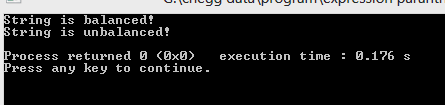
/*
In the provide code the code checks the given expression is
balanced or not. for this
here we are using a check function that identifies the expression
and give the proper
output. for this in function check. we are using stack array as a
stack for push the braces {[()]} for operation
and if the braces come in expression then it will go to stack. if
the operator comes +-/*then
it will pop the expression and match from another stack symbol. and
finally it tells us .. it is
balanced or not
*/
#include <iostream>
using namespace std;
int top;
void check (char str[ ], int n, char stack [ ])
{
for(int i = 0 ; i < n ; i++ )
{
if (str [ i ] == '(')
{
top = top + 1;
stack[ top ] = ' ( ';
}
if(str[ i ] == ')' )
{
if(top == -1 )
{
top = top -1 ;
break ;
}
else
{
top = top -1 ;
}
}
}
if(top == -1)
cout << "String is balanced!" << endl;
else
cout << "String is unbalanced!" << endl ;
}
int main ( )
{
char str[ ] = { '(' , 'a' , '+', ' ( ', 'b ' , '-' , ' c' ,')' , ' ) '} ;
char str1 [ ] = { '(' , '(' , 'a' , ' + ' , ' b' , ')' } ;
char stack [ 15 ] ;
top = -1;
check (str , 9 , stack ); //Passing balanced string
top = -1 ;
check(str1 , 5 , stack) ; //Passing unbalanced string
}
 venereology answered 3 weeks ago
Related Solutions
Explain what this code does. Will this work? Let us discuss cents = new *Ent[num_cents]; for...
Determine the output of the following pseudo-code. Also, explain how did you get this output. fun(int...
What is the output of the following code? Explain your answer in a paragraph or two....
a. What will be the output of LINE A in code “a” and output of code...
Run the following code and explain what the code does Run this code at least twice...
no need to explain 11. What is output by the following code segment? boolean isHighTemp =...
What output is produced by the following code? Explain how it works. public class A {...
Let us consider strategic risk. Look at the matrix and identify the two parameters that determine...
What output is produced by the following code? Explain how it works (at least 5 lines)....
What output is produced by the following code? Explain how it works (at least 5 lines)....
- 1.List 3 differences between Packet Switching and Circuit Switching 2.Briefly explain HOL Blocking 3.List 3 differences...
- 1. Market and firm in short-run and long-run. Suppose, instead of a permanent increase in income,...
- IT Project Management: Explain in detail and give 3 references: What are some ways to manage...
- “A working mother receives $300,000 salary, while spends $30,000 for hiring baby-sitter.” What's the impact on...
- In a women's 100-m race, accelerating uniformly, Laura takes 1.90 s and Healan 3.15 s to...
- The HUANG Company currently has one bond issue outstanding. This bond pays a coupon rate of...
- These two waves travel along the same string: y1 = (3.52 mm) sin(1.75?x - 470?t) y2...