Question
In: Economics
1. Market and firm in short-run and long-run. Suppose, instead of a permanent increase in income,...
1. Market and firm in short-run and long-run.
Suppose, instead of a permanent increase in income, there was a permanent decrease in income. Trace out the complete short-run and long-run impact using our 2 diagram market and firm analysis. Add a few sentences.
2. The Luxury Box.
Suppose a firm can sell 25 luxury boxes at $1,000,000 per box. In order to sell one more luxury box, it must lower its price to $950,000 per box and sell all 26 boxes at this new lower price.
1. What will happen to this firm’s revenue if it sells that extra box? Does it seem like a good idea?
2. What is the relationship between the price the good is sold for and the firm’s marginal revenue?
3. Can you explain your result in b? Why is the price setter different than the price taker?
Solutions
Expert Solution
(1) If instead of permanent increase in income,
there is permanent decrease in income the whole consumption would
decline in the economy in the short run as people do not have
enough money to consume goods, AD shifts back to AD1 which raises
the prices to P1 from P0 and reduce quantity level to Y1 from Y0.
When in long run, suppliers get to know that there is not enough
demand for goods in the market, they will produce less goods as
inventory will rise if they will continue producing at this level,
they will shift SRAS0 to SRAS1 which decreases the prices to its
initial level and reduce quantity level to Y2.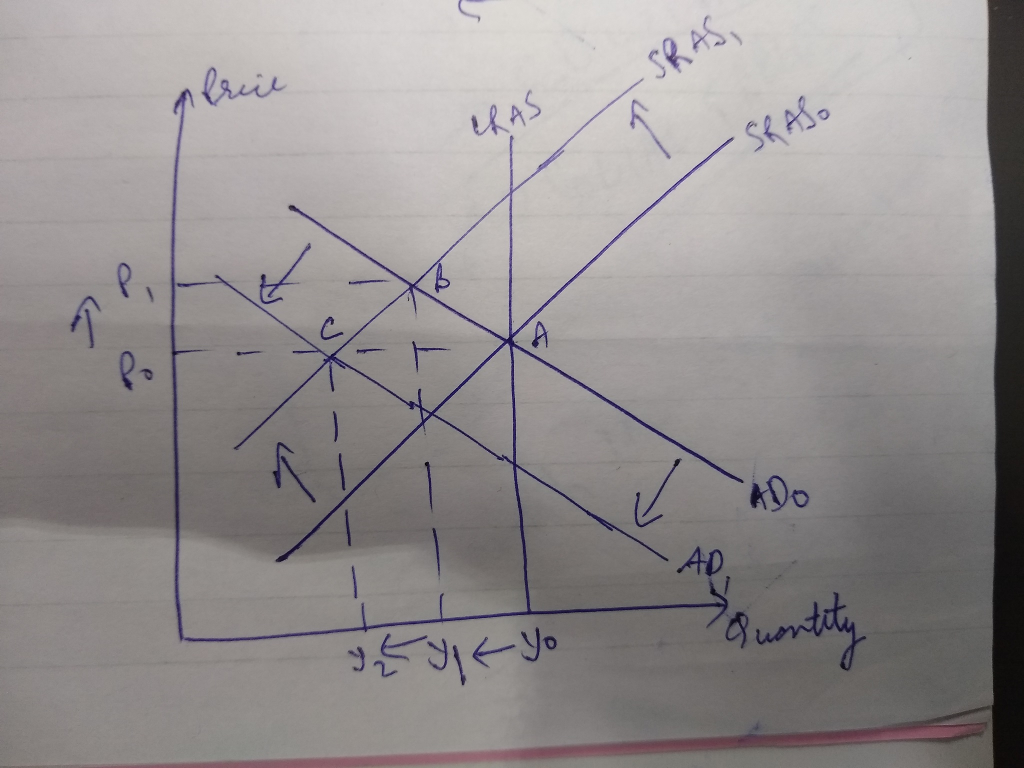
(2) (1) If they sell 25 units in $25000000 and 26 units in 26 * 950000 = $2470000, which is not an profitable case for the company. They must focus on selling 25 units.
(2) (2) Marginal revenue is the revenue generated from the extra unit sold in the market. The price of the extra unit sold can completely change the marginal revenue. Assume a condition there is excess inventory reserve of a firms and they are willing to sell their quantity at any level of price above their cost. Assume the normal selling is $100 and they are ready top sell it at $55 which reduces the marginal revenue and assume another condition when they have huge demand for the produce and in this case they can charge $110 dollars too which can raise the marginal revenue.
(2) (3) A price setter is an entity that has the ability to set its own prices, because its products are sufficiently differentiated from those of competitors while a price taker is a person or company that has no control to dictate prices for a good or service.
 Rahul Sunny answered 1 hour ago
Related Solutions
Suppose that this increase in oil prices was permanent. What are the long run effects on...
using permanent income hypothesis, how the effect on long run and short run consumption income relationship...
1. A firm should ________ in the short run and ________ in the long run if...
The idea of permanent income is that consumption depends on a long-run measure of income rather...
Suppose the economy is in long-run equilibrium. If there is a sharp increase in the minimum wage as well as an increase in taxes, then in the short run, real GDP will
1. The difference between a monopolistically competitive firm in the short run versus the long run...
Assume instead that an increase in the money supply raises real output in the short run....
1. The "business cycle" refers to short-run fluctuations in macroeconomic activity. a long-run increase in GDP....
The creation of the Permanent Income Hypothesis was generated out of the observed difference between short-run...
Use the AD-AS diagram to graphically illustrate the short-run and long run impacts of an increase...
- 1. Market and firm in short-run and long-run. Suppose, instead of a permanent increase in income,...
- IT Project Management: Explain in detail and give 3 references: What are some ways to manage...
- “A working mother receives $300,000 salary, while spends $30,000 for hiring baby-sitter.” What's the impact on...
- In a women's 100-m race, accelerating uniformly, Laura takes 1.90 s and Healan 3.15 s to...
- The HUANG Company currently has one bond issue outstanding. This bond pays a coupon rate of...
- These two waves travel along the same string: y1 = (3.52 mm) sin(1.75?x - 470?t) y2...
- An analyte has been discovered ( so it's new) in the Tobago population. Define the term...