Question
In: Computer Science
Using Visual Studio, C# Programming Lecture: Objects, Inheritance and abstract classes, member init list, shape, circle...
Using Visual Studio, C# Programming
Lecture: Objects, Inheritance and abstract classes, member init list, shape, circle and cylinder.
Complete Exercises 4 and 5 (100pts)
4. Person and customer classes
Design a class named Person with properties for holding a person's name, address, and telephone number. Next, design a class named Customer, which is derived form the Person class. The Customer class should have a property for a customer number and a Boolean property indicating whether the customer wishes to be on a mailing list, Demonstrate an object of the Customer class in a simple application.
5. PreferredCustomer Class
A retail store has a preferred customer plan where customers can earn discounts on all their purchases. The amount of a customers discount is determined by the amount of the customers cummulative purchases in the store as follows:
- When a preferred customer spends $500, he or she gets a 5 percent discount on all future purchases.
- When a preferred customer spends $1,000, he or she gets a 6 percent discount on all future purchases.
- When a preferred customer spends $1,500, he or she gets a 7 percent discount on all future purchases.
- When a preferred customer spends $2,000, he or she gets a 10 percent discount on all future purchases.
Design a class named PreferredCustomer, which is derived from the Customer class you created in Exercise 4. The PreferredCustomer class should have properties for the amount of the customer's purchases and the customer's discount level. Demonstrate the class in a simple application.
Complete below for 100pts extra credit
- Use overloaded constructors and member initialization list
- Person will be an abstract class with a virtual function called CalcDiscount
- Override the discount method for a normal customer and
for a preferred customer
- A normal customer gets a 0% discount review #5 for a preferred customer
- Create one array of the defined Person object where you instantiate Customers and Preferred Customers in the array
- Implement and test your override of the discount method
- Remember your array must be of the Person type
Person[] people=new Person[2];
people[0]=new Customer(arguments here);
people[1]=new Preferredcustomer(arguments here);
people[0].calcdiscount();
people[1].calcdiscount();
| use overridden methods to effect polymorphism. | overload operators
to enable them to manipulate objects. |
| determine an
object’s type at execution time. |
create sealed
methods and classes. |
| create abstract
classes and methods. |
Solutions
Expert Solution
Note: Done accordingly. Please comment for any problem. Please Uprate. Thanks
Code:
Customer.cs
using System;
using System.Collections.Generic;
using System.Linq;
using System.Text;
using System.Threading.Tasks;
namespace CustomerManagement
{
public class Customer : Person
{
public Customer(string name, string address, string phone, string
id,
bool onEmailList)
: base(name, address, phone)
{
CustomerID = id;
OnEmailList = onEmailList;
}
public string CustomerID { get; set; }
public bool OnEmailList { get; set; }
public override double calcDiscount()
{
return 0;
}
public override string ToString()
{
return
String.Format(
"CustomerID: {0}\nCustomer Name: {1}\nCustomerAddress: {2}\n"
+
"Customer Phone: {3} \n" +
"Customer On Email List: {4}\nDiscount: {5}%",
CustomerID, CustomerName, Address, Phone, OnEmailList, 0
);
}
}
}
Person.cs
using System;
using System.Collections.Generic;
using System.Linq;
using System.Text;
using System.Threading.Tasks;
namespace CustomerManagement
{
public abstract class Person
{
public Person(string name, string address, string phone)
{
CustomerName = name;
Address = address;
Phone = phone;
}
public string CustomerName { get; set; }
public string Address { get; set; }
public string Phone { get; set; }
public virtual double calcDiscount(){
return -1;
}
}
}
PreferredCustomer.cs
using System;
using System.Collections.Generic;
using System.Linq;
using System.Text;
using System.Threading.Tasks;
namespace CustomerManagement
{
public class PreferredCustomer : Customer
{
public PreferredCustomer(string name, string address, string phone,
string id,
int spentAmount, bool onEmailList)
: base(name, address, phone, id, onEmailList)
{
this.spentAmount = spentAmount;
discountLevel = setDiscountLevel();
}
public double spentAmount { get; set; }
public double discountLevel { get; set; }
public double setDiscountLevel()
{
int range = (int)spentAmount / 500;
switch (range)
{
case 0:
return 0;
case 1:
return 0.05;
case 2:
return 0.06;
case 3:
return 0.07;
default:
return 0.10;
}
}
public override string ToString()
{
return
String.Format(
"CustomerID: {0}\nCustomer Name: {1}\nCustomerAddress: {2}\n"
+
"Customer Phone: {3} \n" +
"Customer Spending: {4:C2}\nCustomer On Email List: {5}\nEligible
for discount: {6}%",
CustomerID, CustomerName, Address, Phone, spentAmount,
OnEmailList,discountLevel*100
);
}
public override double calcDiscount()
{
setDiscountLevel();
return discountLevel;
}
}
}
Main.cs
using System;
using System.Collections.Generic;
using System.Linq;
using System.Text;
using System.Threading.Tasks;
namespace CustomerManagement
{
class Program
{
static void Main(string[] args)
{
Person[] people=new Person[2];
people[0] = new Customer("Cust", "NYC", "98909", "1", false);
people[1]=new PreferredCustomer("Preffered Cust","NYC","98809","2",6000,true);
Console.WriteLine("Discount for normal customer
:"+people[0].calcDiscount()*100 + " %");
Console.WriteLine("Discount for preferred customer :" + people[1].calcDiscount() * 100 + " %\n\n");
Console.WriteLine(people[0]);
Console.WriteLine(people[1]);
Console.ReadKey();
}
}
}
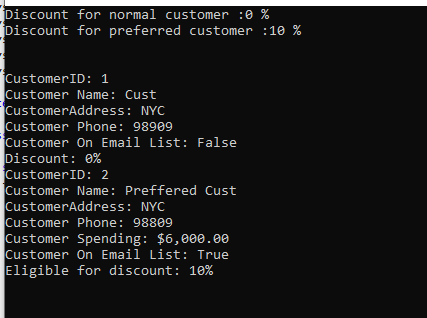
Output:
 venereology answered 1 month ago
Related Solutions
there is a superclass SHAPE, and 2 derived classes CIRCLE and CYLINDER. The member methods of...
Write a C# code that creates objects and classes with their member functions for KrisFlyer, a...
Please do this in visual studio C++. Overview In this programming challenge, you will create an...
Homework 3 – Programming with C++ What This Assignment Is About: • Classes and Objects •...
Programming Language: C# CheckingAccount class You will implement the CheckingAccount Class in Visual Studio. This is...
The solution has to be written on C++ Visual Studio Thank you (Package Inheritance Hierarchy) Package-delivery...
Chapter 9 Programming Project (Inheritance, Abstract Class/Methods, Overriding Methods) -For all classes, you need to provide...
This is a discussion question for my csc 252 computer programming c++ visual studio so post...
Objectives: 1. To get familiar with C# programming language 2. To get familiar with Visual Studio...
answer the following using C# Design and program a Visual Studio Console project in C# that...
- Based on what you learned in this module, identify one person who you believe possesses primarily...
- An Auditor may decide to make use of a specialist in obtaining sufficient appropriate audit evidence...
- Dirac's Theorem states that "A simple graph with n vertices (n >= 3) is Hamiltonian if...
- Two 10-cm-diameter charged rings face each other, 15cm apart. The left ring is charged to -29nC...
- Under what conditions would it be possible for an excise tax to have no efficiency cost...
- explain the difference between activities and financial statements of service businesses and merchandising businesses.
- 2. Compare and compare the matrix multiplication algorithm and the Floyd-Warshall algorithm to find all pairs...