Question
In: Accounting
Lou Barlow, a divisional manager for Sage Company, has an opportunity to manufacture and sell one...
Lou Barlow, a divisional manager for Sage Company, has an opportunity to manufacture and sell one of two new products for a five-year period. His annual pay raises are determined by his division’s return on investment (ROI), which has exceeded 23% each of the last three years. He has computed the cost and revenue estimates for each product as follows:
| Product A | Product B | ||||
| Initial investment: | |||||
| Cost of equipment (zero salvage value) | $ | 280,000 | $ | 490,000 | |
| Annual revenues and costs: | |||||
| Sales revenues | $ | 340,000 | $ | 440,000 | |
| Variable expenses | $ | 156,000 | $ | 206,000 | |
| Depreciation expense | $ | 56,000 | $ | 98,000 | |
| Fixed out-of-pocket operating costs | $ | 79,000 | $ | 59,000 | |
The company’s discount rate is 15%.
Click here to view Exhibit 8B-1 and Exhibit 8B-2, to determine the appropriate discount factor using tables.
Required:
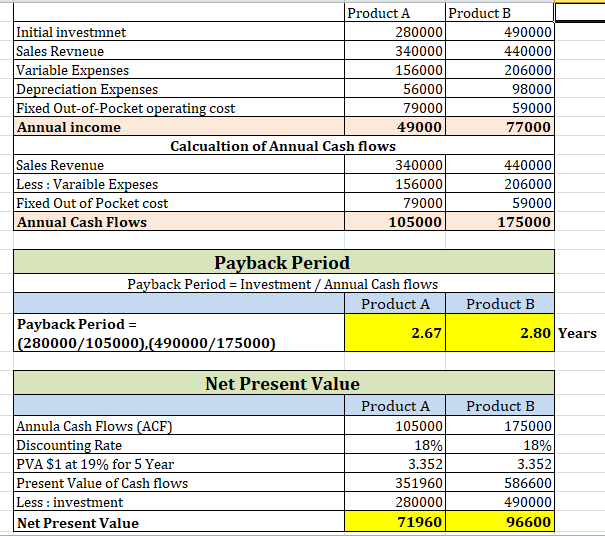
1. Calculate the payback period for each product. (Round your answers to 2 decimal places.)
2. Calculate the net present value for each product. (Round discount factor(s) to 3 decimal places.)
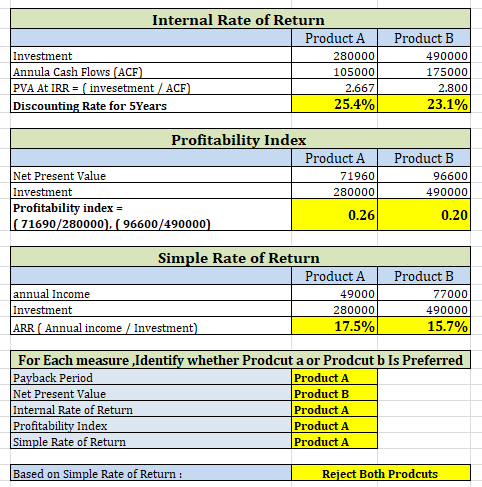
3. Calculate the internal rate of return for each product. (Round percentage answers to 1 decimal place. i.e. 0.1234 should be considered as 12.3% and round discount factor(s) to 3 decimal places.)
4. Calculate the project profitability index for each product. (Round discount factor(s) to 3 decimal places. Round your answers to 2 decimal places.)
5. Calculate the simple rate of return for each product. (Round percentage answers to 1 decimal place. i.e. 0.1234 should be considered as 12.3%.)
6a. For each measure, identify whether Product A or Product B is preferred.
6b. Based on the simple rate of return, Lou Barlow would likely:
| Accept Product A | |
| Accept Product B | |
| Reject both products |
Solutions
 ekkarill92 answered 1 month ago
Related Solutions
Lou Barlow, a divisional manager for Sage Company, has an opportunity to manufacture and sell one...
Lou Barlow, a divisional manager for Sage Company, has an opportunity to manufacture and sell one...
Lou Barlow, a divisional manager for Sage Company, has an opportunity to manufacture and sell one...
Lou Barlow, a divisional manager for Sage Company, has an opportunity to manufacture and sell one...
Lou Barlow, a divisional manager for Sage Company, has an opportunity to manufacture and sell one...
Lou Barlow, a divisional manager for Sage Company, has an opportunity to manufacture and sell one...
Lou Barlow, a divisional manager for Sage Company, has an opportunity to manufacture and sell one...
Lou Barlow, a divisional manager for Sage Company, has an opportunity to manufacture and sell one...
Lou Barlow, a divisional manager for Sage Company, has an opportunity to manufacture and sell one...
Lou Barlow, a divisional manager for Sage Company, has an opportunity to manufacture and sell one...
- Fogerty Company makes two products—titanium Hubs and Sprockets. Data regarding the two products follow: Direct Labor-Hours...
- 1. Imagine that you want to obtain a loan from a bank for a business that...
- Write a function named int2ordinal that takes an integer as its only parameter and returns the...
- An experiment to measure the value of g is constructed using a tall tower outfitted with...
- Discuss the two estimation methods of classification-type data mining models while considering ANN as a classifier.
- For the equilibrium: CO2(g) + H2(g) ⇌ CO(g) + H2O(g), Kp = 10-5 at 25°C and...
- Sanyu Sony started a new business and completed these transactions during December. Dec. 1 Sanyu Sony...