Question

In: Physics

An electron is constrained to the central perpendicular axis of a ring of charge of radius...

An electron is constrained to the central perpendicular axis of a ring of charge of radius 2.3 m and charge 0.020 mC. Suppose the electron is released from rest a distance 0.056 m from the ring center. It then oscillates through the ring center. Calculate its period. (The electron is always much closer to the ring center than a radius.)

Solutions

Expert Solution

I have solved this question earlier with different figures. Please workout using yours figures. If you need any further help just PM me. If I have helped you please rate me 5 stars first (before you rate anyone else)

An electron is constrained to the central perpendicular axis of a ring of charge of radius 2.6 m and charge 0.020 mC. See Section 22-6. Suppose the electron is released from rest a distance 0.085 m from the ring center. It then oscillates through the ring center. Calculate its period in seconds. (The electron is always much closer to the ring center than a radius.)   
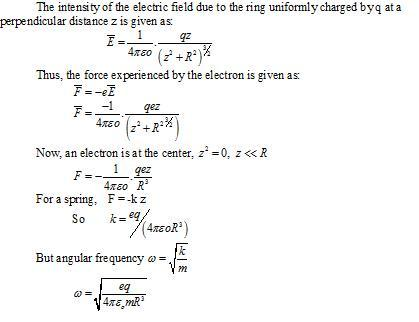
As we know that Period ( T ) = 2? / ?

   Charge ( q ) = 0.046 mC = 0.046 * 10-3C

Radius ( R ) = 2.9 m

Charge of electron ( e ) = 1.6 * 10-19C

Mass of the electrion ( m ) = 9.1 * 10-31kg

   k = 1/4??o = 9 *109 Nm2/C2

Plugin the values and solve it


Related Solutions

A uniformly charged, thin ring has radius 15.5 cm and total charge +23.3 nC. An electron...
A uniformly charged, thin ring has radius 15.5 cm and total charge +23.3 nC. An electron is placed on the ring’s axis a distance 26.1 cm from the center of the ring and is constrained to stay on the axis of the ring. The electron is then released from rest. Find the speed of the electron when it reaches the center of the ring. (Give your answer in scientific notation using m/s as unit)
A ring of charge with radius 1.5 cm and a charge of 100nC has the electric...
A ring of charge with radius 1.5 cm and a charge of 100nC has the electric field along the primary axis of the ring as E=kQx/(R^2+x^2)^3/2 1. find electric field 2.25 cm from the center of the ring along the primary axis 2. what force would a charge of -5nC experience at this point 3. what point charge would you have to place at x=-5cm to make the electric field zero at this location?
A ring of charge with radius R = 2.5 m is centered on the origin in...
A ring of charge with radius R = 2.5 m is centered on the origin in the x-y plane. A positive point charge is located at the following coordinates: x = 17.1 m y = 3.8 m z = -16.3 m The point charge and the total charge on the ring are the same, Q = +81 C. Find the net electric field along the z-axis at z = 4.5 m. Enet,x = Enet,y = Enet,z =
An electron of charge q = -c is first traveling perpendicular to a constant electric field....
An electron of charge q = -c is first traveling perpendicular to a constant electric field. Illustrate a diagram depicting the trajectory of the electron, and name the shape of the trajectory (whether it's linear, circular, parabolic, hyperbolic, or elliptical). Explain why the electron has the trajectory you found out.
Let us model an electron not as a point charge, but as a sphere of radius...
Let us model an electron not as a point charge, but as a sphere of radius R over whose surface the the charge −1.6 × 10⁻¹⁹ C is distributed uniformly. (a) Calculate the energy density u(r) of the electric field at all points in space (i.e., both inside and outside the sphere). (b) Calculate the total energy associated with the electron’s field. There are at least two equivalent ways to do this: (1) You can integrate the energy density directly,...
An electron is released from rest on the axis of an electric dipole that has charge...
An electron is released from rest on the axis of an electric dipole that has charge e and charge separation d = 33 pm and that is fixed in place. The release point is on the positive side of the dipole, at distance 9.4d from the dipole center. What is the electron's speed when it reaches a point 3.2d from the dipole center?
A charge of 2.20 µC is uniformly distributed on a ring of radius 9.0 cm. Find...
A charge of 2.20 µC is uniformly distributed on a ring of radius 9.0 cm. Find the electric field strength on the axis at the following locations. (a) 1.2 cm from the center of the ring N/C (b) 3.9 cm from the center of the ring N/C (c) 4.0 m from the center of the ring N/C (d) Find the field strength at 4.0 m using the approximation that the ring is a point charge at the origin. N/C (e)...
A charge of 2.20 µC is uniformly distributed on a ring of radius 9.0 cm. Find...
A charge of 2.20 µC is uniformly distributed on a ring of radius 9.0 cm. Find the electric field strength on the axis at the following locations. (be careful calculating c and d the last post was wrong. please include e.) (a) 1.2 cm from the center of the ring   N/C (b) 3.9 cm from the center of the ring   N/C (c) 4.0 m from the center of the ring   N/C (d) Find the field strength at 4.0 m using...
A nonconducting ring of radius of 11.6 cm is uniformly charged with a total positive charge...
A nonconducting ring of radius of 11.6 cm is uniformly charged with a total positive charge of 10.0 µC. The ring rotates at a constant angular speed 18.6 rad/s about an axis through its center, perpendicular to the plane of the ring. What is the magnitude of the magnetic field on the axis of the ring 5.00 cm from its center? pT
Consider an electron between two grounded conducting parallel plates perpendicular the x axis, and intersecting x...
Consider an electron between two grounded conducting parallel plates perpendicular the x axis, and intersecting x at ±a. A particle with charge q is placed at x = a/2 between the plates. Derive an expression for the magnitude and direction of the force exerted on the particle. Write your answer in terms of the parameters q and a of the problem, and use a computer if necessary to obtain a numerical value for your answer. Computed numerical values should be...
ADVERTISEMENT
ADVERTISEMENT
ADVERTISEMENT