Question

In: Accounting

An investor company owns 30% of the common stock of an investee company. The investor has...

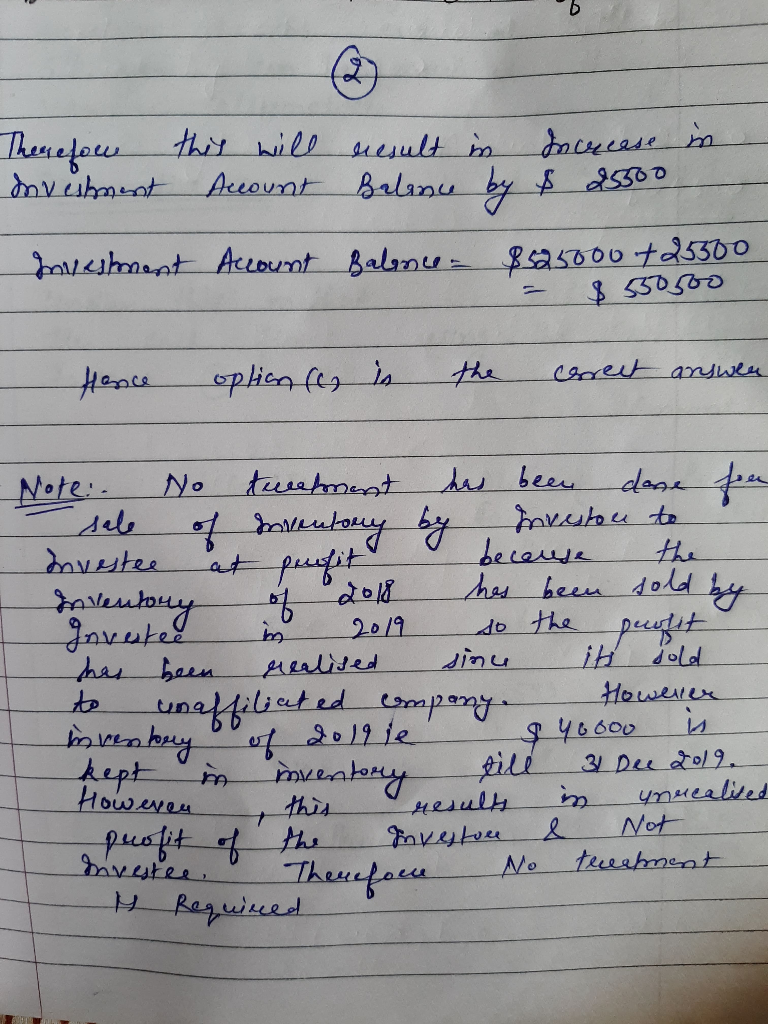
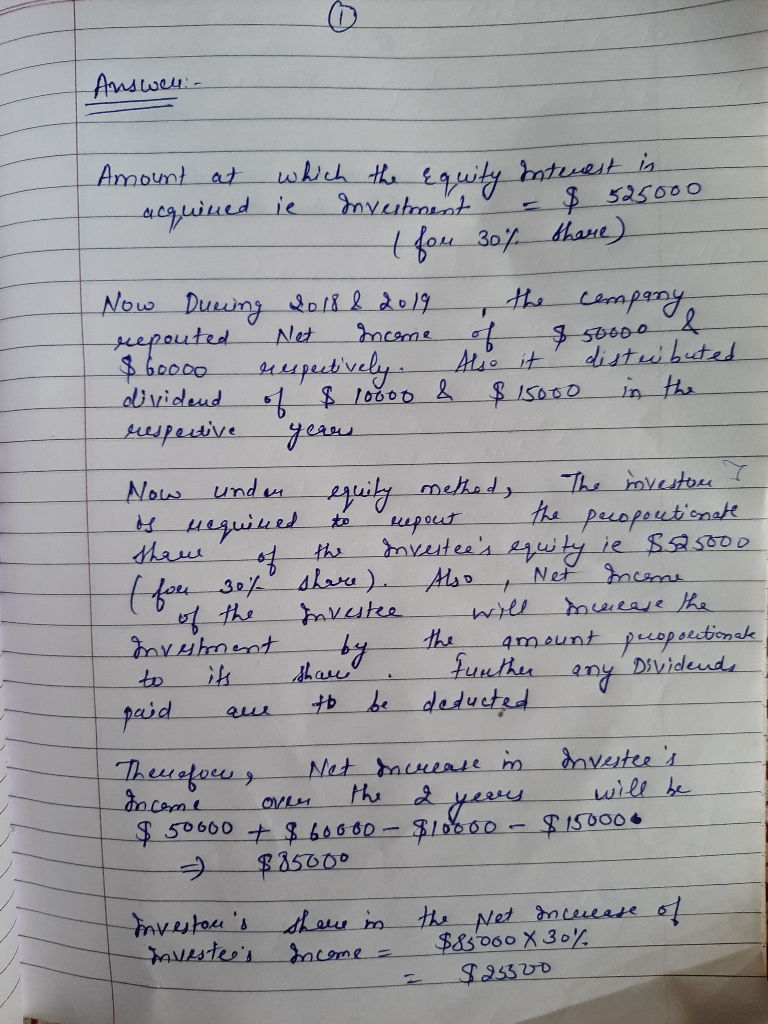
An investor company owns 30% of the common stock of an investee company. The investor has significant influence over the investee, and acquired its equity interest in the investee on January 1, 2018 for $525,000. On the date of acquisition, the investee’s stockholders equity was $1,500,000, and the fair values of the investee’s individual net assets were equal to their reported book values. During the year ended December 31, 2018, the investee reported net income of $50,000 and dividends of $10,000. During the year ended December 31, 2019, the investee reported net income of $60,000 and dividends of $15,000. The investor routinely sells inventory to the investee at a 25% profit margin. At December 31, 2018 and 2019, the investee held inventories purchased from the investor for $30,000 and $40,000, respectively. (At the end of each period, all of these inventories are sold by the investee to unaffiliated companies in the next period.)

What is the balance in the Equity Investment account on December 31, 2019?

Select one:

a. $ 525,000

b. $ 547,500

c. $ 550,500

d. $ 570,000

Solutions
Expert Solution


Related Solutions

Assume an investor acquired 100% of the voting common stock of an investee on January 1,...
Assume an investor acquired 100% of the voting common stock of an investee on January 1, 2012 in a transaction that qualifies as a business combination. As a result of the acquisition, the investor recognized no goodwill and no bargain purchase gain in the post-acquisition consolidated financial statements (i.e., all of the resulting Acquisition Accounting Premium relates to identifiable net assets). The investor uses the equity method to account for its pre-consolidation investment in the investee. In addition, there are...
Multiple Choice Investor is not a parent entity if The investor has power over the investee...
Multiple Choice Investor is not a parent entity if The investor has power over the investee Investors have the ability to influence investment returns The investor has the right to the investee's variable returns The investor has significant influence over the investee The accounting method applied for business combinations in accordance with PSAK 22 / IFRS 3 is: Acquisition method The pooling of ownership method Proportional consolidation method Equity method A is a newly formed entity to acquire B and...
The following financial statement information is for an investor company and an investee company on January...
The following financial statement information is for an investor company and an investee company on January 1, 2013. On January 1, 2013, the investor company's common stock had a traded market value of $10.5 per share, and the investee company's common stock had a traded market value of $19 per share. Book Values Fair Values Investor Investee Investor Investee Receivables & inventories $60,000 $30,000 $54,000 $27,000 Land 120,000 60,000 180,000 90,000 Property & equipment 135,000 60,000 150,000 78,000 Trademarks &...
On January 1, 2013, an investor purchases 18,000 common shares of an investee at $12 (cash)...
On January 1, 2013, an investor purchases 18,000 common shares of an investee at $12 (cash) per share. The shares represent 20% ownership in the investee. The investee shares are not considered "marketable" because they do not trade on an active exchange. On January 1, 2013, the book value of the investee's assets and liabilities equals $900,000 and $200,000, respectively. On that date, the appraised fair values of the investee's identifiable net assets approximated the recorded book values, except for...
Prout Company owns 80% of the common stock of Sexton Company. The stock was purchased for...
Prout Company owns 80% of the common stock of Sexton Company. The stock was purchased for $1,600,000 on January 1, 2017, when Sexton Company's retained earnings were $800,000. On January 1, 2019, Prout Company sold fixed assets to Sexton Company for $360,000. These assets were originally purchased by Prout Company for $400,000 on January 1, 2009, at which time their estimated depreciable life was 25 years. The straight‐line method of depreciation is used. On December 31, 2020, the trial balances...
Baker Company has common and preferred stock outstanding as follows. Common stock: 100,000 shares, $30 par...
Baker Company has common and preferred stock outstanding as follows. Common stock: 100,000 shares, $30 par value 8 percent preferred stock: 10,000 shares, $100 par value Dividends on preferred stock have not been paid for the last three years (in addition to the current year). a. If the company pays a total of $120,000 in dividends, how much will the common stockholders receive per share if the preferred stock is not cumulative? (Round your answer to 2 decimal places.) b....
Consider an investor who owns stock XYZ. The stock is currently trading at $120. The investor...
Consider an investor who owns stock XYZ. The stock is currently trading at $120. The investor worries that the outlooks for the market and the stock are not favorable. The investor decides to protect his potential losses by using derivatives. Assume the investor decided to purchase a European call option on stock ABC. Further assume that the current price of the stock is $130. The investor paid $10 for the call with the strike price at $155. (A)If the stock...
Simon Company owns 40% of the outstanding voting common stock of Nixon Corp. and has the...
Simon Company owns 40% of the outstanding voting common stock of Nixon Corp. and has the ability to significantly influence Nixon Corp.’s operations. During 2016 Simon had sold inventory costing $35,000 to Nixon for $50,000. All but 25% of that inventory had been sold to outsiders by Nixon Corp. by then end of fiscal year 2016. What amount of unrealized intra-entity inventory profit should be deferred by Simon Company in 2016? What is the journal entry that Simon company would...
Matthew, Inc. owns 30 percent of the outstanding stock of Lindman Company and has the ability...
Matthew, Inc. owns 30 percent of the outstanding stock of Lindman Company and has the ability to significantly influence the investee’s operations and decision making. On January 1, 2018, the balance in the Investment in Lindman account is $336,000. Amortization associated with this acquisition is $17,100 per year. In 2018, Lindman earns an income of $126,000 and declares cash dividends of $31,500. Previously, in 2017, Lindman had sold inventory costing $31,800 to Matthew for $53,000. Matthew consumed all but 25...
Matthew, Inc. owns 30 percent of the outstanding stock of Lindman Company and has the ability...
Matthew, Inc. owns 30 percent of the outstanding stock of Lindman Company and has the ability to significantly influence the investee’s operations and decision making. On January 1, 2018, the balance in the Investment in Lindman account is $398,000. Amortization associated with this acquisition is $17,700 per year. In 2018, Lindman earns an income of $206,000 and declares cash dividends of $51,500. Previously, in 2017, Lindman had sold inventory costing $32,900 to Matthew for $47,000. Matthew consumed all but 20...
ADVERTISEMENT
ADVERTISEMENT
ADVERTISEMENT