Question
In: Physics
A body moves along a straight line, its distance from the origin at any instant being...
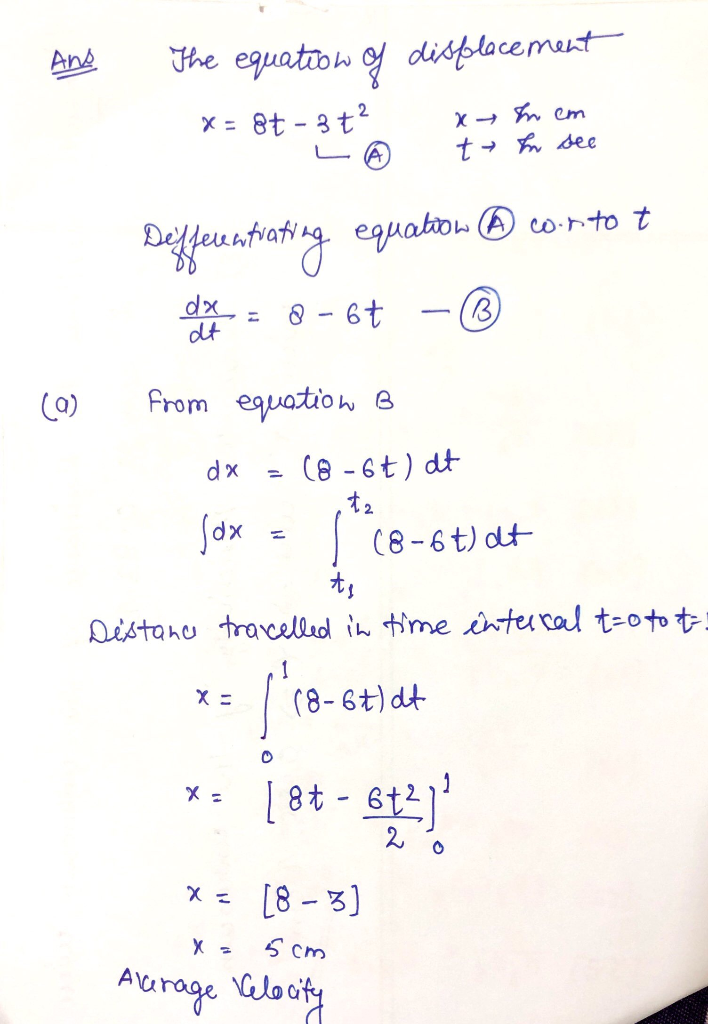
A body moves along a straight line, its distance from the origin at any instant being given by the equation x = 8t − 3t^2, where x is in centimeters and t is in seconds.
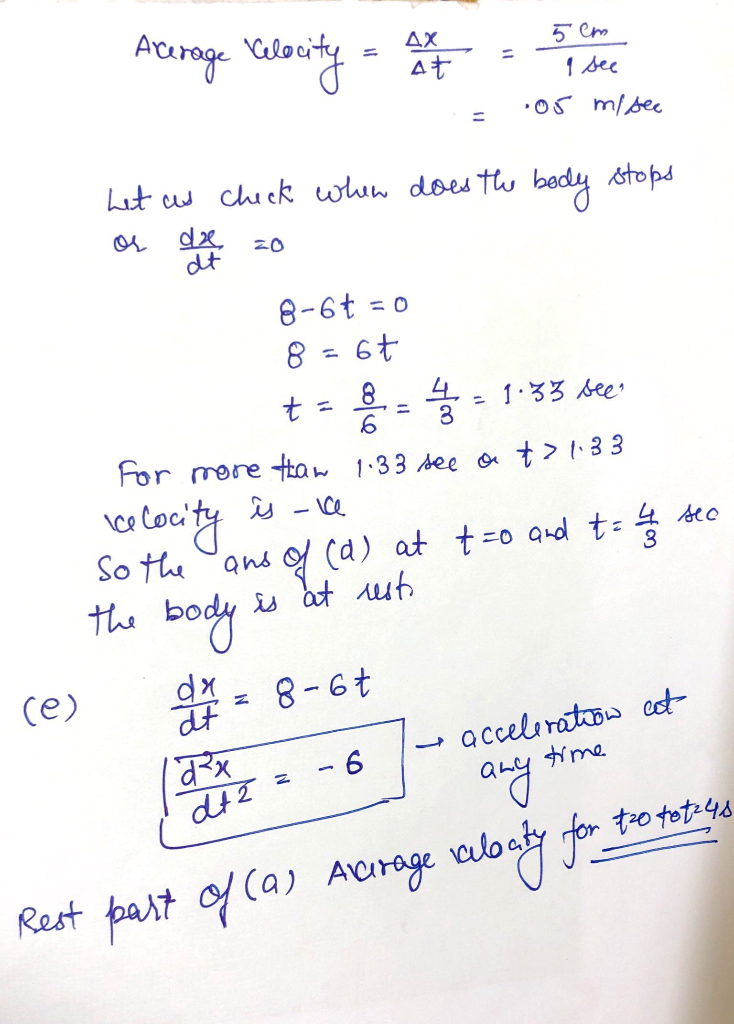
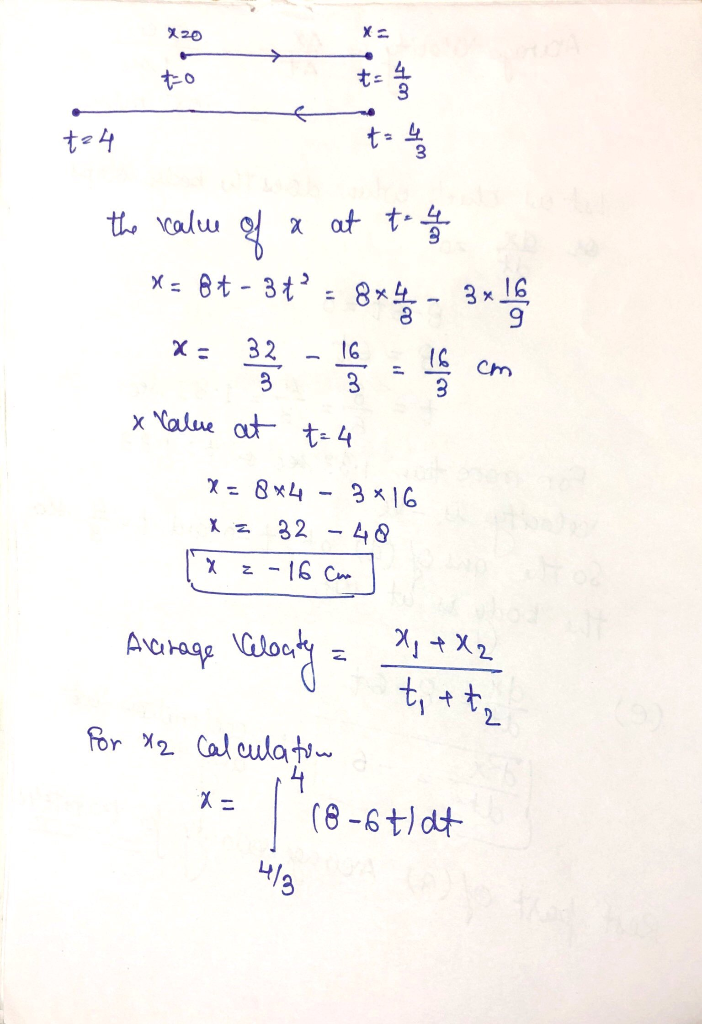
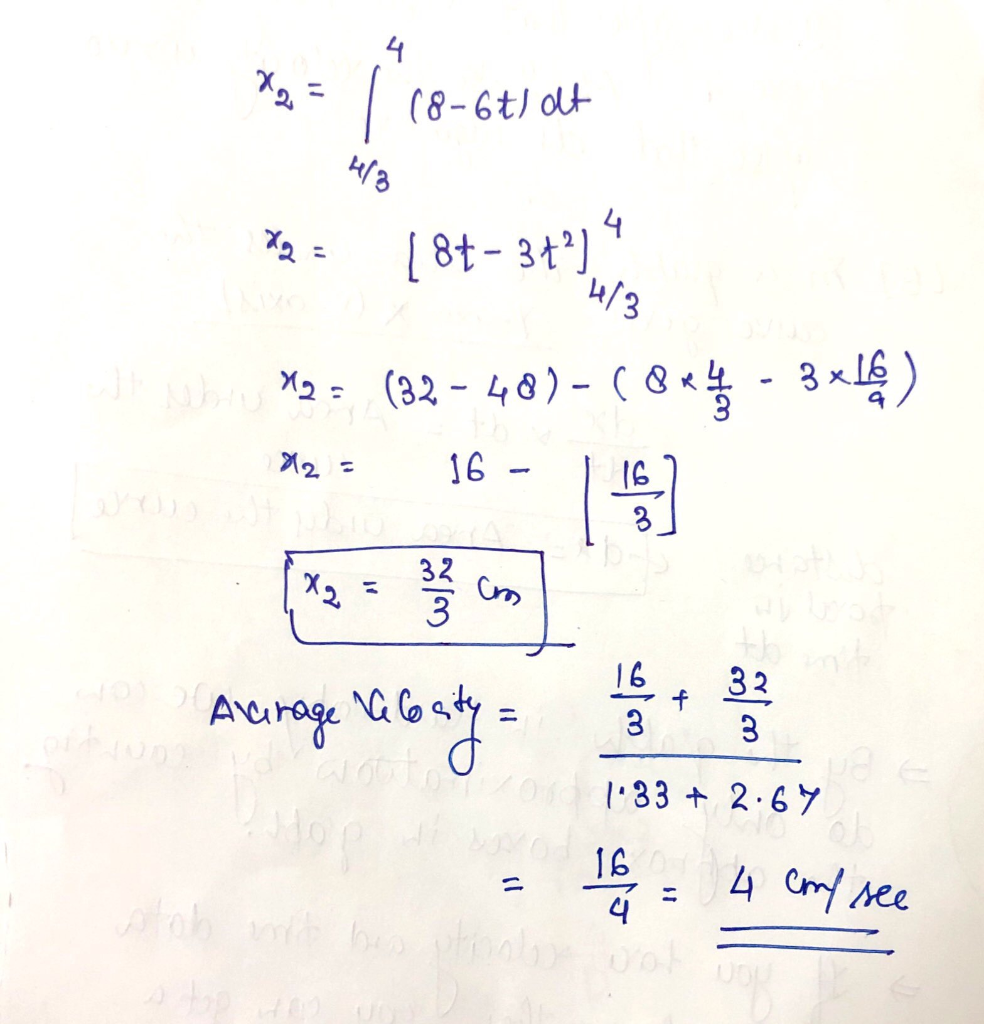
(a) Find the average velocity of the body in the interval from t = 0 to t = 1 sec, and in the interval from t = 0 to t = 4 sec.
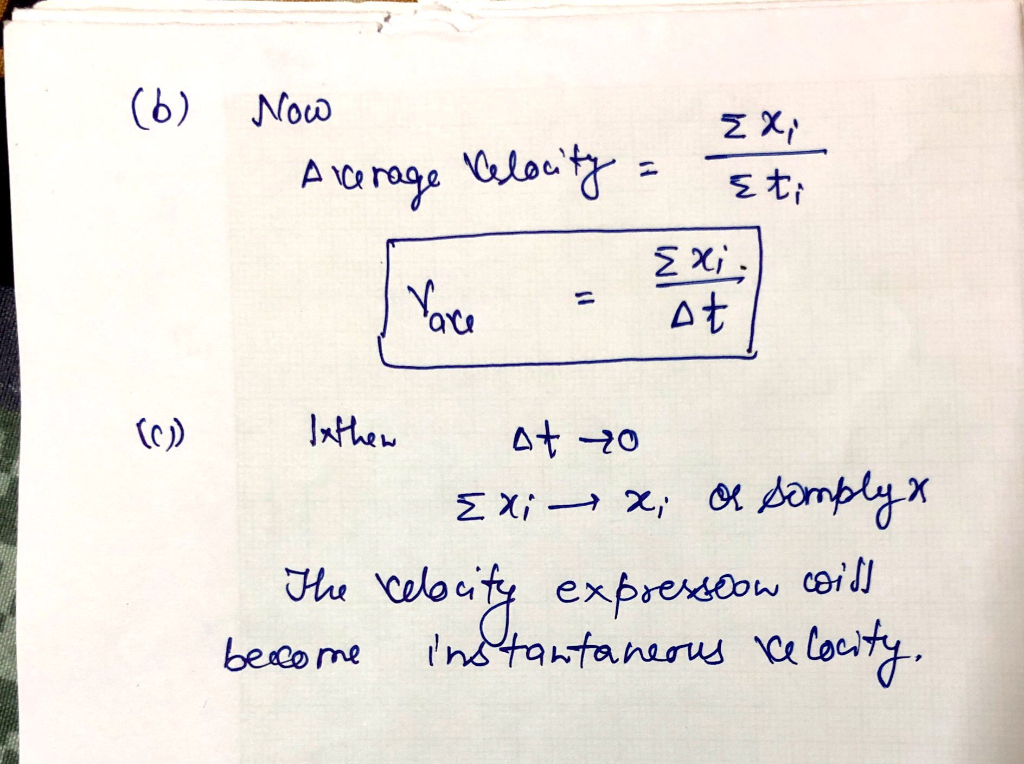
(b) Find the expression for the average velocity in the interval from t to t + Δt.
(c) What is the limiting value of this expression as Δt approaches zero?
(d) Find the time or times at which the body is at rest. (e) Find the expression for the acceleration at any time.Type or paste question here
Solutions
 genius_generous answered 2 months ago
Related Solutions
2. a. A particle moves in a straight line along with the ? − ???? its...
2. a. A particle moves in a straight line along with the ? −
???? its displacement is given by the equation ?(?) = 5? 3 − 8? 2 +
12? + 6,? ≥ 0, where ? is measured in seconds and s is measured in
meters. Find: i. The velocity function of the particle at time ?
(2marks) ii. The acceleration function of the particle at time t.
(2marks) iii. The acceleration after 5 seconds (1marks) b. Find the...
A Honda Civic travels in a straight line along a road. Its distance x from a...
A Honda Civic travels in a straight line along a road. Its
distance x from a stop sign is given as a function of time t by the
equation x(t)= α t2− β t3, where α = 1.44
m/s2 and β = 5.00×10⁻² m/s3
a. Calculate the average velocity of the car for the time
interval t=0 to t1 = 1.95 s .
b. Calculate the average velocity of the car for the time
interval t=0 to t2 = 3.96...
A Honda Civic travels in a straight line along a road. Its distance x from a...
A Honda Civic travels in a straight line along a road. Its
distance x from a stop sign is given as a function of time t by the
equation x(t)=αt2−βt3, where α = 1.48
m/s2 and β = 0.0465 m/s3
A)Calculate the average velocity of the car for the
time interval t=0 to t= 2.02 s.
Express your answer in meters per second.
B)Calculate the average velocity of the car for the time
interval t=0 to t= 4.03 s.
Express...
An object moves along a straight line. The position as a function of time is given...
An object moves along a straight line. The position as a
function of time is given by the following
22 formula x(t)=5m+(2m/s)t–(0.6m/s)t^2. Please answer all of the
parts, I will give a good rating**** :)
How long after starting does it take the object to pass the
origin?
At what time is the object located 4 m from the origin?
Sketch the following graphs: x(t), v(t), a(t).
Find the object’s initial acceleration.
At what time will the object come to...
A particle of mass M moves along a straight line with initial speed vi. A force...
A particle of mass M moves along a straight line with initial
speed vi. A force of magnitude Fpushes the particle a distance D
along the direction of its motion.
A) Find vf, the final speed of the particle after it has
traveled a distance D. Express the final speed in terms of vi, M,
F, and D.
B) By what multiplicative factor RK does the initial kinetic
energy increase, and by what multiplicative factor RW does the work
done...
Two cars, A and B, travel in a straight line. The distance of A from the...
Two cars, A and B, travel in a straight line. The distance of A
from the starting point is given as a function of time by
xA(t)=?t+?t2, with ?=2.60m/s and ?=1.20m/s2. The distance of B from
the starting point is xB(t)=?t2??t3, with ?=2.80m/s2 and
?=0.20m/s3.
Part B
At what time(s) are the cars at the same point?
Express your answer numerically. If there is more than one
answer, enter each answer separated by a commas.
Part C
At what time(s)...
A particle moves along a straight line with an acceleration a=2v1/2m/s2, where v is in m/s....
A particle moves along a straight line with an acceleration
a=2v1/2m/s2, where v is in m/s.
If s = 0, v = 1 m/s when t = 0,
determine the time for the particle to achieve a velocity of 18
m/s. Also, find the displacement of particle when t = 1 s.
Express your answer using three significant figures and
include the appropriate units.
a particle moves aling a straight line and its position at time t is given by...
a
particle moves aling a straight line and its position at time t is
given by s(t)= (t^3)-13.5t^2+54t where s is measured in feet and t
is seconds. consider t in the interval [0,infinity)
1) when is the particle moving in the positive direction? ( i
tried (0,3) U(6, infinity) but it didnt work)
2) what is the total distance the particle travels travels
between time 0 and time 7
3) when is the particle speeding up?
4) when is...
The flow of a vector field is F=(x-y)i+(x^2-y)j along the straight line C from the origin...
The flow of a vector field is F=(x-y)i+(x^2-y)j along the
straight line C from the origin to the point (3/5, -4/5)
A. Express the flow described above as a single variable
integral.
B. Then compute the flow using the expression found in part
A.
Please show all work.
An object is moving along a straight line, and the uncertainty in its position is 2.20...
An object is moving along a straight line, and the uncertainty
in its position is 2.20 m. (a) Find the minimum uncertainty in the
momentum of the object. Find the minimum uncertainty in the
object's velocity, assuming that the object is (b) a golf ball
(mass = 0.0450 kg) and (c) an electron.
ADVERTISEMENT
ADVERTISEMENT
Latest Questions
- These two waves travel along the same string: y1 = (3.52 mm) sin(1.75?x - 470?t) y2...
- An analyte has been discovered ( so it's new) in the Tobago population. Define the term...
- A freestyle skier is training for the Olympics. In this sport the skier starts at the...
- 16. When demand decreases in a competitive market, a. Supply rises. b. Actual price rises. c....
- Draw a picture that shows FA oxidation vs. FA synthesis Color-code each pathway Include: All steps...
- In IRAC Form Clifford Aymes was hired by Jonathan Bonelli of Sun Island Sales, Inc., to...
- 1.Describe the log-linear regression model and how it is used to measure the elasticity of the...
ADVERTISEMENT