Question

In: Economics

Inequality. There are two types of labor in the economy: skilled labor Lsk and unskilled labor...

Inequality. There are two types of labor in the economy: skilled labor Lsk and unskilled labor Lunsk. Skilled and unskilled labor earn different real wages: Wsk/P and Wunsk/P. The production function is given by

Y =Aln(Lsk)+4ln(Lunsk).
The parameter A reflects technology. The supply of skilled labor is given by LSsk = Wsk/P and the

supply of unskilled labor is given by LSunsk = 10.

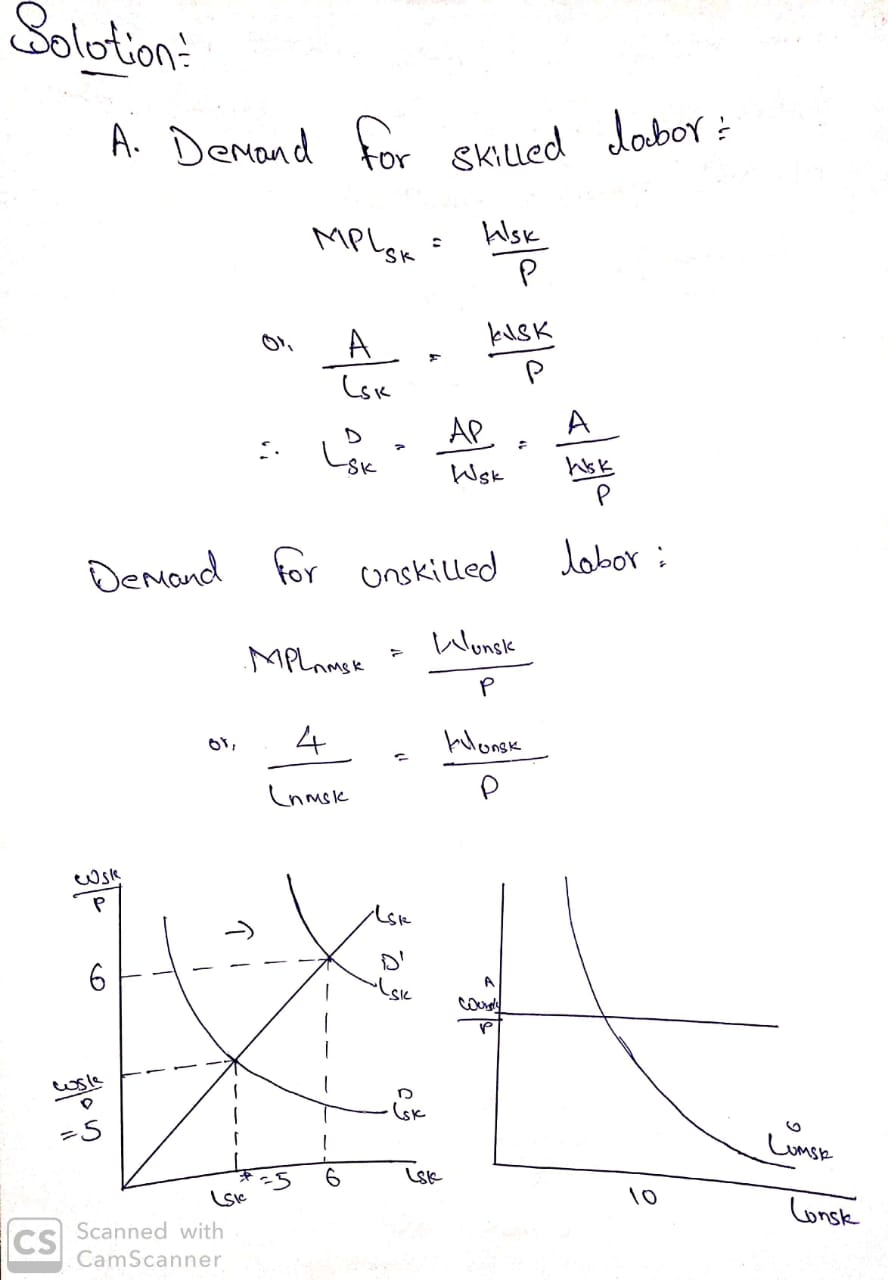
  1. (A) Derive the demand functions for skilled and unskilled labor, LDsk and LDunsk. Sketch the equilibrium graphically on two diagrams: the market for skilled labor and the market for unskilled labor. Don’t worry about the precise shape of the curves.

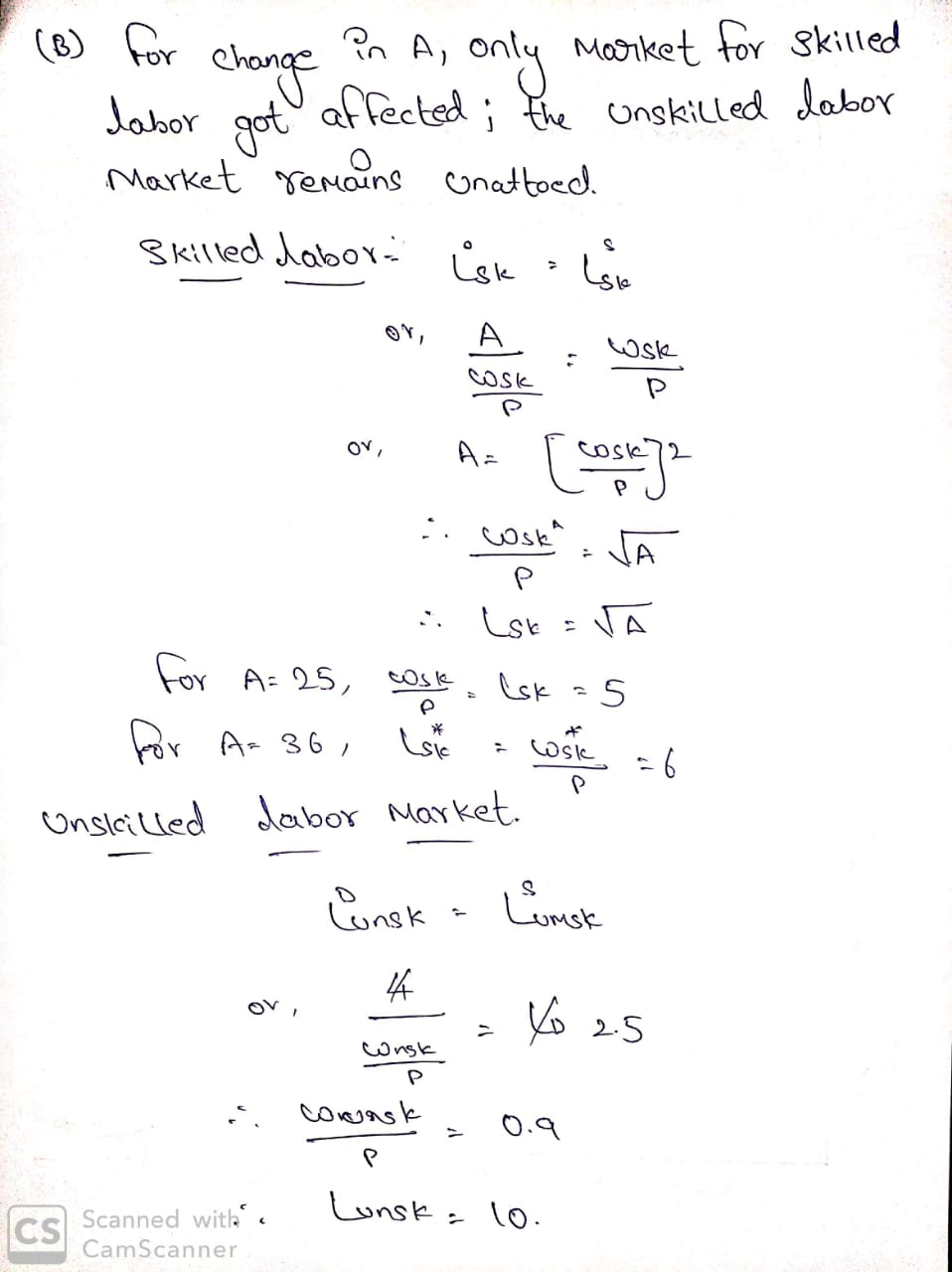
  2. (B) The level of technology A was 25, and during the last year it went up to 36. Find the original and the new equilibria (you need to calculate two levels of employment and two real wages). What is the direction of change in GDP? Re-draw the diagrams from part B to show how the increase in A affects the equilibrium on both markets. Clearly label all axes, shifts, and curves.

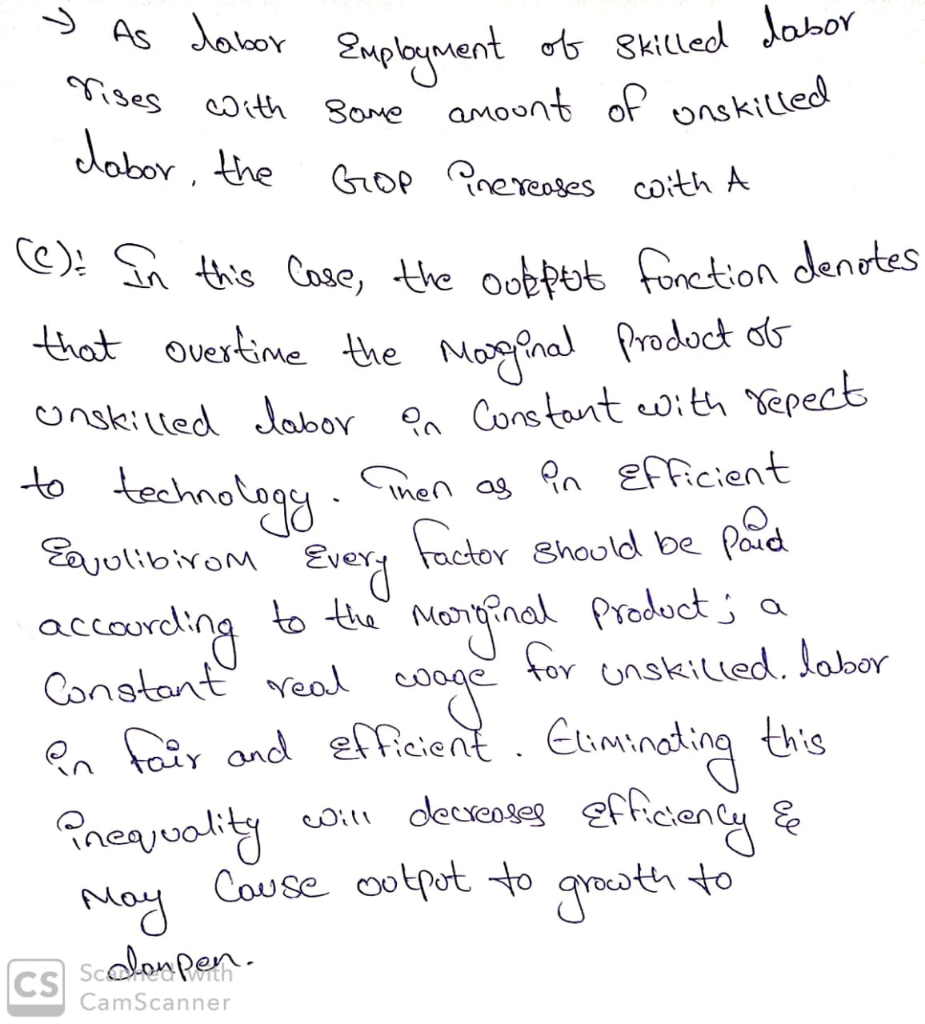
  3. (C) As the American economy has been growing, income inequality has been rising too. In the context of this problem, is inequality in incomes of skilled an unskilled workers a “fair” outcome? If you were a policymaker, would you want to eliminate this kind of inequality?

Solutions
Expert Solution


Related Solutions

6. A construction company has two types of employees: skilled and unskilled. A skilled employee can...
6. A construction company has two types of employees: skilled and unskilled. A skilled employee can build 1 yard of a brick wall in one hour. An unskilled employee needs twice as much time to build the same wall. The hourly wage of a skilled employee is $15. the hourly wage of an unskilled employee is $8. a. Write down a production function with the inputs of LS and LU, where LS is the number of hours of skilled workers...
There has been an increase in the wage inequality (gap between the skilled and unskilled wage)...
There has been an increase in the wage inequality (gap between the skilled and unskilled wage) in the U.S. over the last 30 years. Can international trade be a cause of the rising inequality? Explain by appealing to the theories of trade that you have learnt in class. What do you think is the most plausible explanation for the rising inequality
A firm uses skilled labor, unskilled labor, and capital, and is initially in equilibrium. Suppose that...
A firm uses skilled labor, unskilled labor, and capital, and is initially in equilibrium. Suppose that the wage paid to unskilled labor falls, and that unskilled labor is a substitute in production with both skilled labor and capital. Depict in separate graphs of (a) capital and unskilled labor and (b) capital and skilled labor how the original equilibrium choices change in response to the decline in wages paid to unskilled workers. What are the expected impacts on the wage and...
A firm uses skilled labor, unskilled labor, and capital, and is initially in equilibrium. Suppose that...
A firm uses skilled labor, unskilled labor, and capital, and is initially in equilibrium. Suppose that the wage paid to unskilled labor falls, and that unskilled labor is a substitute in production with both skilled labor and capital. Depict in separate graphs of (a) capital and unskilled labor and (b) capital and skilled labor how the original equilibrium choices change in response to the decline in wages paid to unskilled workers. What are the expected impacts on the wage and...
Explain the wage gap/inequality between skilled and unskilled workers using the Heckscher-Ohlin-Samuelson theorem
Suppose that there are two types of workers in the labor market, type A (low skilled)...
Suppose that there are two types of workers in the labor market, type A (low skilled) and type B (high skilled). The market for type A is at equilibrium while the market for type B workers currently exhibits a surplus of workers. Discuss the effect of the introduction of a minimum wage in the market for type A workers on the quality of workers hired in the type A market and on the distribution of workers across the two markets...
Suppose that there are two types of workers in the labor market, type A (low skilled)...
Suppose that there are two types of workers in the labor market, type A (low skilled) and type B (high skilled). The market for type A is at equilibrium while the market for type B workers currently exhibits a surplus of workers. Discuss the effect of the introduction of a minimum wage in the market for type A workers on the quality of workers hired in the type A market and on the distribution of workers across the two markets...
Analyze the impact of increased illegal immigration on both skilled and unskilled U.S. labor markets assuming...
Analyze the impact of increased illegal immigration on both skilled and unskilled U.S. labor markets assuming that these immigrants are only unskilled workers, and that unskilled and skilled workers are gross complements. Explain your reasoning carefully and show your results in a supply-demand graph for both skilled and unskilled labor markets.
Consider an economy that produces manufacturing goods and R&D services with two types of high skilled...
Consider an economy that produces manufacturing goods and R&D services with two types of high skilled workers (Engineers and Scientists) and one type of low-skilled workers. The production technology for R&D services is high-skill-labor intensive, while manufacturing is low-skill intensive. In the medium-run, engineers are stuck in the manufacturing sector and Scientists are stuck in the R&D but the low-skilled workers can move between the two sectors. In the long-run, however, all factors are mobile. Suppose that this economy opens...
Suppose low skilled labor and capital are substitutes but high skilled labor and capital are complements....
Suppose low skilled labor and capital are substitutes but high skilled labor and capital are complements. Over the past 45 years the price of capital has dropped substantially because of the computer revolution. Draw and explain 2 labor market diagrams To show what has happened to the demand for high and low skilled labor Now add new supply curves to your diagrams to show the effect of an increase in the number of high skilled workers and a decrease in...
ADVERTISEMENT
ADVERTISEMENT
ADVERTISEMENT