Question

In: Physics

5) Two particles are placed on the y-axis. Particle 1, with a charge of -2 C,...

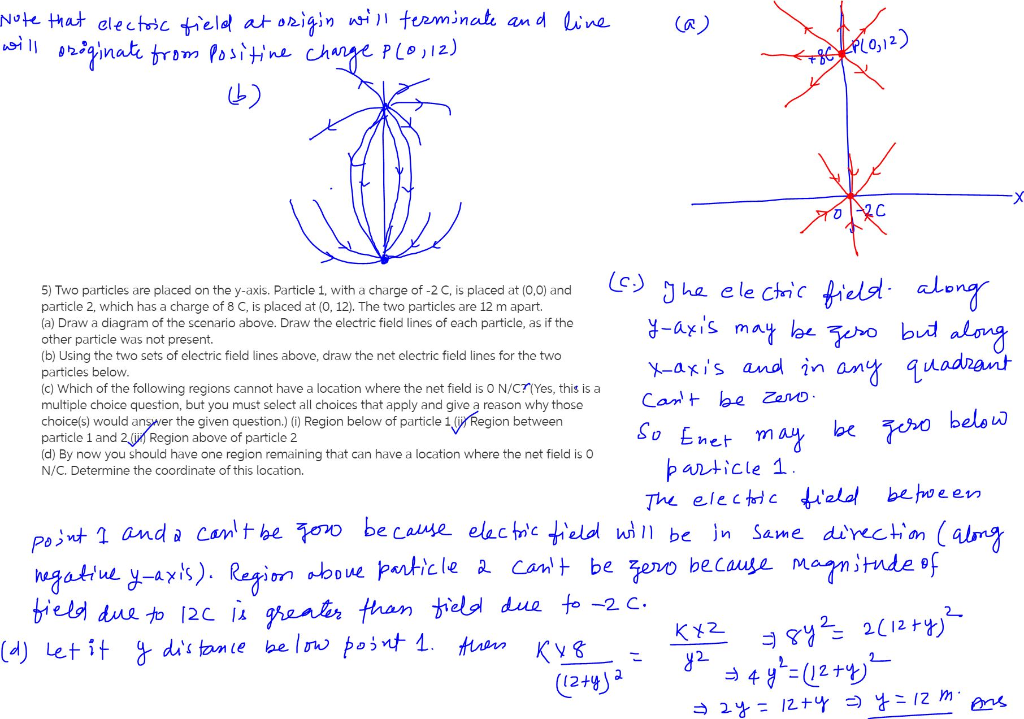
5) Two particles are placed on the y-axis. Particle 1, with a charge of -2 C, is placed at (0,0) and particle 2, which has a charge of 8 C, is placed at (0, 12). The two particles are 12 m apart.

(a) Draw a diagram of the scenario above. Draw the electric field lines of each particle, as if the other particle was not present.

(b) Using the two sets of electric field lines above, draw the net electric field lines for the two particles below.

(c) Which of the following regions cannot have a location where the net field is 0 N/C? (Yes, this is a multiple choice question, but you must select all choices that apply and give a reason why those choice(s) would answer the given question.) (i) Region below of particle 1 (ii) Region between particle 1 and 2 (iii) Region above of particle 2

(d) By now you should have one region remaining that can have a location where the net field is 0 N/C. Determine the coordinate of this location.

Solutions
Expert Solution


Related Solutions

Two particles are fixed on an x axis. Particle 1 of charge 49.0 μC is located...
Two particles are fixed on an x axis. Particle 1 of charge 49.0 μC is located at x = -34.5 cm; particle 2 of charge Q is located at x = 33.6 cm. Particle 3 of charge magnitude 43.9 μC is released from rest on the y axis at y = 34.5 cm. What is the value of Q if the initial acceleration of particle 3 is in the positive direction of (a) the x axis and (b) the y...
Two particles are fixed on an x axis. Particle 1 of charge 57.8 μC is located...
Two particles are fixed on an x axis. Particle 1 of charge 57.8 μC is located at x = -12.7 cm; particle 2 of charge Q is located at x = 16.3 cm. Particle 3 of charge magnitude 40.6 μC is released from rest on the y axis at y = 12.7 cm. What is the value of Q if the initial acceleration of particle 3 is in the positive direction of (a) the x axis and (b) the y...
Two particles are fixed on an x axis. Particle 1 of charge 51.4 μC is located...
Two particles are fixed on an x axis. Particle 1 of charge 51.4 μC is located at x = -22.8 cm; particle 2 of charge Q is located at x = 10.8 cm. Particle 3 of charge magnitude 20.8 μC is released from rest on the y axis at y = 22.8 cm. What is the value of Q if the initial acceleration of particle 3 is in the positive direction of (a) the x axis and (b) the y...
A point particle with charge q = 4.2 ?C is placed on the x axis at...
A point particle with charge q = 4.2 ?C is placed on the x axis at x = ?10 cm and a second particle of charge Q = 7.8 ?C is placed on the x axis at x = +25 cm. (a) Determine the x and y components of the electric field due to this arrangement of charges at the point (x, y) = (10, 10) (the units here are centimeters). Ex =  N/C Ey =  N/C (b) Determine the magnitude and...
Consider two charged particles that lay on the x-axis. Particle 1 (with charge +q) sits at...
Consider two charged particles that lay on the x-axis. Particle 1 (with charge +q) sits at location (d, 0, 0). Particle 2 (with charge -2q) sits at location (-d, 0, 0). Find the electric field as a function of the angle (θ) measured from the x-axis for all points in the x-y plane that are a distance (2d) away from the origin. (i.e. all the points on the circle with radius 2d).
Three particles are fixed on an x axis. Particle 1 of charge q1 is at x...
Three particles are fixed on an x axis. Particle 1 of charge q1 is at x = -a and particle 2 of charge q2 is at x = +a. If their net electrostatic force on particle 3 of charge Q is to be zero, what must be the ratio q1/q2 when particle 3 is at (a) x = +0.754a and (b) x = +1.65a?
Two charged particles are located in the X-Y plane. Particle 1 carries -0.200 uC of charge...
Two charged particles are located in the X-Y plane. Particle 1 carries -0.200 uC of charge and is located at x= 3.55 m and y = 1.21 m. Particle 2 carries 0.920 uC of charge and is located at x = -3.47 m and y = 1.65 m. Find the Y component of the Electric Field at a point located at x = 2.87 and y = 3.96 m, in Newtons per Coulomb.
Three point charges are placed on the y-axis, a charge q at y=a, a charge -2q...
Three point charges are placed on the y-axis, a charge q at y=a, a charge -2q at the origin and a charge q at y=-a. Such an arrangement is called an electric quadrupole. (a) Find the magnitude and direction of the electric field at points on the positive x-axis. (b)What would be the force exerted by these three charges on a fourth charge 2q placed at (b,0). Explain the steps along the way and thought process behind solving.
Three charges are placed on the y-axis. The first, with charge 8nC, sits at y=5cm. The...
Three charges are placed on the y-axis. The first, with charge 8nC, sits at y=5cm. The second, with charge -14nC, is at y=0cm. The third, -10nC, is at y=−5cm. a) What is the electric potential on the x-axis at x=10cm? b) What is the magnitude of the electric field at x=10cm? c) What is the electric potential at x= −10cm? d) What is the magnitude of the electric field at x= −10cm?
Question: Particles of charge +65, +48, and ?95 ?C are placed in a line (Figure 1)...
Question: Particles of charge +65, +48, and ?95 ?C are placed in a line (Figure 1) . The center one is L = 35cm from each of the others. Part A: Calculate the net force on the left charge due to the other two. Enter a positive value if the force is directed to the right and a negative value if the force is directed to the left. Part B: Calculate the net force on the center charge due to...
ADVERTISEMENT
ADVERTISEMENT
ADVERTISEMENT