Question
In: Physics
A boy on a bicycle moving with 10 m/s approaches a moving car with 5 m/s...
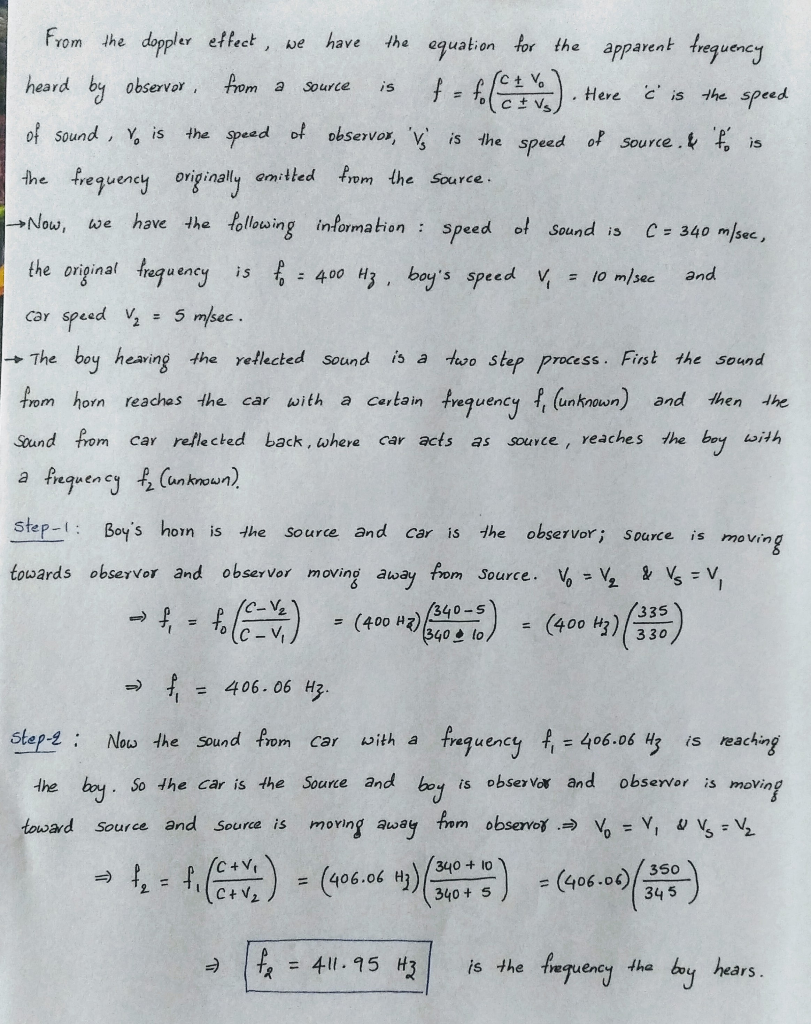
A boy on a bicycle moving with 10 m/s approaches a moving car with 5 m/s (both are moving in the same direction) as he sounds his horn at frequency 400.00 Hz. The sounds he hears reflected back from the car. Assume speed of sound is 340 m/s. Calculate the frequency the boy perceives.
What would be the answer plus a step by step guide on how you managed this problem?
Thank you.
Solutions
 genius_generous answered 3 months ago
Related Solutions
1. A boy in a pedal car is moving at a speed of 1.40 m/s at...
1. A boy in a pedal car is moving at a speed of 1.40 m/s at the
start of a 2.10 m high and 12.4 m long incline. The total mass is
54.5 kg, air resistance and rolling resistance can be modeled as a
constant friction force of 41.0 N, and the speed at the lower end
of the incline is 6.80 m/s. Determine the work done (in J) by the
boy as the car travels down the incline.
2....
A 1700 kg car moving east at 17 m/s collides with a 1800 kg car moving...
A 1700 kg car moving east at 17 m/s collides with a 1800 kg car
moving south at 20 m/s, and the two cars stick together. Consider
east the positive x-direction and north the positive
y-direction.
a) What is the x-component of the initial momentum before the
collision? ( -7100 kg·m/s, 64900 kg·m/s or 28900 kg·m/s)
b) What is the y-component of the initial momentum before the
collision? (-36000 kg·m/s, -7100 kg·m/s, 64900 kg·m/s or 36000
kg·m/s)
c) What is...
A 1410-kg car moving east at 17.0 m/s collides with a 1880-kg car moving south at...
A 1410-kg car moving east at 17.0 m/s collides with a 1880-kg
car moving south at 15.0 m/s, and the two cars connect
together.
a) What is the magnitude of the velocity of the cars right after
the collision? (m/s)
b) What is the direction of the cars right after the collision?
Enter the angle in degrees where positive indicates north of east
and negative indicates south of east. (°)
c) How much kinetic energy was converted to another form...
A 10 kg ball moving at 6 m/s strikes a 5 kg ball that is at...
A 10 kg ball moving at 6 m/s strikes a 5 kg ball that
is at rest, with contact of 0.5 seconds. The 10 kg ball comes to a
complete stop.
(a) What average force was exerted on the 10 kg ball?
(b) What average force was exerted on the 5 kg ball?
(c) What is the final momentum of the 5 kg ball?
(d) What is the initial momentum of the 10 kg ball?
Brakes are applied to a 3000-kg car moving at 30 m/s. The car skids 200 m...
Brakes are applied to a 3000-kg car moving at 30 m/s. The car
skids 200 m and stops. What is the coefficient of kinetic
friction?
A railroad car of mass 3.10 ✕ 10^4 kg moving at 3.50 m/s collides and couples...
A railroad car of mass 3.10 ✕ 10^4 kg moving at 3.50 m/s
collides and couples with two coupled railroad cars, each of the
same mass as the single car and moving in the same direction at
1.20 m/s.
(a) What is the speed of the three coupled cars after the
collision?
__m/s
(b) How much kinetic energy is lost in the collision?
__J
A car moving due east at 6 m/s collides at the intersection with an identical car....
A car moving due east at 6 m/s collides at the intersection with
an identical car. If the entangled wreckage moves at 5.5 m/s at 22
degrees north of east after the collision, what was the velocity
and direction of the second car immediately before the collision?
The entangled wreckage slides along the horizontal road leaving
skid marks. If the coefficient of friction between the entangled
wreckage and the road is 0.34, how long are the skid marks?
A puck with a mass m1 = 28.0 g moving at 1.00 m/s approaches a stationary...
A puck with a mass m1 = 28.0 g moving at 1.00 m/s approaches a
stationary puck with a mass m2 = 102 g on an air table and they
undergo a two-dimensional elastic collision. As a result of their
interaction, the incident puck moves away with a speed v1 = 0.785
m/s and the other puck moves away with a speed v2 in a different
direction. What is the angle between the velocities v1 and v2 ?
Explain please!!!
A mass is moving at 10 m/s in the +x direction and it collides in a...
A mass is moving at 10 m/s in the +x direction and it collides
in a perfectly elastic collision with a mass of 4 kg moving in the
-x direction. The collision takes places in 0.22 seconds and after
the collision the mass that was moving in the +x direction is
moving in the -x direction at 8 m/s and the mass that was moving in
the -x direction is moving in the +x direction at 14 m/s. What is...
A mass is moving at 10 m/s in the +x direction and it collides in a...
A mass is moving at 10 m/s in the +x direction and it collides
in a perfectly elastic collision with a mass of 2 kg moving in the
-x direction. The collision takes places in 0.21 seconds and after
the collision the mass that was moving in the +x direction is
moving in the -x direction at 9 m/s and the mass that was moving in
the -x direction is moving in the +x direction at 13 m/s. What is...
ADVERTISEMENT
ADVERTISEMENT
Latest Questions
- Question 3 (a) What do you understand by a time series forecasting approach? Describe each of...
- 1 Which of the following overflow values clips all content that extends beyond the containing element’s...
- What are the key environmental and biological controls over decomposition rate in ecosystems?
- describe why independent oversight is important to taxpayers.
- Graph a Monopoly. Compare the price, quantity, and ATC of a monopoly with a perfectly competitive...
- Problem 18-12 Various shareholders' equity topics; comprehensive [LO18-1, 18-4, 18-5, 18-6, 18-7, 18-8] Part A In...
- Hello There, This is discussion Question For Advanced Database Systems Question: (a) Please define what a...
ADVERTISEMENT