Question
In: Economics
Frank spends a total of $2500 per month on rent for his apartment: he spends $1250...
Frank spends a total of $2500 per month on rent for his apartment: he spends $1250 of his own money and . receive a cash reimbursement of $1250 from his employer. The employer is in the process of adopting a new policy that would provide him a lump sum transfer of $1250, which can be used for housing or other goods. Using a graph, demonstrate whether Frank would prefer the current program, the proposed program, or would be indifferent between the two.
Solutions
Expert Solution
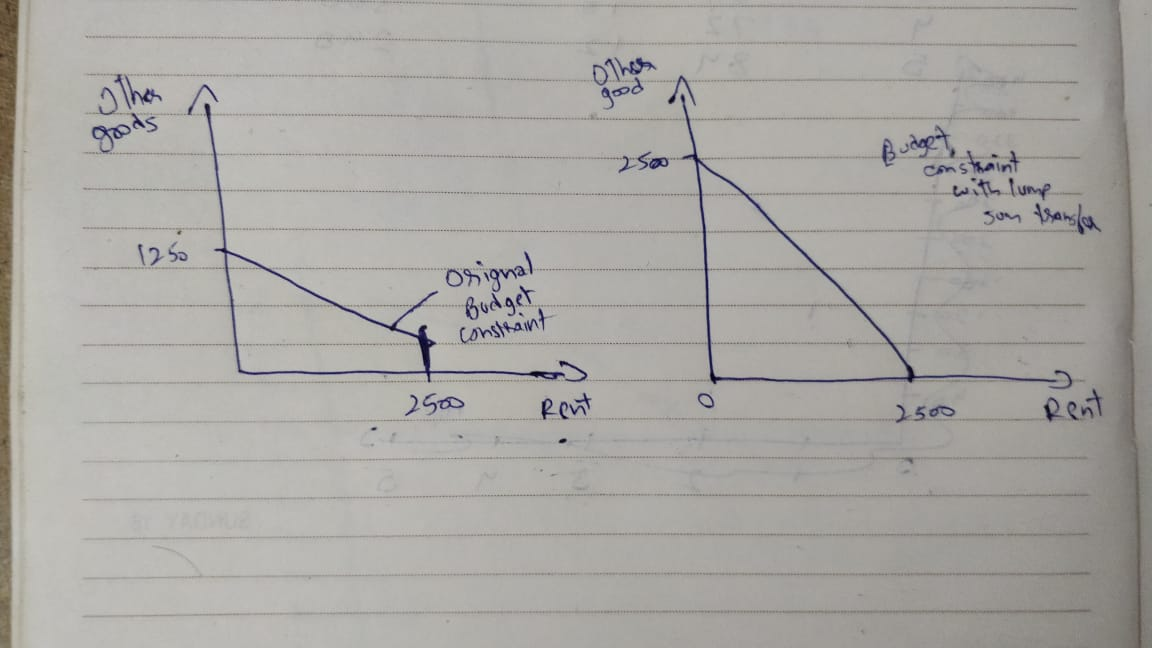
When Frank receives 1250 reimbursement , his personal income is
only 1250, so if he chooses not to pay rent he can only spend 1250
on other goods . This is shown by the diagram of his budget
constraint on the left.
When Frank receives 1250 as lump sum transfer, his income is now
2500 and he can spend that all on rent or on other goods as shown
by diagram on the right.
Frank should be indifferent between two programmes as in both the
cases he spends all his income on rent .
If the rent had been lower like $2000 then he would have been better off with lump sum transfer as in that scenario he can but some other goods with leftover income. But he can't do the same in reimbursement case as heonly gets the reimbursement of the value he spends over his income on rent ( so if rent is $2000 he pays 1250 of his own and gets 750 reimbursement)
 Rahul Sunny answered 2 months ago
Related Solutions
You rent out an apartment for 15 years, with rent starting at $500 per month and...
Underwriting information: 200 unit apartment building 1,000 per month average rent 8% vacancy 40% total operating...
Underwriting information: 200 unit apartment building 1,000 per month average rent 8% vacancy 38% total operating...
You have one apartment to lease, and the quoted rent is $750 per month. The lease...
I wish to show that the average apartment rent in Atlanta is over $1200 per month....
Five years ago, the average apartment rent in southwest Virginia was $895 per month. A recent...
Five years ago, the average apartment rent in southwest Virginia was $895 per month. A recent...
The average monthly rent for a 1-bedroom apartment in San Francisco ranges from approximately $2500 to...
Part1) Bob's Apartment Building has 100 units that rent for $1,110 per month each. What is...
A real estate office handles a 60-unit apartment complex. When the rent is $530 per month,...
- In 2012, cost per Medicare beneficiary did what?
- 3. A. What techniques can a firm use to optimize demand deposit holdings? B. How do...
- The half-life of mercury-197 is 64.1 hours. If a patient undergoing a kidney scan is given...
- Double bonds react with Br2 to form a dibromide. Isobutylene undergoes cationic polymerization under conditions where...
- 1. Which sex chromosomes are limited to only one sex? A. X and Z B. X...
- prepare a tecnical report that discuss about "A custom Union (CU) constitute a partial movement towards...
- in your own opinion, It has been said that a smartphone is a computer in your...