Question
In: Chemistry
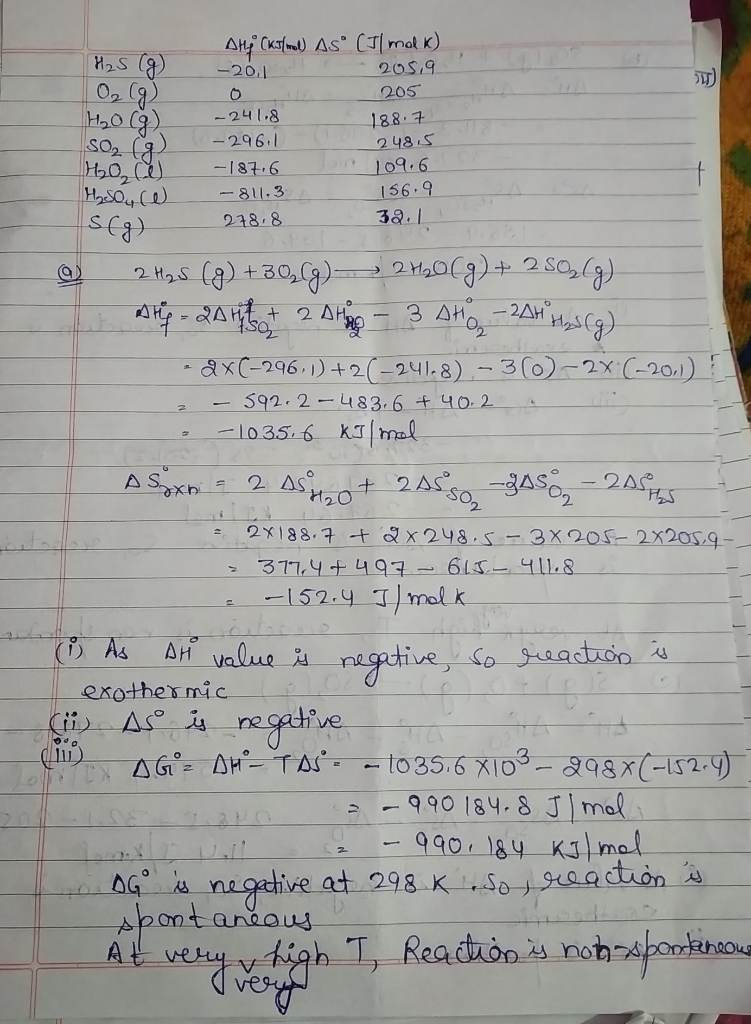
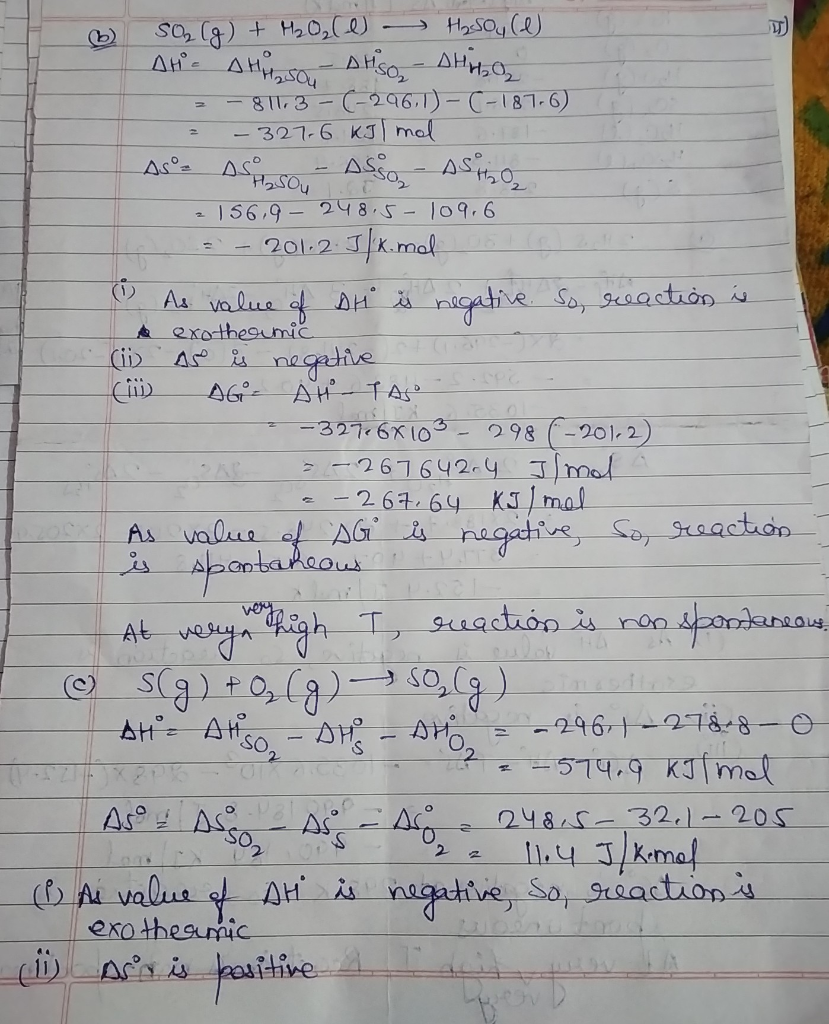
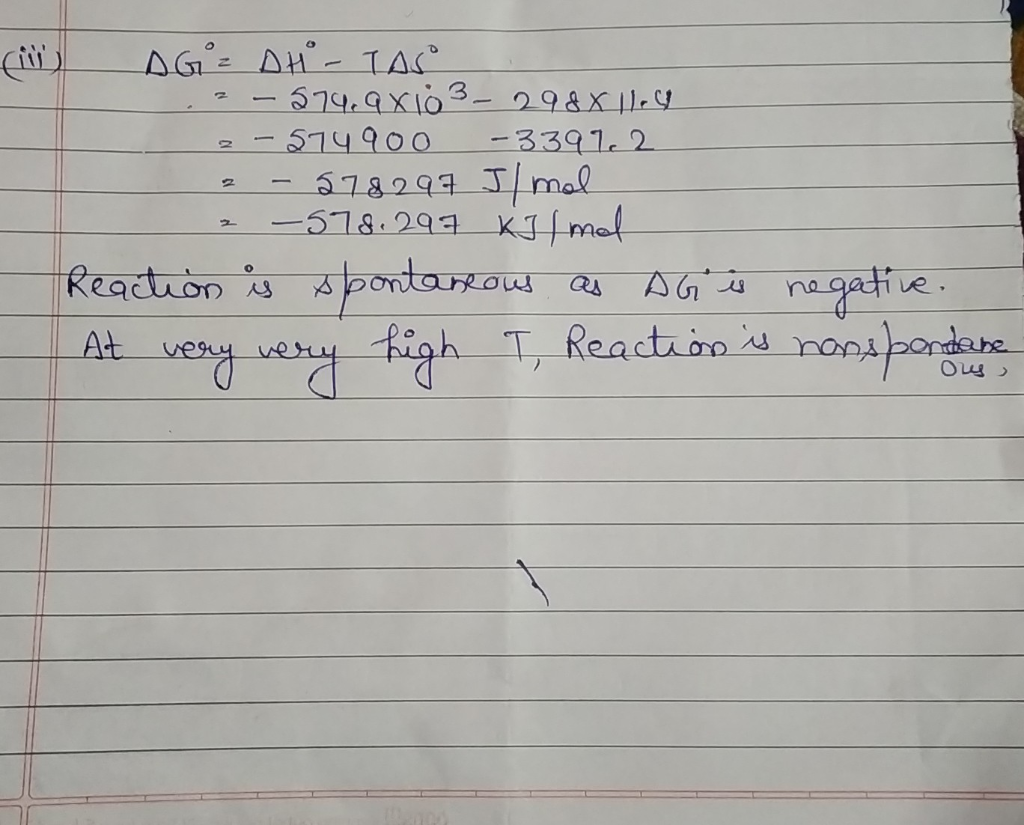
Using Appendix 4 for ∆Hf ° and ΔS˚, which of the following reactions is spontaneous: (5.a)...
Using Appendix 4 for ∆Hf ° and ΔS˚, which of the following reactions is spontaneous:
(5.a) 2 H2S(g) + 3 O2(g) → 2 H2O(g) + 2 SO2(g)
(5.b) SO2(g) + H2O2(ℓ) → H2SO4(ℓ)
(5.c) S(g) + O2(g) → SO2(g)
You must determine whether a given reaction (i) is exothermic or endothermic, (ii) has a positive or negative entropy, and (iii) if a given reaction is spontaneous only at low temperature or only at high temperature, or at all temperatures.
Solutions
 queen_honey_blossom answered 3 months ago
Related Solutions
which of the following reactions are spontaneous?
which of the following reactions are spontaneous?
From the following combinations of ΔH and ΔS, predict if a process will be spontaneous at...
From the following combinations of ΔH and ΔS, predict if a process
will be spontaneous at a high or low temperature: (a) both ΔH and
ΔS are negative, (b) ΔH is negative and ΔSis positive, (c) both ΔH
and ΔS are positive, (d) ΔH is positive and ΔS is negative.
Which of the following processes are spontaneous? For each process also indicate whether ΔS, ΔSsurr,and ΔSuniv,...
Which of the following processes are spontaneous? For each
process also indicate whether ΔS, ΔSsurr,and ΔSuniv, are positive,
negative or zero:
a. The freezing of supercooled liquid water at −3°C and 1
bar.
b. The freezing of liquid water at 0°C and 1 bar by removing a
small amount of heat.
c. The adiabatic expansion of a van der Waals gas into a
vacuum.
d. The reversible isothermal compression of an ideal gas
For which of the following reactions would the entropy of reaction (ΔS°rxn) be positive (an increase...
For which of the following reactions would the entropy of
reaction (ΔS°rxn) be positive (an increase in entropy for the
system)? Select all that apply.
A. The dissolution of sodium chloride (table salt): NaCl (s) ⇄
Na+ (aq) + Cl– (aq)
B. The dissolution of sucrose (sugar): C12H22O11 (s) ⇄ C12H22O11
(aq)
C. The deposition of water vapor to give ice: H2O (g) ⇄ H2O
(s)
D. The combustion of heptane (a component of gasoline): C7H16
(l) + 11 O2...
What is the enthalpy of the following reactions? Use the appendix in your text book using...
What is the enthalpy of the following reactions? Use the
appendix in your text book using heat formatino values.
1. SO3+ H2O-----H2SO4
2. 3K2O2+3H2O----6KOH+O3
3. Fe3O4+8HCL----2FeCl3+FeCl2+4H2O
Predict if the following reactions are spontaneous (e.g. using the Z method) and calculate E0, DG0...
Predict if the following reactions are spontaneous (e.g. using
the Z method) and calculate E0,
DG0 and K for each reaction
Reduction of H+ by Zn(s) (to form H2 and
Zn2+)
Oxidation of Cu by Cl2(g) (to form Cu2+
and Cl-)
Oxidation of Cl- by F2(g) (to form
Cl2 and F-)
Reduction of Cu2+ by Fe2+ (to form Cu(s)
and Fe3+)
For which of the following reactions is ΔS° < 0 at 25°C? Question 14 options: 2KClO3(s)...
For which of the following reactions is ΔS° < 0 at
25°C?
Question 14 options:
2KClO3(s) → 2KCl(s) +
3O2(g)
2HgO(s) → 2Hg(l) +
O2(g)
Br2(l) → Br2(g)
P4(s) + 5O2(g) →
P4O10(s)
(NH4)2Cr2O7(s)
→ N2(g) + 4H2O(l) +
Cr2O3(s)
For which of the following reactions is ΔS° > 0 at
25°C?
Question 15 options:
MgO(s) + CO2(g) →
MgCO3(s)
2H2(g) + O2(l) →
2H2O(l)
2Li(s) + O2(g) →
Li2O(s)
2CO(g) + O2(g) →
2CO2(g)
F3BNH3(s) →
BF3(g) + NH3(g)...
Which of the following reactions is spontaneous as written? C(s) + 2H2 (g) = CH4 (g)...
Which of the following reactions is spontaneous as written?
C(s) + 2H2 (g) = CH4 (g)
2H2 (g) + O2 (g) =
2H2O(l)
4HCN(g) + 5O2(g) =
2H2O(l) + 4CO2(g)
2N2(g)
NaI(s) = Na+(aq) +
I-(aq)
Which of the following reactions would you predict to be spontaneous at all temperatures (assuming ΔH°rxn...
Which of the following reactions would you predict to be
spontaneous at all temperatures (assuming ΔH°rxn does not change
significantly with temperature)?
H2S(g) + 2O2(g) → H2SO4(l) ΔH°rxn = –793 kJ/mol
2Ag(s) + 3N2(g) → 2AgN3(s) ΔH°rxn = +1240 kJ/mol
C6H6(l) + 3H2(g) → C6H12(l) ΔH°rxn = –207 kJ/mol
Na2CO3(s) + 2HCl(aq) → 2NaCl(aq) + H2O(l) + CO2(g) ΔH°rxn =
–834 kJ/mol
CaCO3(s) → CaO(s) + O2(g) ΔH°rxn = +179 kJ/mol
Calculate E∘ for each of the following reactions, and tell which are spontaneous under standard-state conditions....
Calculate E∘ for each of the following reactions, and tell which
are spontaneous under standard-state conditions. Part A
2Fe2+(aq)+Pb2+(aq)→2Fe3+(aq)+Pb(s) Express your answer using two
decimal places. E∘ = V SubmitMy AnswersGive Up Part B
Mg(s)+Ni2+(aq)→Mg2+(aq)+Ni(s) Express your answer using two decimal
places. E∘ = V SubmitMy AnswersGive Up Part C Tell which are
spontaneous under standard-state conditions. Check all that apply.
Check all that apply. 2Fe2+(aq)+Pb2+(aq)→2Fe3+(aq)+Pb(s)
Mg(s)+Ni2+(aq)→Mg2+(aq)+Ni(s)
ADVERTISEMENT
ADVERTISEMENT
Latest Questions
- On January 1, 2018, bonds with a face value of $ 79,000 were sold. The bonds...
- How do I make this sort in true alphabetical order instead of ascii(ABCabc) order? I am...
- As a healthcare provider in physical therapy, athletic training, or as an exercise scientist and personal...
- in the market for makeup artists, what happens after the invention of high-definition tv allowing viewers...
- 10. What are the three monetary policy tools of the Fed? Briefly describe how each tool...
- In what ways would the role of a manager working in a nonstandard international assignment arrangement...
- Write a Bash script called move that could replace the UNIX command mv. 'move' tries to...
ADVERTISEMENT